Wharrams to weather: How bad is it?

mental_boy

Junior Member
Joined
Jun 2, 2010
Posts
98
Reaction score
0
Location
Oakland, CA
Anyone here have any experience sailing on a Wharram? They have a poor reputation for windward ability, but how bad is it really? I'm curious about time to get from downwind point A to upwind point B, not how close to the wind one can sail or how difficult it is to tack.

For example, would a Tangaroa 35 get shellacked by a Catalina 27? Or a cal 20?

This is just an academic question, so please refrain from mentioning the cramped cabins, the apalling resale value, the inefficient use of timber or the propensity to rot.

I've known three people who have undertaken 40+ ft catamaran construction. Two "yacht" type designs and one Pahi 42. The Pahi builder finished his boat in two years and spent ~10 years on and off cruising mexico and central America. One of the last posts on his blog says something about the mast step rotting, and then he doesn't mention the boat anymore. The other two guys spent 10+ years building, neither finished and both are now deceased.
 
I appreciate what you are saying. Wharram designs have many positive aspects, but I suspect that is you have to ask the question, then a wharram cat may not be the design you are looking for. Richard Woods has simple 40' cat designs which could be built in a time frame similar to a wharram, but would have superior upwind performance. Although a Wharram rig would most likely be cheaper to build.
 
No experience on sailing Wharrams but perhaps, if you consider buying or even building and eventually sailing one, your question, academically, justifies an addition of how windward ability can (simply) be improved and tuned?
 
It depends on what you mean by "shellacked". In storm conditions a Wharram will happily make some headway, while the Catalina of Cal may not even survive. However, if you mean a race around the buoys in fair weather, it won't perform as a racer. I have sailed my old Tangaroa in really rough conditions and it handled well. The worst was a wave breaking over and completely covering the boat. I climbed the mizzen mast when the wave was coming and saw the boat disappear. That was about 25 years ago when I could shimmy up a mast.
 
It depends on what you mean by "shellacked". In storm conditions a Wharram will happily make some headway, while the Catalina of Cal may not even survive. However, if you mean a race around the buoys in fair weather, it won't perform as a racer. I have sailed my old Tangaroa in really rough conditions and it handled well. The worst was a wave breaking over and completely covering the boat. I climbed the mizzen mast when the wave was coming and saw the boat disappear. That was about 25 years ago when I could shimmy up a mast.

I meant after the race the catalina crew would come over and help with the brightwork :D

I guess I'm just interested what level of crappy monohull performance a given wharram cat would align with. Something I can relate to. E.g. I used to have a Ranger 26 that weighed 6000lbs and had 322 square feet of sail area. Your tangaroa weighed 25% less and had 15% more sail area (assuming built to plan) and a longer waterline length. So I assume it would outperform the Ranger at least on a broad reach, though not sure how it would compare upwind.

When you were sailing your Tangaroa do you remember comparing performance with any other boats upwind? Or did you just fire up the outboard?
 
I appreciate what you are saying. Wharram designs have many positive aspects, but I suspect that is you have to ask the question, then a wharram cat may not be the design you are looking for. Richard Woods has simple 40' cat designs which could be built in a time frame similar to a wharram, but would have superior upwind performance. Although a Wharram rig would most likely be cheaper to build.

I know this sounds rude and shallow, but my problem with most of Wood's designs is the dated aesthetic. Not new enough to look modern, not old enough to look classic. Why build something that looks dated when you can buy something that is dated for a lot less? So yes, they're probably better boats in many ways, but the decision to build something like that is as much (or more) emotional as it is rational.

Wharram's classic boats in my mind have a sort of salty, ship like quality about them. It's like the catamaran version of a Thomas Colvin design. Admittedly they're often poorly constructed with hideous tribal art plastered on the side, but when done well they can be quite fetching.

gallery-classicdesigns-079.jpg


wpid-photo-20150608194313799.jpg
 
I didn't race the Tangaroa around a triangle course, so pointing high was never a crucial issue. Long distance cruising is different. However, the overall VMG(velocity made good) was better than the average monohull.
 
Our Ariki 48 has daggerboards and a modern big roach full batten main. We have limited (as in almost none) boat on boat comparisons. It seems to go well to weather. We were inside the other day and were tacking up the lake with the boards up and were passing through the anchorage area. We were slipping at a brisk rate. We dropped a board partially and bam, we were slipping about 90% less. Maybe 20 degrees better made good. This was in light air with a slight negative tide. My Tiki 30 had the stock Wharram gaff wingsail rig. Very conservative low aspect main sail. In light air going to weather in waves it flat sucked. In flat water or with more wind it wasn't so bad. crack off and the boat was very fast. A boat with bunks, sub $100k, 2' draft topped out in high teens.
https://youtu.be/m5-iNnEPFVk
 
Peter Nannested had a Wharram 22 foot Hina which he sailed many miles called Superb, Strong and Tough; he raced it to and in a Bay of Islands race period way back in the early 1980s and on a fresh day, SS&T cleaned up the smaller size division which included some high performing Quarter Tonners from Farr, Mull and co. The reaching legs allowed the Wharram to gain but SS&T hung in there very well to windward too - and won by 3 or 4 minutes.
 
Hobie cat 14 and 16 has no boards and hulls similar to Wharrams, using strong aft mast rake, they got enough weatherhelm to use rudders as very effective leeway preventer. Balancing the rudders helps to recover low helm loads.
 
I had a Hinemoa for a few years. Had a lot of fun in her. It had a bigger than standard rig - about 22 sq meters -. In a breeze over say 15 knots it would foot it to windward against similar size light disp keel boats. However in light breezes <10 knots, it was frustrating, particularly trying to sail against a current, without foils you go sideways a lot. I would have liked to try it with a dagger board but never got round to building one for it.

https://www.youtube.com/watch?v=E2YYOzfAfNA

In the end I built a tri which solved the light weather/windward sailing issues.
 
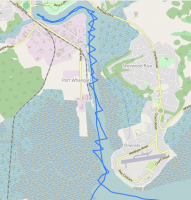
I've attached a gps track from onboard a Tiki 26 with a conventional bermudan main/jib. This was tacking up quite a narrow channel in Whangarei Harbour in about 10 knots. We would basically sail right out to the edges, even hitting the sandy bottom a little at times. Try that on a keelboat!

This harbour is the ideal setting for a boat like this, the day before we were blasting along in shallow water, almost flying a hull at times. Very reassuring to have a shallow draft strong boat.
 

Attachments

  • Part Track.png
    Part Track.png
    133.1 KB · Views: 961
Forum posts represent the experience, opinion, and view of individual users. Boat Design Net does not necessarily endorse nor share the view of each individual post.
When making any potentially dangerous or financial decision, always employ and consult appropriate professionals. Your circumstances or experience may be different.

  • Back
    Top