
Seven Sisters tri, with wave-piercing amas

ImaginaryNumber

Imaginary Member
Joined
May 8, 2009
Posts
436
Reaction score
60
Location
USA
Does anyone know anything about Seven Sisters trimaran? It seems almost like it is a monohull with wave-piercing amas added on. How well would it be expected to handle high winds and breaking seas? Apparently it was sailed/motored from Hawaii to California, and now it is being sailed down Mexico, Guatemala and Costa Rico, so it isn't totally unseaworthy.

Seven_Sisters_hybrid.jpg


Seven Sisters is a hybrid design, based on the wavepiercer concept, with the outer hulls piercing through the waves to stabilize motion. This 40' yacht was built in 1998 in Hawaii, and is equipped with three propulsion sources: Sails, a 10 KW solar panel powered electric motor, and a high efficiency 70 HP engine, capable of generating 15-17 knots, with virtually no wake.


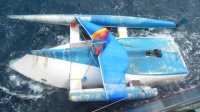
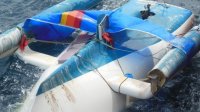
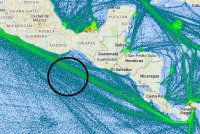


I like the crew, who needs the amas......It looks like they are following the old Oceanbird from England configuration. Reportedly very seaworthy with a large main hull and wave piercing amas. One of the early folders.
 
Oceanbird_9m.jpg


Ocean_Bird36.jpg


Yes, Seven Sisters does look similar to the Oceanbird trimarans. Would you elaborate why they were considered to be seaworthy? Don't most current ocean-going cruising trimarans have an ama volume of at least 100% of displacement? And isn't this volume needed both for lateral stability when beating, and to prevent capsize in breaking waves? How can these low-volume amas be useful in anything but benign conditions?

Here's another trimaran sort-of along these same lines.

wide_tri_small_amas.jpg


Very_Wide_Trimaran.jpg
 
Well, they proved themselves in tough conditions, the old fashioned way of vetting a design. The Gougeon's used smaller amas the same way. The theory is the boat spills the wind in a heavy gust without lifting the main hull, keeping the windage low. Not done as often now but with the popularity of foils growing we'll probably see a resurgence. The Hull step and flair on these wider hulls adds reserve buoyancy and righting moment at the steeper angles.

It might be interesting to check safety records, last time I looked boats like these didn't do any worse if the rig was proportional to the stability. Modern large ama volume racers go over much more often because they can be pushed harder while flying the main hull. Valuable for outright speed but less so for cruising. Rig stresses can be less as well because the heel acts like a shock absorber.
 
The Gougeon trimarans follow a different approach to speed than most, they tend to be extremely light with tiny rigs, they focus on efficiency rather than raw power, the design spiral goes in the opposite direction than most, i like their approach.

Steve.
 
Well, they proved themselves in tough conditions, the old fashioned way of vetting a design. The Gougeon's used smaller amas the same way. The theory is the boat spills the wind in a heavy gust without lifting the main hull, keeping the windage low. Not done as often now but with the popularity of foils growing we'll probably see a resurgence. The Hull step and flair on these wider hulls adds reserve buoyancy and righting moment at the steeper angles.

It might be interesting to check safety records, last time I looked boats like these didn't do any worse if the rig was proportional to the stability. Modern large ama volume racers go over much more often because they can be pushed harder while flying the main hull. Valuable for outright speed but less so for cruising. Rig stresses can be less as well because the heel acts like a shock absorber.

The wider hull, and presumably the increase carrying capacity, of Seven Sisters and the Oceanbird trimarans appeal to me for a cruising boat. And I like the folding amas a lot. Cheaper to berth, and easier to find a marina that can haul them.

But I still am unconvinced that low-volume amas are prudent. How do you know that the Oceanbirds have a good safety track record? Do you know that they’ve weathered heavy winds and breaking seas? I understand how low-volume amas can allow more heel to spill wind, but that also means that once the amas are submerged their stability quickly decreases. AFAIK, Oceanbirds are no longer built. Maybe that is an answer in itself.
 
Actually I have read up on their history and they have weathered many tough conditions. I'd never try to convince you however as I'm not in sales. They suffered the hardships of many small production yards, suggesting otherwise is a bit thick at best without knowing their history.....

One aspect of the Oceanbird design that contributed to its stability is the heavier than usual weight and payload, a different approach all around. The purpose is for a cruising boat, not a light speedster, this market has been neglected in tris for some time.

One thing about the 7 Sisters I have reservations about are the low akas. The Oceanbird used the tube arms for less through the water drag when going through waves.

I haven't been able to find much on the Internet regarding Ocean Birds. Someone mentioned that as they get older the joints of the crossbeams tend to have problems with wear and corrosion. Someone did write a book about sailing one.

Ocean Bird: 7000 Miles in a Trimaran, by Ralph Stephenson.

Has anyone read this book? Did they mention how well their boat handled heavy weather?

Cavalier, would you elaborate how heavier than normal weight and payload will increase their stability. I'm definitely interested in a stable, payload-carrying cruising tri, not a hot racing tri.
 
A couple other period books that have information on Oceanbird are Robert Harris' "Racing and Cruising Trimarans" and some of the books by D.H. (Nobby) Clark such as "Trimarans".

Weight is ballast if carried low and the boat is built for it. Oceanbird was and had the lines to carry a inboard mounted low with the tankage and storage. Jim Brown's Searunners also championed this approach. Oceanbird however carried it further being described as a monohull with floats for stability and a 4000+ pound payload. The wide flaring bow gave enormous forward stability and the moderate sail area avoided diagonal stability problems. Diagonal stability is much less of an issue on moderate beamed trimarans because the main bow carries much of the forward load like a monohull.

Any folding tri should consider the crossbeams and connections to be wear parts and inspect accordingly, They are straightforward to inspect and fabricate on a Oceanbird because it is all in the open.

Cruising needs differ from racing but design fashions often follow popular trend rather than performance needs. A load carrying cruising tri is a very different boat than a racer or cruiser designed from racing trends. When evaluating boats outside of the current norm it is important to understand what they were designed for. Modern folders such as Farriers and Dragonflies are very different boats with higher speed potential but they aren't designed for the cruising payload of Oceanbird.
 

Attachments

  • z17025581Q,Zaloga-statku-PZM-odnalazla-na-Pacyfiku-uszkodzony.jpg
    z17025581Q,Zaloga-statku-PZM-odnalazla-na-Pacyfiku-uszkodzony.jpg
    54.2 KB · Views: 2,204
  • z17025582Q,Zaloga-statku-PZM-odnalazla-na-Pacyfiku-uszkodzony.jpg
    z17025582Q,Zaloga-statku-PZM-odnalazla-na-Pacyfiku-uszkodzony.jpg
    52.7 KB · Views: 1,487
  • found.jpg
    found.jpg
    191.6 KB · Views: 1,382
Last edited:
So sad! Interesting images though, looks as though the bottom of the main hull is designed for planing rather than displacement, which should drastically reduce drag above hull speed.
 
The starboard outrigger busted off fore and aft, things must have got a bit torrid.
 
When did this happen? Anyone found a news report in English? So sad.

Steve
 
It said, found in this condition with no signs of habitation in shark infested waters.
 
Forum posts represent the experience, opinion, and view of individual users. Boat Design Net does not necessarily endorse nor share the view of each individual post.
When making any potentially dangerous or financial decision, always employ and consult appropriate professionals. Your circumstances or experience may be different.

  • Back
    Top