
Semi sleeve sail / luff pocket

kerosene

Senior Member
Joined
Jul 26, 2006
Messages
1,298
Reaction score
210
Location
finland
I was playing with an idea. A sleeved sail on a small boat has aerodynamic advantage. Non-scientific reference in on of the attachments puts it ahead of turning aerodynamic mast (my illustration has too narrow sleeve to be really a luff pocket but lets pretend it is wider).

The disadvantage of such sleeve is inability to reef. Would a combination make sense - a sail with a sleeve for most of the luff yet hoops - or possibly a short sail track - for the lower part that can be reefed. You would still use a halyard for raising the sail. It could travel inside the mast or inside the pocket (like in my illustration).

Is this combining the disadvantages of 2 systems while gaining little or would this make sense? Does any boat use this kind of setup? Would the sail's friction potential sail to bind when raising or lowering?

I think to be ideal the top of the mast would need to rotate with the turning sail.
Just a mental exercise now.
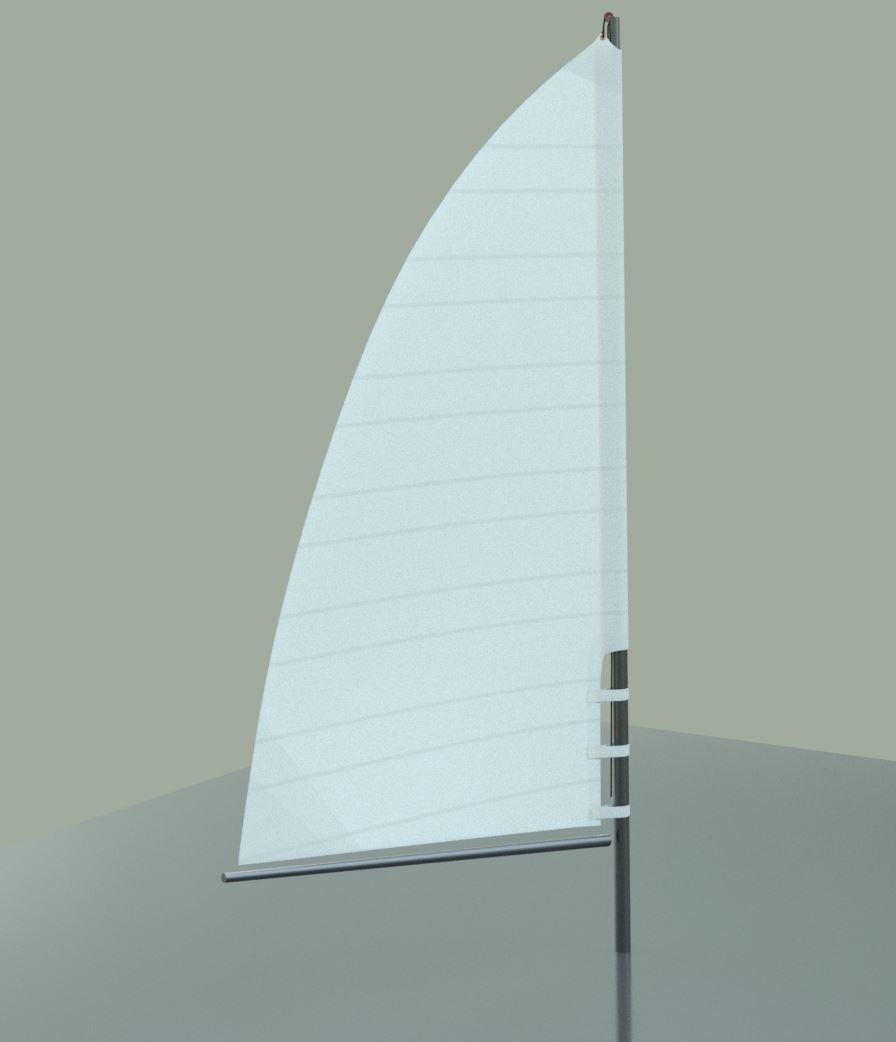

sail2.JPG


sail1.JPG sail2.JPG sail3.JPG sail4.JPG
 
In thinking about the aerodynamic advantages, by making the pocket a lot bigger, you get a smoother air flow and can bunch up a portion of it.
 
Oh that head board (didn't read yet, just skimmed, I assume the board at the top) is a clever solution. It also can act as and end plate to the foil I guess. Like a winglet on an aircraft wing / plate at the end of a f1 rear wing.
 
Rumars has already pointed out the Wingsail with full luff sleeve and reefing, but I suppose you could also have a mast supported by conventional shrouds to about 2/3 height and have a sleeve up to the shrouds ... and then invent a zipped sleeve that operates automatically above the shrouds.
 
then invent a zipped sleeve that operates automatically above the shrouds.
Would that get zippered before the mast went up or after? All of these solutions require threading the sail onto the mast before it's raised or am I missing something?
 
Will, it would automatically zip up above the shrouds as the sail is hoisted - and unzips as the sail is lowered, but I think it would be very difficult to engineer though I haven't looked into it. Just sleeve luff to the shrouds would be efficient and easy. Or the two obvious alternatives of shrouds to mast head, or unstayed mast and full luff sleeve.....
 
The aerodynamic advantage is tiny in reality. The club where I had my first boat, a Moth, lead experiments with them in the 1960s and then gave them up because the aerodynamic advantage was, in reality, far smaller than the problems encountered in adjusting the sail over the wind range. Moths found that luff sleeves didn't really work until about the time they moved to foils, which changed things but only for high-tech foilers.

The same reality had been found out in International Canoes in the 1930s and in other classes. The advantages that some people see in wind tunnels don't appear in the real world. The guys who design things like Finns, skiffs and Europes are not ******. They don't use pockets because they aren't really all that effective aerodynamically.

This isn't conservatism, because where I came from many of us started out boat-owning careers in classes that had wingmasts, pocket luffs, rotating masts etc. We grew up owning some of them, but the simple fact is that the claimed advantages rarely show up.

Oh, wide pockets don't work well because the battens push against the pocket and cause a very lumpy shape, unless you go to short battens (which are generally less efficient) or full battens (which are heavy and cause significant problems in light winds).

I currently have about 12 luff-pocket rigs (windsurfers, Lasers), four rotating wingmasts (Tasar, F18 cat) and three craft with normal rigs and neither one is significantly better overall than the other; they just suit different types of boats that are used in different ways. Any aero advantage to pocket luffs is so small that if I had to reef, I'd use another system.
 
CT249 yes, I hadn't considered things like sail handling and shaping. It would be really interesting to see if that Wharram wingsail works on a monohull.
I had a go of a Tasar once; loved it.
 
It would be really interesting to see if that Wharram wingsail works on a monohull.
It works about as well as it does on his boats. The problem is that the shape is not buildt in, the sail is cut flat, and all the shape comes from the pocket. It's not exactly a racing sail with a lot of control over its shape.
On a mono you have to solve the mast support issue, and you have three choices: freestanding, spreaders above the hailyard attachment, deck spreaders.
 
I have considered the idea.

My solution was to attach the sail to the mast in the convenentional way, with hanks, then have segmented sock panel, which snaps to one side of the sail, goes around the front of the mast, then snaps or buttons to the other side.

This would be installed in segments which would be as high as the reef panels. When reefing, a segment is simply removed from the sail.
 
Forum posts represent the experience, opinion, and view of individual users. Boat Design Net does not necessarily endorse nor share the view of each individual post.
When making any potentially dangerous or financial decision, always employ and consult appropriate professionals. Your circumstances or experience may be different.

  • Back
    Top