brian eiland
Senior Member
- Joined
- Jun 3, 2002
- Posts
- 5,612
- Reaction score
- 330
- Location
- St Augustine Fl, Thailand
Parachute Anchors, Para-Anchor, Sea Anchor
I have been for a long time an advocate for the parachute type sea anchor, deployed from the bow of the vessel, for use as the ultimate survivability tool in really extreme sea conditions:
....from my website…
“Storm survivability should be considered at the design stage for any vessel making offshore passages. It's generally acknowledged that this is best accomplished by facing into a truly strong storm (a big headsea). As mechanical things go, its not hard to imagine some lost of power at a most inopportune time during an extended storm. This could put the solely powered vessel in a perilous position in short order. The motor/sailer and in particular one with our ketch style rig would have several sail configurations which would hold her into the wind. However, I would strongly recommend installing a dedicated sea anchor system that not only takes care of you in those extreme heavy weather situations, but can be utilized in a variety of other less threatening conditions. With a backup sea anchor system aboard, I would ride out a hurricane in this vessel.”
This conclusion on my part was reached was as a result of 3 occasions of actual experiences at sea in storms, but never with a sea anchor onboard. It was following these experiences, and upon reading of others’ experiences with heavy weather tactics that I ran across one of the original books dedicated to the subject, “The Parachute Anchoring System” by John & Joan Casanova, Victor Shane, Daniel Shewmon. I also reviewed Victor’s original “Drag Device Data Base”. These books, and others on heavy weather sailing, combined with my previous practical experiences convinced me that in the ultimate situation the ‘anchor-at-sea’ approach was the best approach as long as it could be attained.
To quote Victor Shane;
“Every form of warfare involves a defense as well as an offense. There are times when the mariner can fight the elements and, with good seamanship, prevail. But there are also times when he must, in all wisdom, cease all offense and place his vessel in a defensive mode. Going with Mother Nature, and trying to keep up with Mother Nature are two different things!”
In a similar vein I wrote about a fight with the sea, “Heavy boats carry their momentum into each trough and crest in a battle with the sea, while relatively lt-weight boats with slender hulls slice through with less battering. "You can out-think the ocean, but you can't out-slug the ocean," quoting a sign posted at the U.S. Naval Academy.
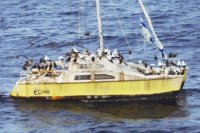
A recent incident (Jan 06) involving a multihull designer Richard Woods, who had to abandon his vessel in a bad storm in the infamous Gulf of Tehuantepec, has prompted me to revisit my thoughts on the subject of parachute sea anchors. Richard deployed a parachute anchor for a period of time, but experienced problems with it, and ultimately expressed dissatisfaction with this survival tool, at least initially. I’m going to post here his initial report as was posted on another multihull forum.
I am hoping that once Richard gets a bit more settled (and hopefully recovers his vessel), that we can attempt to evaluate what failures in system or usage led to his less-than-successful deployment of this survival tool. It should be a learning experience, and a time to more fully explore this very important subject.