
6m waterjet cat - half cabin with fully clear deck

Accident94

Junior Member
Joined
Feb 3, 2022
Messages
6
Reaction score
3
Location
Perth, Australia
Hi All,

I've been lurking for a while but thought i'd dump my thoughts so people can fact-check my logic.

I currently have a jetski, but the novelty is wearing off and i want a boat.
A very specific boat, that doesn't seem to exist.

Here is a very rough 10 minute mockup of what im thinking. Length, beam, cockpit size and engine/jet sizing are roughly accurate, but hull/tunnel is modified from random grabcad bits and peices
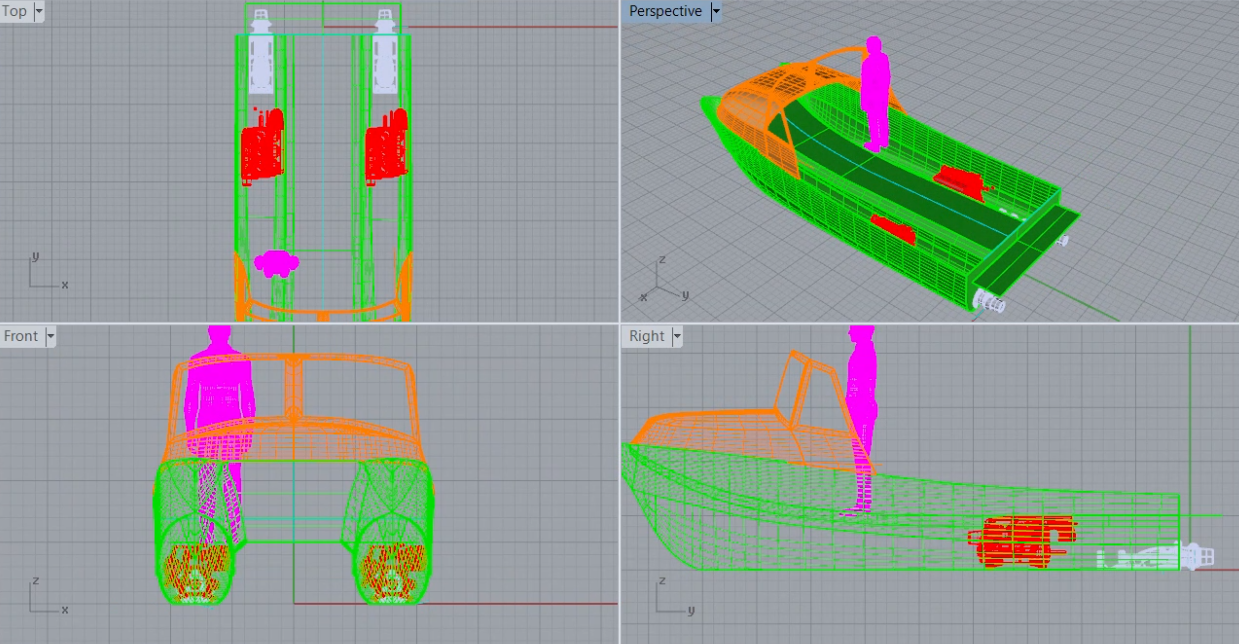
upload_2022-2-4_10-31-35.png


Requirements are as follows:

Easily trailerable: beam < 2.5m, tow weight < 2000kg (1700kg displacement)
Easy to store on said trailer: Length < 6.5m
Berths/facilities for 2 6'5" people overnight, incl. small kitchenette.
Deck space/facilities for 6 pax for day trips
Enough power for watersports
Decent seakeeping characteristics for littoral waters
Max speed > 20kts in low sea state
Shallow-ish draft suited to beaching

Hull selection:
So, monohulls are out because the forward berths need to be positioned so far aft to have adequate space to sleep, sacrificing
So i'll go with a planing cat/tunnel boat.
This way i can fit a double berth under the forward cockpit, which can be placed almost all the way forward. This leaves around 3.5 meters x 2.2 meters of cockpit floor space, which should be plenty for daytime use with a few fold-down chairs

Drive selection:
Looking at the cats on the market in this size the majority have dual outboards and the single outboard models will upset my delicate naval architect's sensibilities anyway. What i don't like about these is the large amount of space you lose to the engines at the stern, not to mention the additional length.
So, inboard.
Stern drives might be doable, but generally the powerplants need a cowling, as they are too large to fit fully under the cockpit deck, plus they add draft to an already deep running (at low speed) hull.
So, a pair of smaller, higher revving engines and a water jet.
This could either be a production jet unit in the 160mm range, or a full driveline pulled from a jetski or seadoo jetboat.
This will impact efficient cruising as i know waterjets are less efficient than props, and the smaller, higher revving, harder working engines will require more maintenance, BUT the have the advantage of fitting entirely within the hulls for a fully clear deck space

Construction:
I have some experience with aluminium construction generally, so for ease of use i want to go for self-jigging laser cut ali plates. This will be a lot of design work, but like i said i have some experience in this area so i'm not particularly worried about it. Note that in my mock up, the hulls are not suited to plate-alloy construction, but as i said its just a mockup.

So what are your thoughts?
For comparison, have a look at something like the leisurecat 6000 brumby which is similar in a lot of ways to what i want, but look how much space in a small boat like that you're losing to the outboards.
https://www.leisurecat.com.au/our-boats/range-of-models/leisurecat-6000-brumby/
 
Last edited:
How you gonna have any clearance for the tunnel if you are sleeping below the cockpit? Makes no sense to me. In my cat, clearances are a little less than I want and no way could I be under the floor.

5-6% lwl is the need, for a 24' boat, the tunnel clearance is thus 1.2 feet or say 14.4" minimum
 
In much the same way as a traditional half cab has a v-berth below the cockpit, or any of the other half-cab cats on the market have a bunk inside the forward superstructure:

Not a lot of headroom, but that's fine, and not different to a lot of bunk arrangements on boats three times the size.
If i switch the berth longitudinal i could probably even get 'standing room' by having a step down into one of the hulls. This means a slightly longer superstructure
Berth would sit somewhere here, above the raised tunnel:
upload_2022-2-4_13-45-13.png


Look under the console in an older (and smaller) sharkcat. Plenty of space there to lay down with a more creative cockpit arrangement.
upload_2022-2-4_13-59-27.png


Sorry, my explanation/terminology might not be correct, hence the confusion
 
Okay, not really under the cockpit is all. Just under the foredeck and only half high. The cockpit is where the controls are and so under the cockpit would mean underfoot by my interpretation at least.

You mean in front of the cockpit.

Check out Wood's 20' Skoota. The helm station is above the berths, so you get more space inside.
 
I suggest you price up a pair of engines connected to waterjets before going too much further.It could be sobering.Over here,something like this could be bought,used and on a trailer for less than one of those engines.Leaving you with a pile of cash and lots of time to go boating.

deletepicturespromday002-2-2.jpg
 
Whether its a pontoon boat or a catamaran hull, it would a fantastic engineering exercise to throw used compact jet ski motors into the hull. Personally I would stick with outboards for simplicity of maintaining even though it would be fun. I like your hull design and wish boats like the Australian made kevlacat 5.2 meter 1900 offshore was available in the States. Over here it seems like everyone is obsessed with walk around center consoles on any of the smaller catamaran hulls. And a lot of the small catamarans seem to have a low bow compared to the Kevlacat 5.2. I might do a similar project in the upcoming years but with outboards.
 
Few replies below, but one new potential issue first.

I've read a lot of controversy about the apparently poor broaching behaviour of small cats in this class.
Some claim its not an issue, but i can definitely see how it would be an issue in a following or stern quartering sea

I wonder if in a stern quartering sea if the broaching would not be worsened by the potential for the jet closest to the oncoming wave to ventilate or even lift out of the water as the wave rolls diagonally under the boat and the hull tips forward and down/to the side. The resulting asymetrical loss of power (and since its a jet, steering authority) would make it impossible to recover the broach

Not that i plan to be crossing any bars, but it might explain why it hasn't been done before?

You mean in front of the cockpit.

Check out Wood's 20' Skoota. The helm station is above the berths, so you get more space inside.

Yep, this is pretty much the arrangement i was looking at, however obviously the skoota design has the demihulls much further apart and a much wider beam.
My bad, i see how the terminology was confusing now.

I suggest you price up a pair of engines connected to waterjets before going too much further.It could be sobering.Over here,something like this could be bought,used and on a trailer for less than one of those engines.Leaving you with a pile of cash and lots of time to go boating.

The motors are an expensive part of any small boat.

If i go the used route, i can pick up a pair of fully functional jetskis in the 150-250hp region (probably seadoo/rotax units, for parts availability) for $6-9000 AUD each. In winter, they're cheaper and if i can pick up one or both wrecked then thats cheaper again (i would refresh the engines & jets before embedding them in the hull no matter what), plus say $500 each for re-pitched new impellers to suit the higher load on the pump

Compared to an outboard the same age/hours this seems cost comparative, although i do acknowledge that the jets and highly strung jetski motors will have higher maintenance costs.

I wont be going the new route, but if i did i could get something like a hamilton jet or scott waterjet (or something else from new zealand as they seem to make all the small name brand waterjets) which would require a larger (physically) inboard motor to power it. since it is unlikely this would fit under the floor, it would defeat the purpose.

Alternatively if i ever went into production i could get something like the Rotax 1630 Ace jet propulsion package (which is literally a seadoo engine and jet), but it looks like its OEM only.
No idea on price for the rotax jet, but high HP outboards aren't known for being cheap either. A 200HP merc v6 is around $28,000 here, which is the same price as a brand new seadoo with the above jet unit in 300hp trim, and a free jetski hull to boot.

I could buy a boat similar to the one you linked, and i acknowledge it would be significantly easier and more economical, and likely provide 90% of the functionality at 10% of the cost. But it wouldn't be nearly as interesting.

Whether its a pontoon boat or a catamaran hull, it would a fantastic engineering exercise to throw used compact jet ski motors into the hull. Personally I would stick with outboards for simplicity of maintaining even though it would be fun. I like your hull design and wish boats like the Australian made kevlacat 5.2 meter 1900 offshore was available in the States. Over here it seems like everyone is obsessed with walk around center consoles on any of the smaller catamaran hulls. And a lot of the small catamarans seem to have a low bow compared to the Kevlacat 5.2. I might do a similar project in the upcoming years but with outboards.

The hull design isn't in any way a 'real' hull form, but thanks :) Literally a stock model of a strip plank half cab that i narrowed and copy/pasted and stretched till it looked about right.
For starters, its not suited to plate construction, but the general particlars are right for the purposes of confirming that i can fit the smaller units under the deck, and a bed in the closed forward cabin.

For me, having the jets is the whole idea. I like the various australian/south african cat designs too, but the space/length inefficiency of the outboard irks me. They are easier to maintain as you suggest, but the trade off is length and deck space. I propose the other end of the compromise and sacrifice operating costs in order to gain features/utility.

I think the obsession with walk-arounds comes from the fishing market. I'm guessing as im not a fisherman, but here in Australia especially in the north, we have massive uninhabited areas that people want to go into and fish for days or weeks at a time. Hence, internal cabin space and range are higher priorities than the '360 degree fishability' that so many centre consoles tout.

Thanks all for the feedback, keep it coming!

I might start working on an actual hullform soon, and maybe make a scale test model to test the ventilating jet/broaching concept
 
HI guys, so i've been thinking about this a lot and playing around with hull shapes, and and i need to reduce part count (and weld length) to make fabrication cost effective.

To that end, how do you think a single deadrise hull would go? would the amount of entrained air make the jets ventilate?

Quick mock up of what im talking about:

upload_2022-2-24_14-42-0.png
 
I've read a lot of controversy about the apparently poor broaching behaviour of small cats in this class.
uld make it impossible to recover the broach

Not that i plan to be crossing any bars, but it might explain why it hasn't been done before?

90% of the functionality at 10% of the cost.

Thanks all for the feedback, keep it coming!

Like watching boats at haulover inlet! Cat with dual outboards getting stuffed. Lots of designs get stuffed at haulover tho.

Wonder what resale would be?I've read it's nice with outboards to be able to leave them at mechanics & take boat home. But maybe that's smaller outvoards. Dunno.

What about noise? Dunno but jet engine might get old.
https://www.boatingmag.com/boat-engine-comparison/

either of your designs might make cool avatars?

Edit:
https://www.boatsnews.com/story/27809/parker-monaco-110-two-well-hidden-outboards
Covered with a sunning area & hid two outboards. Still wouldn't run as shallow as a jet boat but should get much better fuel economy & much less noise. Soundproofing might be incredibly valuable. Altho one article above made it sound like coast guard regs made it tough to reduce sound from jet boat.
 

Attachments

  • Screenshot_20220224_012211.jpg
    Screenshot_20220224_012211.jpg
    27.5 KB · Views: 353
  • Screenshot_20220224_012144.jpg
    Screenshot_20220224_012144.jpg
    17.5 KB · Views: 325
Last edited:
There was an asym cat guy here a few years ago and the boat would not work well. You have to be careful with these hulls because they can be weight sensitive and even prop thrust sensitive.

waterplane area looks lower at asym and reserve is lower with vertical sides and asym

To be honest, I'm not wise enough to comment, but the drawing makes me gutcheck nervous. And you ought to be running hydrostatics with any drawing for a real solid evaluation of what you've drawn.
 
Like watching boats at haulover inlet! Cat with dual outboards getting stuffed. Lots of designs get stuffed at haulover tho.
That looks hectic.
Luckily we don't have anything like that near where i live. no tides to speak of and no fast flowing rivers, but that is the behaviour im talking about.
i imagine the length of the racing cat would make the hulls track beter. For a recreational cat, you'd be looking at probably half the L/B whish can

Wonder what resale would be?I've read it's nice with outboards to be able to leave them at mechanics & take boat home. But maybe that's smaller outvoards. Dunno.
No idea really, but i feel like this design solves a common problem with small boats:
They're too small.
With usable cabin space you don't have enough cockpit room for day use. WIth a big enough cockpit, your cabin is unusable for overnighters.
Service wise, i can't see it being worse than a jetski. The earlier supercharged models needed heavy servicing every 100hrs which meant a lot of engines going in and out. With a bit of clever design i should be able to design them so they're more or less 'quick release'

What about noise?
Not really a concern for me personally, but it ought to be minimised.
Newer 4t naturally aspirated jetskis aren't that loud. For reference, i'm currently considering 150HP rotax 4 stroke w/ 155mm waterjet from the SeaDoo WAKE 155 models. The supercharged models go 215/255, but then you need to deal with the aforementioned supercharger.

either of your designs might make cool avatars?
Good idea lol.

Covered with a sunning area & hid two outboards.
I could put a motor cowling of some sort on outboards or inboards, and you can dress that up as a table or a sunbed or use it for storage etc, but a flat deck is better.
Something i dont think i touched on before is the additional LOA that outboards require. Jets can be recessed so that basically only the reversing bucket protrudes from the transom when in use:
upload_2022-2-25_8-47-6.png

so you can have deck all the way to the back of your boat, and then a fold down swim platform/transom so your towed length is pretty much identical to your hull overall length.
plus no outboards to drag along the road means you can have a trailer that is much lower to the ground than is typical for a usual skyscraper-esque powercat/trailer combo
upload_2022-2-25_8-53-14.png


There was an asym cat guy here a few years ago and the boat would not work well. You have to be careful with these hulls because they can be weight sensitive and even prop thrust sensitive.
Is this the one?:
Asymmetrical Cat Hull Design Advice https://www.boatdesign.net/threads/asymmetrical-cat-hull-design-advice.59628
Sounds similar to what i want to design actually but from reading the thread, too heavy an not enough waterplane area.
I'll have to try and avoid the same pitfalls i guess.

waterplane area looks lower at asym and reserve is lower with vertical sides and asym
To be honest, I'm not wise enough to comment, but the drawing makes me gutcheck nervous. And you ought to be running hydrostatics with any drawing for a real solid evaluation of what you've drawn.

It requires some further work no doubt. I would probably keep the 12ish degree deadrise at the transom constant for the first 2m or so to allow for engine installation. Really just intended for the drawing to demonstrate the sort of thing i was thinking
I have freeship installed and set up for when i start designing in earnest. No doubt a bit of learning curve coming from Maxsurf, but im sure i'll figure it out.
I also need to do some initial structural assessment once i have a rough hullform to get CG for stability/scale model tests. For this i need some additional resources. ISO12215 for starters.
 
Yes, that is the boat I was referring to..the hulls looks awful close to your iirc
 
Ok, so I've had a chance to do some modelling in freeship, hydrostatics etc. Currently pretty happy with the design, using mostly developable surfaces. Bit of a hassle getting rid of the last of the Gaussian curvature in side shell at the bow. It disappears if I get rid of the flat plate at the bow, but at this stage I'd like to keep that to gain some depth in the forward cuddy cabin.
if anyone has any tips for getting rid of it (in Freeship) please let me know

Have also confirmed fitment of the jets and engines in the hulls.

I'm looking at getting a copy of the 'secrets of tunnel boat design' book from aeromarine research, as I have no idea what the tunnel geometry should look like.

Now onto lightship weight calcs and then scale testing.

I've found some 16mm jets for RC boats which should allow me to do 1/10 scale (600mm LOA) scale RC model. Bit of Arduino trickery and I should be able to scale power and motions to at least the right order of magnitude. Not kidding myself about the accuracy but some idea would be nice.
 

Attachments

  • JetCatv5.png
    JetCatv5.png
    1.3 MB · Views: 377
  • received_754266632576741~2.jpg
    received_754266632576741~2.jpg
    449.8 KB · Views: 343
Forum posts represent the experience, opinion, and view of individual users. Boat Design Net does not necessarily endorse nor share the view of each individual post.
When making any potentially dangerous or financial decision, always employ and consult appropriate professionals. Your circumstances or experience may be different.

  • Back
    Top