Attaching Rigging to the Mast

brian eiland

Senior Member
Joined
Jun 3, 2002
Posts
5,587
Reaction score
325
Location
St Augustine Fl, Thailand
A number of years ago I was visiting a friends second home in Lunenburg NS. I got to view this vessel that was once owned by Gen Patton.

This past weekend in Lunenburg NS, there appear a few 'tall ships',...not the real big ones, but a nice little selection. Along with them there were a few other historic vessels, and a very modern Bermudian 'sloop'.

This beautiful schooner caught me eye. It was an Alden design built for then Col George Patton
https://sailwhenandif.com/an-historic-vessel/
stbd-side-ps-jpg.78864


I had been thinking of 'new ways' to attach some of the rigging to the mast. I was pleasantly surprised to find this,...
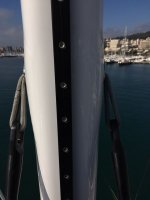
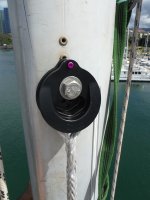
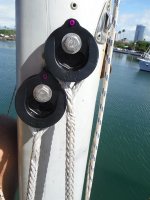
Another thing I found interesting on this vessel was the method utilized to attach the shrouds and intermediates to the mast column. Instead of poking holes in the mast tube, they wraped the rigging around the mast column and kept that rigging from sliding down the tube by attaching 'cheek blocks' to the mast.
dscf1290-ps-jpg.79232
dscf1289-ps-jpg.79233
dscf1295-ps-jpg.79234


It harkens back to older days when a lot of square-riggers had their multiple rope/wire shrouds wrapped around their mast columns at their upper locations.

I've made the same suggestion for attaching rigging to modern mast, particularly carbon tubes where I hate to see holes poked in and those odd-ball kinked swaged fittings used.

A few postings I've made on this subject
Aftmast rigs??? https://www.boatdesign.net/threads/aftmast-rigs.623/page-66

What similar rigging have others seen,...particularly with modern materials ??
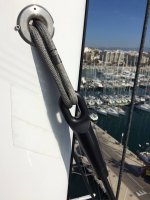
 
Well, that style of rigging goes back at least as far as Biblical times.
I'm quite sure that if the engineers and designers of modern rigs that use all kinds of esoteric materials thought there was any reason to use that style of rigging they would have jumped on it a long time ago.
It's bulky, heavy, and not very clean in an aerodynamic sense.
 
It also prevents a sail attached to the mast from passing the stay attachments
 
....a few references from some older postings on the aftmast subject thread...

Lash Tangs instead of Terminals attach rigging to spar

brian eiland said: ↑
Rigging Force Review for Aft-Mast
..... AND it will NOT consist of two individual jumper stays (wire cables), but rather will be fashioned of a continuous loop of ‘cable’ that would wrap around the back-side of the mast at its lower ‘termination’, and might even do so at its upper ‘termination’.

The actual jumper stay ‘cable’ itself will be constructed from one of the new-age synthetic rigging materials such as Dyneema, Spectra, PBO, LCP, Aramid, C-6 carbon tow, etc. Ideally this stay material will have NO pre-stretch requirements thus no pre-loading. It should be very strong upon immediate application of force, and in a minimal diameter that it can be looped around the mast section in a continuous manner, at least on one end, maybe both. As a continuous loop, ‘both sides’ will always be carrying ½ the total load, rather than one side under load, while the other might be slack. There will also be a minimum of ‘fittings’ required to attach them to the mast (less weight, less failure pts). I imagine a simple ‘block’ of material attached to the mast around which the loop of this jumper stay can not slide any further along the mast….and one end needs to be adjustable
Not exactly my idea of a 'wrap around connection'. but it is a soft fiber technology in lieu of traditional tangs..

....found on Rigging Projects blog and Facebook pages.
"One of the details we specified for a new Hall Spars & Rigging Swan 82 spar: We used Blew Stoub lash tangs instead of t-terminals to interface the Future Fibres supplied Aramid runners with the spar. The lash loops give us better articulation, easy servicing and lower profile."

Attached Files:


carbon rigging – Rig Pro Newport's Blog https://rigpronewport.wordpress.com/tag/carbon-rigging/

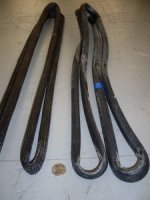
Big Loups
We just made these fine LOUPS for securing the runners on the Rambler 100. Used in basket, they have a
SWL of 44,100 lbs. Break strength =176,400 lbs.

Attached Files:

big LOUPS.jpg
File size:
52.6 KB
 
Looking for more photos of 'cheek blocks', or whatever might be the best name for these items? Reference these postings:
Soft Rigging Solutions http://www.boatdesign.net/forums/multihulls/soft-rigging-solutions-47997-2.html#post735744


Gallery 3 — Colligo Marine http://www.colligomarine.com/mastconnections-gallery/

Another type of soft fiber rigging connection to the mast.
( I like these but they are not quite what I am looking for in this instance)

Attached Files:
 
When and If a two masted staysail Schooner designed by John Alden
I see it was rebuilt by Gannon and Benjamin Marine Railway on Martha’s Vineyard. Barged there in pieces and finished around 1994. In 1990 she broke loose in a gale and was wrecked. There was a huge gaping hole in her port side, broken frames, twisted cabin sole, thoroughly demolished interior, destroyed rudder, smashed keel.
I ripped this information from When and If - Wikipedia https://en.wikipedia.org/wiki/When_and_If
 
Continuous Line/Loaded Twin Backstays

I'm in need of some ideas to attach my twin backstays (possibly 2/4 of them) to a cruising catamaran design. One twin set would attach at the masthead, and one twin set would attach at the hounds. In both cases the 2 legs one of these backstays would be under full load, unlike most other arrangements on most sailboats. The legs of the backstay would be anchored at wide beam of a multihull vessel. That wide beam anchoring is what makes this a possibility, as does the lack of a big traditional mainsail. (so this idea might be limited to multhull craft)

We all know that its mostly the capability of applying good backstay tensions that allow us to maintain good forestay tensions. Dividing up our backstay loadings into 2, maybe 4, stays should be a good thing, both for the strength required of the rigging line material itself, ...as well as the strength required at the anchoring point on the vessel.

So here is one of those vessels i want to put these twin backstays on,..
Aftmast rigs??? https://www.boatdesign.net/threads/aftmast-rigs.623/page-80#post-951750
one of several images
dscf9595-jpg.190810

those 2 very rear lines are the backstays,..the other white line is the sheeting line for the wishbone boom on the mizzen sail

Now before you get upset that it is on my 'aftmast design', please consider I am looking at standing the mast straight up on a new version, BUT still needing good backstay support,..via the twins.

I am still enamored with the concept of wrapping that backstay(s) around the mast tube to pull backward. Need to come up with some creative (and hopefully simple) methods of accomplishing that?
 
Brian, my Wharram Tiki 38 has mast tangs and loops/eyes that go around the mast, all part of the original design.

The plans called for a wood mast. I had mine made in aluminum. I copied the plans but used aluminum instead of wood, welding the tangs to the mast.

The original stays were wire but I used dyneema and made eyes at the end that dropped over the top of the mast and hooked onto the tangs. It has been good for several years of cruising so far.

If I ever replace the system, I will make separate dyneema loops that go over the mast and tangs and then attach the stays to those. If you have to replace a stay it is very difficult. The overlapping eyes interfere with removal of the lower stays. You either have to cut the eye or drop the mast to do it. If you cut the eye, you still have the issue of weaving it through existing stays to reinstall the replacement.

I don't have pictures to hand but can take a couple if you want to see how I did it. It is a very simple and seemingly strong system, with most of the force spread on the surface of the mast.
 
Sure i would like to see a few photos as i do not totally understand the description.
 
I wrote a short message to Colligo marine,...

I am somewhat familiar with your cheeky tangs, but to me they still represent dividing up the twin backstay into 2 individual side stays.

This is the idea I am pursuing. A single line of rigging material would start out at one of the sterns of a catamaran, go up to the hounds (or the masthead), wrap half way around the mast, then go back down to the other stern. There would be some sort of cheek blocks mounted to the exterior skin of the mast tube,...to route that continuous stay-line around the mast tube, while keeping that stay-line from sliding down the mast tube.

Perhaps a few of these images of a wooden mast can impart the general idea,..
dymeen-loops-around-mast-tube-jpg.100039


photo-16-jpg.100040


photo-14-jpg.100041


I'm seeking to have that 'twin backstay' actually be a SINGLE line looping around the mast at both the hounds and the masthead. That would mean both legs carrying an equal load holding back the mast.
  • That arrangement would allow the mast to make small necessary excursions to either side. And those side excursions will be held in check by the SHROUDS, ..not the backstays.
Will those modern rigging materials stand up to a little bit of friction around the smooth mast tube?
 
It's rainy and rough right now so I might have to wait until the front passes to take pictures.

For a better idea of the system, look at the second rig photo in your thread. Thats the way mine is set up, though with much bigger tangs to retain the stays.

I dont see why this system could not be adapted for a single continuous stay wrapped around the mast. Movement might be an issue, but sleeving the line and/or making the loop around the mast separate from the stay may work.

A Wharram rig moves a lot because of the flexible hull lashings and there have been no issues reported with that part of the rig that I know of.
 
Thanks BGW,...yes don't get hurt in bad weather trying to get photos.

I think I see what you are saying now. I've given thoughts to that as well, and I'm wondering if it can be simplified further. I'm asking Colligo about that now,..in case they have any record of something like that.
 
A few points, here.

1.) The advantage of looped stays and shrouds instead of bolted, tangled ones, is that the bending strength of the mast is less effected. There is no relatively large hole in the mast. Instead, there might be a few much smaller holes for the screws or pegs that keep the dog-blocks from slipping. Maybe just one, or just one at each end. Glue can do the rest

On my sailing raft, the back shrouds and the forestay were held to the mast with loops. Two nails were used instead of dog-blocks. This was a simple solution. And it was cheap.
But the sailing raft had no jib. It didn't need to hold a tight forestay.

2.) the disadvantage is that getting enough tension to get a very tight forestay is much more iffy. The tighter you make it, the more load you put on the dog-blocks. And this load is not just compression. The loop will tend to want burrow between the mast and the dog-blocks, then pry them off. To keep this from happening, you might use a tight band around the dog-blocks at their top. But, then you are squeezing them together. You are also squeezing the mast and decreasing its width. If the mast is solid, this is not much of a problem. But, if the mast is hollow, you will need something between its walls to resist this squeeze.
Then, you might as well just drill a bigger hole in the mast and use a tang.

If the mast is mostly under compression, and the bolt is tight fitting enough. This bolt hole and bolt will affect the compression strength of the mast very little. This is the likely reason such a shroud attachment system is almost universally used on Bermuda rigs with large jibs.

If I were designing a cruising catamaran, I would avoid using a jib at all, or atleast use as small a one as I could get away with.

I would also avoid using a very large, tall mainsail.

I would seriously consider a cat-schooner rig and eat the loss of windward performance that such would cost me.

Racers, of course, can't afford to accept such a loss.

But racing is all about being fastest. Cost, durability, and ease of use, are well behind this one requirement on the priority list.

Cruising is about durability, ease of maintenance, and ease of use. Speed, although also a requirement, takes a back seat to these.
 
I'm going to put together 3 brief sketchs of some ideas I am entertaining.

BTW, I think a custom designed cheek block would not trap the continuous stay in a manner to pry it off the mast tube. What if the cheek block appeared as a sheave where it was holding the stay-line-cordage? (I think a few of those 'cheeky tangs' from Colligo are of that nature)
 
Forum posts represent the experience, opinion, and view of individual users. Boat Design Net does not necessarily endorse nor share the view of each individual post.
When making any potentially dangerous or financial decision, always employ and consult appropriate professionals. Your circumstances or experience may be different.

  • Back
    Top