Cargo Sharpie Design

Schooner Guy

Junior Member
Joined
Nov 15, 2010
Posts
20
Reaction score
0
Location
NC
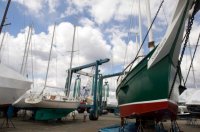
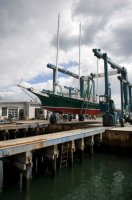
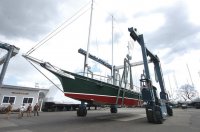
I'm looking for a large steel sharpie type design in the 70 lwl no more than 80 loa draft 3-4 ft. Tom Colvin did a few however since his passing in 2014 his plans seem to no longer be available. She would be used as a full time live aboard and possibly transporting cargo. Can you guys recommend someone who would like to design this at a reasonable price or somewhere to find similar plans ?
 

Attachments

  • Schooner Sarah G 1.jpg
    Schooner Sarah G 1.jpg
    16.1 KB · Views: 1,940
  • SoundWaters 2.jpg
    SoundWaters 2.jpg
    43.9 KB · Views: 2,644
Personal Philosophy Comment

The reliable diesel engines are real nice. To get an honest four foot draft is an excellent goal. The problem is adequate keel size for this depth. A full hull to four feet will have no keel. Wishing for sails to go upwind at all mandates a true ballast centerboard.

I figured that a true motorsailer is desirable. This means use to sails to assist in reaches and more downwind. Centerboards have a seaworthiness issue. Do you leave them down in a storm to get damaged or not?

A clipper ship hull with almost square rigger performance expected is an idea worthy of consideration. Put in that powerful diesel and use it always.
Get one that self rights also.

The sails in an engine-out scenario could still get you to shore in an emergency. Just anchor of a beach and walk to a telephone. It might take a day of weather weighting to raise the sails but the wait is predictable.

Putting up perfect sail rig with a lame keel costs. The huge rigging does effect self righting negatively. So consider. I think P. Bolger mentioned of these tradeoff considerations.

The small ships of Colvin were self righting I believe. Real nice designs get one.

If you are a low budget self designer please consider my "Litoral Trawler"
There is a thread of mine here. You can not ever expect hulls with chines to self right. My design is ...well it is the lowest cost round bilge trawler hull ever designed. It is easy to use Aluminum for it also.

 
The reliable diesel engines are real nice. To get an honest four foot draft is an excellent goal. The problem is adequate keel size for this depth. A full hull to four feet will have no keel. Wishing for sails to go upwind at all mandates a true ballast centerboard.

I figured that a true motorsailer is desirable. This means use to sails to assist in reaches and more downwind. Centerboards have a seaworthiness issue. Do you leave them down in a storm to get damaged or not?

A clipper ship hull with almost square rigger performance expected is an idea worthy of consideration. Put in that powerful diesel and use it always.
Get one that self rights also.

The sails in an engine-out scenario could still get you to shore in an emergency. Just anchor of a beach and walk to a telephone. It might take a day of weather weighting to raise the sails but the wait is predictable.

Putting up perfect sail rig with a lame keel costs. The huge rigging does effect self righting negatively. So consider. I think P. Bolger mentioned of these tradeoff considerations.

The small ships of Colvin were self righting I believe. Real nice designs get one.

If you are a low budget self designer please consider my "Litoral Trawler"
There is a thread of mine here. You can not ever expect hulls with chines to self right. My design is ...well it is the lowest cost round bilge trawler hull ever designed. It is easy to use Aluminum for it also.


DouglasEagleson i'm not sure we are on the same page... I'm not looking for a motorsailer I know these type of hulls must have a centerboard and they don't have a true keel both of these sharpies are Colvin designs and in the 80 x 14ft x 3.5 ft range one of them is Sarah G which I will post the link of her sailing to Bahamas. I am not looking for a world cruising yacht. Sharpie's were used in the this area (Eastern NC) until late 30's early 40's with no engine and in some very rough conditions so I know they do sail well if designed properly. I'm not a designer at all which is why I am asking your guys help with finding a designer at a reasonable cost I have been quoted $35,000 which is why I am asking you guys https://youtu.be/pzfHCMRj3d4
 
reply to schooner guy

I am sorry for my confusion. Your idea is one I had as a young man. I was going to get a Colvin Schooner and put 50 caliber machine gun mounts on it. It was one of his cargo designs. Maybe Gazzelle .

Running in the Caribbean back then was shot gun mandatory days, drugs and all. Some islands were defacto drug kingpen run airfield islands. Sending drugs to the US citizens was a joke for the Queen.
 
If you are a low budget self designer please consider my "Litoral Trawler"
There is a thread of mine here. You can not ever expect hulls with chines to self right. My design is ...well it is the lowest cost round bilge trawler hull ever designed. It is easy to use Aluminum for it also.

Can you explain the part about not expecting a hull with chines to self right
 
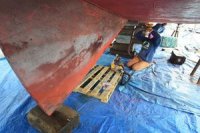
Here are some more pics I found
 

Attachments

  • SoundWaters 3.jpg
    SoundWaters 3.jpg
    82 KB · Views: 2,023
  • SoundWaters 8.jpg
    SoundWaters 8.jpg
    50.1 KB · Views: 1,261
  • SoundWaters 9.jpg
    SoundWaters 9.jpg
    27.4 KB · Views: 1,234
  • SoundWaters 10.jpg
    SoundWaters 10.jpg
    96.5 KB · Views: 1,618
  • SoundWaters 12.jpg
    SoundWaters 12.jpg
    15.9 KB · Views: 1,252
  • SoundWaters 7.jpg
    SoundWaters 7.jpg
    339.2 KB · Views: 1,355
self rrighting concept attempt

As best as I can figure, which is not a professional level.

Consider a overturned barge hull. Obviously at some width the barge will never sellfright. Then consider decreasing the barge beam to a point where center of mass makes it rock easily.

The concept is to consider is bilge effect on this rocking event. If the straight barge hulls exist then a rock force is met with an increasing force to return it to upside-down. Buoyancy increases when you step to the side and use your weight to assist.

So now consider the round bilge upside-down. The inward curve of the bilge while upside-down has a decreasing buoyancy when rocked. The hull does not....?

It gets hard here for me to try to describe it mathematically. But a round bilge up side-down has a decreasing force of righting when tipped or stood on.

A chine vessel is a class of righting buoyancy. The volume of hull below the waterline also has a buoyancy force. This allows non-ballasted boats to self-right. A basic hull curve function exists I believe for perfect self-righting. You need an architect to enforce a degree of self righting. A chine designer is not necessarily any deeper a thinker than me.

The Sharpie is truly unseaworthy. Making Sharpies is a F grade. The vessel you have selected in a fashion will not self-right. I was endeared by a P Bolger Sharpie ~30' long. I finally determined that the ballast in the hull floor was useless. But it is self righting with no ballast using a small rig. A perfect ply motorsailer project for me. Loading it lightly for it little sea world.

Loading is issue.
 
DouglasEagleson: Might I recommend a course at West Lawn and some sea time I think your understanding of boats is somewhat limited to you own thoughts.
 
doug at school

Absolutely correct.

But I do remember advice from Phil Bolger's book. If you are bothering to make a true sailer, why use a chine hull when a rounded bilge design is hardly any more expensive. A custom sail boat will simply lose value comparatively sharpie versus round hull.

I do not believe I am the only person winging it concerning self-righting.

Thanks Doug
 
Douglas this hull design has a displacement of 35 tons (70,000 pounds) they are seaworthy if u know what u are doing. As far as a round bottom it IS massively more expensive than a flater bottom because of the equiment required to make the round bottom as far as the chine hull u keep referring to there are many types a chine hull such as multi chine which designers like Bruce Roberts and other metal boat designs use to created a round effect. A flat bottom is very stable and are seaworthy after all cargo ships are flat bottomed and even though a cargo ship is not self righting it is seaworthy
 
If you are in NC, there is a really good naval architect in Wanchese: Glen "P-Nut" Haught. I built several sportfishermen designed by him, but sailboats are what he really loves.
 
If you are in NC, there is a really good naval architect in Wanchese: Glen "P-Nut" Haught. I built several sportfishermen designed by him, but sailboats are what he really loves.

Thanks I will try to get in contact with him
 
Sharpie Ballast Dilemma Idea

Putting in a full ballasted centerboard on a large cargo sharpie entails something like 15,000 pounds on the board bottom. A daunting design.

I got to thinking about Bolger's 30' sharpie and correct ballast. So here is an alternative attack.

Use no ballast. Put in a dive plane like fin affair about amidships. Each plane side goes opposite of the other giving a water speed caused torsion to counter act sailing heel.

The more heel the higher the available torsion because heel means speed and power.

No ballast for self righting means a normal trawler like upper structure to cause return to upright.

The drag of the planes can use excess sail power once the hull speed is attained. In light winds the plane angle can necessarily be zero meaning little drag.

They are not stability planes for wave action unless you build in a dual use.
 
Forum posts represent the experience, opinion, and view of individual users. Boat Design Net does not necessarily endorse nor share the view of each individual post.
When making any potentially dangerous or financial decision, always employ and consult appropriate professionals. Your circumstances or experience may be different.

  • Back
    Top