Pedal Boat Design

Rick--

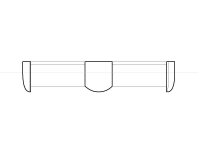
Pictured is (in my opinion) our best bet. Eppler did a lot of work on HYDROFOILS and the 838 has a generous 18.37% max thickness. More importantly for what we are doing, the max thickness is WAY back at 46.5% of the chord. The image is to scale to give you an idea of the shape/size and has a 3mm skin of Carbon Fiber (CF) with a main spar for back to back D tubes.

Keep in mind that for tubes, increasing diameter increases strength exponentially while increasing wall thickness improves strength lineally. You mentioned that the load is distributed evenly, and that is likely the case, however modules of elasticity really don't care. If the "fixed points" are the ends, the loads WILL multiply inwards to towards the center. A perfect example of this in CF are helo main rotor blades. They are fixed on one end and the elasticity (loading) builds out towards the tips.

SW allows you to enter the Modulus of elasticity for your exact CF cloth, weave direction, and resin. Because we only need strength in one direction (the foils very thin and there is no crush loading) the weave choice is pretty clearly dictated.

Now because our blades have to be able to rotate they will be on pins/axles.

Using your 275 N (60 pounds) loading (is this a bit high maybe?) on a 43" span on the pictured structure I get almost 2" of deflection (about 50mm). Thats actually withing the structural range of the CF with one caveat. With both positive and negative pitch in the wheels rotation your subjecting the blade to that deflection in BOTH direction about 30 times a minute...over and over thousands of times.

You also loose over an inch of your width at the extreme of that flex. That means about a half inch gap at either end and thats going to be draggy as hell.

I think the 2" (50mm) of flex might seem high to you because your seeing the 80mm width in your mind and not the 14mm thickness that isn't even a rectangular cross section...60 pounds in the center of a 1.1m length of something that thin is a LOT. Turn it on it's edge and we get a lot more strength. Even end to end as a column it could likely do it, but on the flat is tough.

Picture a hight tech 1m R/C sail plane CF wing which is essentially what this is. Now picture it with a 60 pound fuselage lol.

Anything over about 25" or so and your just going to be beating the blades to death. Either go shorter, or give me more diameter (much bigger chord) to work with.
 

Attachments

  • eppler_hydrofoil.jpg
    eppler_hydrofoil.jpg
    32.2 KB · Views: 753
Rick--

How about 40" (1m) between the hull sides, split the wheel into two using a single central down strut about 1" (25mm) thick and using the hull sides for the outer ends? The hulls could have a recessed pocket for this so that there was virtually zero drag (beyond what was normal on the hull). That gives you blades 19.5" (half a meter) for each wheel. On the single center down strut you could incorporate the boats rudder and get a little bit of two for the price of one action going in the drag department.

If the center line of the wheel was placed on the center line of the hulls any twist corner to opposite corner on the hulls would have virtually no effect on the wheel. (In this location a rudder on the down strut would be worthless though)

And no I haven't forgotten about sleep...I just don't sleep as much or in the same way others do lol.
 
Wow--

Wanna see some weird numbers Rick, don't plot your thrust/drag vectors for a circular motion, but rather an elliptical motion with the long axis vertical (decreases your flat spots top and bottom slightly and increases the "working" portions front and back) and then elliptical with the long axis in the direction of your boat travel.
 
Rick--

How about 40" (1m) between the hull sides, split the wheel into two using a single central down strut about 1" (25mm) thick and using the hull sides for the outer ends? The hulls could have a recessed pocket for this so that there was virtually zero drag (beyond what was normal on the hull). That gives you blades 19.5" (half a meter) for each wheel. On the single center down strut you could incorporate the boats rudder and get a little bit of two for the price of one action going in the drag department.

If the center line of the wheel was placed on the center line of the hulls any twist corner to opposite corner on the hulls would have virtually no effect on the wheel. (In this location a rudder on the down strut would be worthless though)

And no I haven't forgotten about sleep...I just don't sleep as much or in the same way others do lol.

BG
I agree with the deflection. I did a full carbon foil and got 31mm so it is close to what you have.

The centrally supported system may be the best way to go. My forces are at design of 150W and they will go up considerably with higher power. You could expect to double the value given so even worse.

How about you do the design of the foils to an acceptable deflection and I can do the performance prediction once you have it. Halving the width will reduce deflection dramatically of course. Giving the foils side plates is a big step.

The central fin will cost in drag but it will provide something for a rudder as you say.

This shows why testing under flow conditions has value. You would not see any impact of extra drag if there was no flow. This drag needs to be accounted for in comparing the system with a paddlewheel. On the other hand, in real life, the paddlewheel will have large windage and water tests will not show this up. The drag from both will be similar I expect but caused by different factors.

Rick
 
Rick--

At half meter width you could stand on the blades. ( I couldn't but I am "chubby" =) Figure 8-10 mm or less at 250n (60 pounds). I could likely improve on that some with a few tries and some tinkering as well. Does that Eppler Hydrofoil work for you? I have the plot points if you need them.

Here is another interesting notion just for grins.

Splitting the wheel might lend itself to your mono hull / trimaran platform. In the cross section sketch the inward sides of the wheels are recessed into your main hull so there is zero net drag loss over the same area of hull. On the outward ends a good portion of the wheel end plates are recessed into your outrigger hulls. Reduces the drag by half maybe. Could also work the trailing edges of the wheel plates to be rudders...makes the rudders effectively zero net gain for drag as you have already paid the piper for that displacement.

With the rudders half meter out the boat would also be shockingly agile for its length. Would not be impossible to make the boat turn with more power to one wheel also. As I see it also, your not drawing any more wind either for the more substantial cross members...slight weight penalty of course, but not much.

Seems you could even go with deeper draw on the outriggers and say a 2" width--pulling the 2" out of thin air--but the point is the longer width with a narrower cross section that makes for lower drag.

Blue lines the water line, hulls 10" wide.

Be quite the weed beater thats for sure. That's defiantly a boat I would love to build if it works.
 

Attachments

  • Image1.jpg
    Image1.jpg
    31.3 KB · Views: 461
Rick--

At half meter width you could stand on the blades. ( I couldn't but I am "chubby" =) Does that Eppler Hydrofoil work for you? I have the plot points if you need them.

Here is another interesting notion just for grins.

Splitting the wheel might lend itself to your mono hull / trimaran platform. In the cross section sketch the inward sides of the wheels are recessed into your main hull so there is zero net drag loss over the same area of hull. On the outward ends a good portion of the wheel end plates are recessed into your outrigger hulls. Reduces the drag by half maybe. Could also work the trailing edges of the wheel plates to be rudders...makes the rudders effectively zero net gain for drag as you have already paid the piper for that displacement.

With the rudders half meter out the boat would also be shockingly agile for its length. Would not be impossible to make the boat turn with more power to one wheel also. As I see it also, your not drawing any more wind either for the more substantial cross members...slight weight penalty of course, but not much.

Seems you could even go with deeper draw on the outriggers and say a 2" width--pulling the 2" out of thin air--but the point is the longer width with a narrower cross section that makes for lower drag.

Blue lines the water line, hulls 10" wide.

Be quite the weed beater thats for sure. That's defiantly a boat I would love to build if it works.
BG
I have been thinking about such things. Lets get a mechanism that works and do proof of concept.

I did try a single little oscillating foil at 4X cadence but the torque demand was horrible. Activating it was also messy. The multiple smaller blades on a rotating structure has some interesting possibilities.

The torque demand with three blades is good. The uplift varies more than I expected but this can be altered by the range of blade tilt or adding more blades. We have what could be called aggressive tilt meaning it has a small range.

The Eppler foil is fine. I did look at other shapes and there is not a lot of difference. The best L/d was around 12% thickness but there was little variation.

Rick
 
More like that on the sponsons or outriggers...

I think 3 blades is going to be right because blade shadow happens at TDC and BDC. Add a fourth and at the peak of the power curve the rear blade (call it the 9 o'clock) is dark...might as well not even be there.

Did you run your numbers with the blades on an upright and flat elliptical path like I mentioned? I remembered Greg's comments on his elliptical chain ring.

I mentioned the mono hull because if we have to build a full sized test bed, and the flywheels are actually recessed into the hulls...easier/faster/cheaper for me to build a mono. If there are changes...two hulls and the more complicated super structure of the cat = YUCK. Changes on the mono hull would almost certainly be to the outriggers I figure since thats the only real change to the configuration since you have the hull on yours ironed out.

Besides, if I build a mono hull that means every part would have molds so parts for you would be easy.
 

Attachments

  • Image2.jpg
    Image2.jpg
    27.2 KB · Views: 402
More like that on the sponsons or outriggers...

I think 3 blades is going to be right because blade shadow happens at TDC and BDC. Add a fourth and at the peak of the power curve the rear blade (call it the 9 o'clock) is dark...might as well not even be there.

Did you run your numbers with the blades on an upright and flat elliptical path like I mentioned? I remembered Greg's comments on his elliptical chain ring.

I mentioned the mono hull because if we have to build a full sized test bed, and the flywheels are actually recessed into the hulls...easier/faster/cheaper for me to build a mono. If there are changes...two hulls and the more complicated super structure of the cat = YUCK. Changes on the mono hull would almost certainly be to the outriggers I figure since thats the only real change to the configuration since you have the hull on yours ironed out.

Besides, if I build a mono hull that means every part would have molds so parts for you would be easy.

BG
The stabilised monohull usually ends up being far superior to a cat. I expect loads will drop somewhat because the hull will be more easily driven.

I made a 12ft hull that had 8" beam for a trial - a weekend special from a single sheet of aluminium. I got it up to 13.6kph without any tuning. So you could go to quite a deep hull, narrow and not silly long. There are weight savings due to no supporting frame. You could probably make a boat that could be easily lifted by one person and tossed on the top of a car.

I worked hard to develop low draft propulsion but did not get to the idea here - this is a significant variation on what I have tried. I just made my prop system tolerant of hitting things but this system has merit as noted earlier.

Rick W
 

Attachments

  • V9_First_Test.jpg
    V9_First_Test.jpg
    108.1 KB · Views: 684
Have not considered other than circular path. I would want to see the means of achieving the motion. Remember the path of the blade is close to a sinusoidal wave because it is always travelling forward while going up and down. The Voith prop has a little backward circle as some point.

There are potentially interference effects that I have not modelled due to the size of the blades and small separation as well. A circular path keeps them separated a bit more in the working area than an ellipse.

My thought is to build something to test. Prove the calculations and then explore improvement ideas using the verified maths. It is the faster way to develop. At some point hands have to get dirty.

Rick
 
I REMEMBER V9!

On the ellipticals I meant more to see the difference between a horizontal and a vertical then to use it in a boat. I think the numbers prove what you said about TDC and BDC being dead zones.

I'm thinking and 18 footer would be fine for the mono test bed. (if your going to go to the trouble of building a boat, build a NICE boat I always say =)

We just need to figure out the hull shape that gives us nice flat sides in the middle for the flywheels. I guess projected water line also needs to depend on how much of the 8" diameter rotation you want submerged also.

I forget your probably tripping over boats there and likely have no desire to add another.
 
I REMEMBER V9!

On the ellipticals I meant more to see the difference between a horizontal and a vertical then to use it in a boat. I think the numbers prove what you said about TDC and BDC being dead zones.

I'm thinking and 18 footer would be fine for the mono test bed. (if your going to go to the trouble of building a boat, build a NICE boat I always say =)

We just need to figure out the hull shape that gives us nice flat sides in the middle for the flywheels. I guess projected water line also needs to depend on how much of the 8" diameter rotation you want submerged also.

I forget your probably tripping over boats there and likely have no desire to add another.

BG
I have quite a large boat morgue. Luckily I have a long slender garden where I can pile them up. The aluminium ones have value as recycled metal. V9 hull was given away. I usually spend more time using than building but probably not by a big margin. V9 hull took a weekend to build and I used it on two separate days. It was quite instructive. It was my pre-Michlet/Godzilla days.

Like I have said before - will be ever grateful to Leo Lazauskas. I can now test different hull variations at a rate of about 10,000 per second so it has saved me centuries of development. Nothing like good maths.

Rick W
 
BG
In terms of the boat design/building. If you have a crappy concept, good design and good build you will get a crappy result. If you have a good concept, crappy design, and good build you will get a crappy boat. If you have a good boat, good design and crappy build it will be a crappy boat.

My problem was that I could never be confident about all three aspects so I have done well enough in each to learn.

Michlet takes out a large variable and I have developed good software for prop design. I also have an array of drive systems available.

Something like Greg's CP2 or my V11g are fair to good on all three aspects for the intended purpose.

When you throw in something radically different that overcome basic weaknesses the whole process starts again to get the best from it.

A basic weakness with most prop boats compared to paddling is the vulnerability of the prop to damage and fouling. If you read through Mike Lampi's race pages you really get a good insight. My limited racing experience is the same. So the idea here could be of considerable interest.

Until you have experience with it you really cannot be sure. If it is crappy then the boat will be crappy.

Rick
 
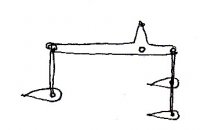
Since the foils at TDC and BDC don't do much, why have 'em around? Here's yet another admittedly unfinished idea that might turn out simpler to build, if it will work.
 

Attachments

  • rocker.jpg
    rocker.jpg
    21.5 KB · Views: 656
Since the foils at TDC and BDC don't do much, why have 'em around? Here's yet another admittedly unfinished idea that might turn out simpler to build, if it will work.

Curtis
Both these foils still pass through a "glide" stage at TDC and BDC of their stroke. The path tracked through the water is not all that different just that activation is on a wheel rather than levers.

Managing forces in the levers is a pain and you only have two foils so it will be rougher running than three blades and the loads on both foils peak at the same time. It does have advantage of balancing the up and down forces. It would be a good concept to explore for simple swing pedal activation.

The rotating system can have more than three foils per the Voith example if it needs to be smoother. The three blades gives quite smooth thrust and torque demand though. If need be it is easy to gear it up and go to a smaller diameter.

Rick
 
Rick,
Would it help much to have more foils on the assembly in a staggered array; say, two on the front beam and one rear, for example? As to the problem of both ends reaching TC and BDC at the same time, maybe the pivot on the horizontal arm could be placed off-center, to put their strokes out of phase.

I think that AoA could be handled with a simple linkage.

I'm thinking on the fly, here.
 

Attachments

  • rocker2.jpg
    rocker2.jpg
    15.2 KB · Views: 406
Forum posts represent the experience, opinion, and view of individual users. Boat Design Net does not necessarily endorse nor share the view of each individual post.
When making any potentially dangerous or financial decision, always employ and consult appropriate professionals. Your circumstances or experience may be different.

  • Back
    Top