Multihull Structure Thoughts

Discussion in 'Multihulls' started by oldmulti, May 27, 2019.

  1. oldmulti
    Joined: May 2019
    Posts: 3,275
    Likes: 2,378, Points: 113
    Location: australia

    oldmulti Senior Member

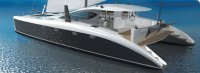
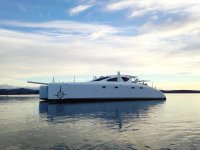
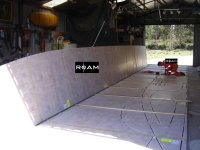
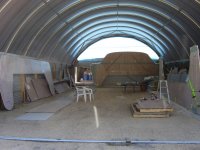
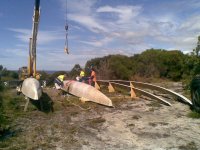
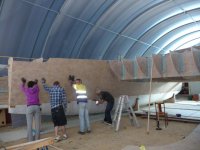
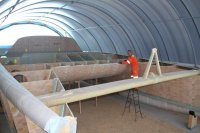
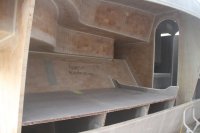
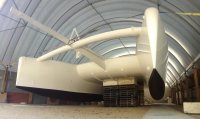
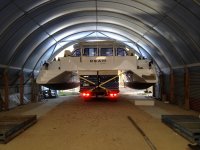
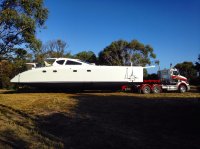
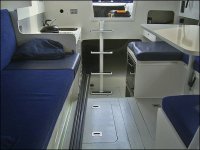
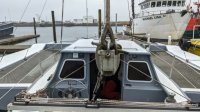
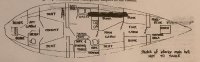
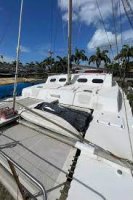
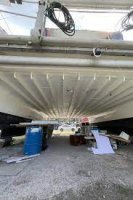
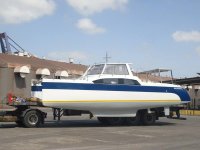
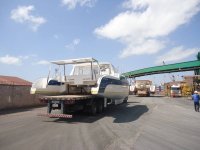
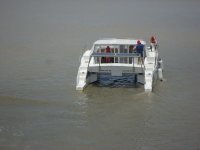
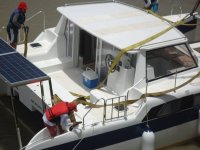
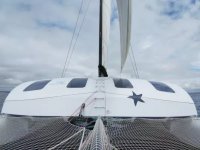
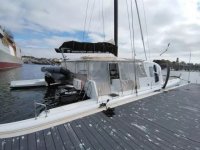
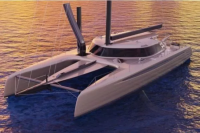
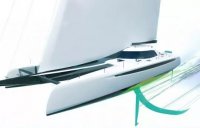
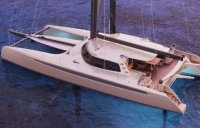
    “Roam” is a Spirited 480 design by Craig Schoinning. This cat is a serious bridge deck performance cruising catamaran that is basically a kit boat for home building or as a starer kit for a professional builder. The Spirited 480 is 48 x 24.8 foot with a “displacement” (read weight) of 18,000 lbs depending on material choice. The payload can be up to 4850 lbs. The 61 foot mast carries 1442 square foot of sail area. The hull length to beam is 14 to 1. The minimum draft is 1.8 foot and has daggerboards that draw over 6 foot. The engine power is 2 x 40hp Lombardini with Sail Drives. Speed under power is 8.5 knots at cruise with peak speed of 10.8 knots.

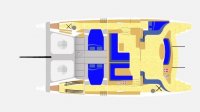
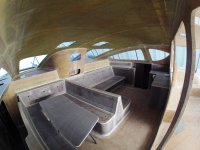
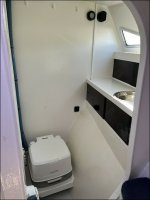
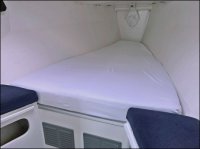
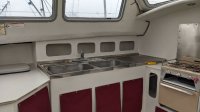
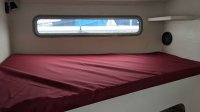
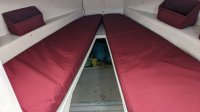
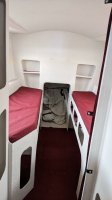
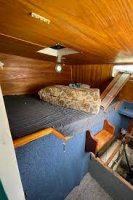
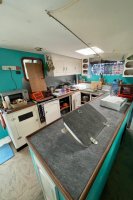
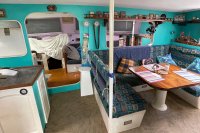
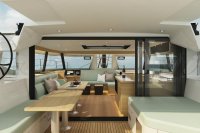
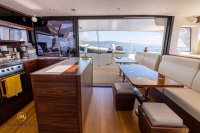
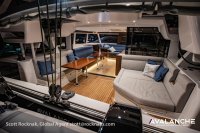
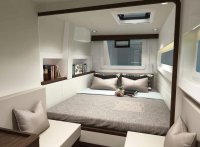
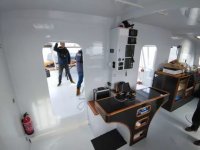
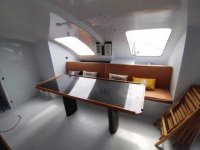
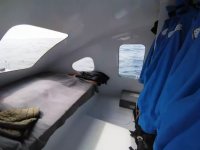
    The Spirited 480 is a serious offshore design with long slim hulls provide easily-driven comfortable performance. The rig size on this design is moderate and is therefore more manageable for the crew. The cockpit is large with large doors and windows to the main cabin creating a flow-through affect. Inside the saloon cabin there is ample space for the galley and saloon seating. The galley is set against the aft bulkhead with generous bench and locker space. Opposite this is the spacious seating area which keeps the galley centrally positioned between the saloon and the cockpit areas. The two forward cabins can be set-up with fore and aft queen sized bunks or athwartships island bunks. The island bunks are popular because they have access steps each side and also a flat section each side of the bed for a book or cup of tea. The options leading forward off these cabins can be either an ensuite, a walk-in-robe or a separate shower. On the standard layout there is a private double cabin aft starboard and opposite a large sized head with separate shower.

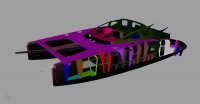
    The build of this design varies according to the owners wants. The kit options include DuFlex Balsa/Foam or Plain Foam with e-glass and vinylester. Carbon is used in bulkhead flanges etc. Some WRC is used in forebeams etc. The kit panels arrive as flat panels and are cut out as required. The hull bottoms arrive as resin infused moulded sections to provide a round bottom cat.

    The interest in this design came from the following web site: the VESSEL — Sail Surf ROAM http://sailsurfroam.com/thevessel

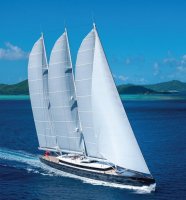
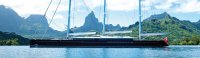
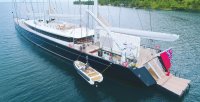
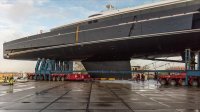
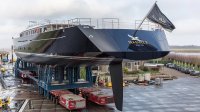
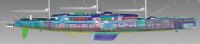
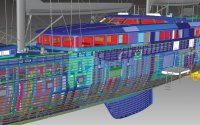
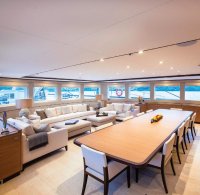
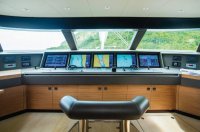
    This cat took 6 years and 7 months to build versus the “estimated” build time of 5000 hours (about 2 years full time), but it is a fully complete build.

    An interesting cat that if you have a spare $500,000 and a few years to build, could be yours. The jpegs tell part of the story.
     

    Attached Files:

    SolGato likes this.
  2. guzzis3
    Joined: Nov 2009
    Posts: 868
    Likes: 163, Points: 43, Legacy Rep: 42
    Location: Brisbane

    guzzis3 Senior Member

    How much sail must those mod70s be carrying ?? Goodness me!

    Cav': Maybe there will be a glut of dirt cheap 60' catamarans for us to buy :D I bid $10k....
     
  3. oldmulti
    Joined: May 2019
    Posts: 3,275
    Likes: 2,378, Points: 113
    Location: australia

    oldmulti Senior Member

    For Guzzi3 the MOD 70 “Phaedo 3” has an air draft of 95 foot with an upwind sail area of 3330 square foot and a downwind sail area of 4400 square foot.

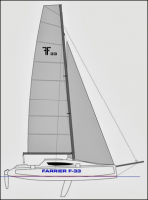
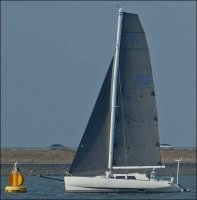
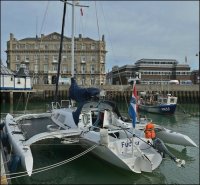
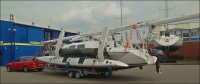
    Back to the boat of the day, a Farrier 33 R. The Farrier 33 R is one of the larger designs Ian Farrier did and is a racer with accommodation. “Fuchur” Farrier F-33 R aft cockpit is based in Holland but was built in Australia by Keals marine under the supervision of Ian Farrier and finalised by Berg Boat in Holland in 2004-2005. A Farrier 33 R is 33 x 23.4 foot and can be folded to 9.5 foot. The weight is 2,900 lbs with a displacement of 5,100 lbs. The 49 foot carbon wing mast with Dyna One HS 8mm + Dyneema cover rigging carries a 463 square foot square top Elvstrøm mainsail, a furling Elvstrøm jib of 225 square foot, a Elvstrøm screecher 450 square foot and a Elvstrøm 828 square foot Code 0. The draft ranges from 1.3 foot to 6 foot over the daggerboard and rudder. The engine is a Yamaha 9.9 High Thrust, 12V start 6.5 knots.

    "Fuchur" is one of over 3000 folding trimarans, built to the designs of Ian Farrier. The F33-R is wider than the F31 and can therefor carry more sail and is light for its weight. Ian refused to design all out racers choosing more conservative structural specifications and had some reasonable accommodation in his designs. The F 33 R is seriously fast across a wind range with averages of 10 knots possible with peaks at over 20 knots. An F 33 R performs very well in light airs especially upwind.

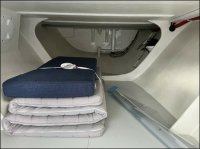
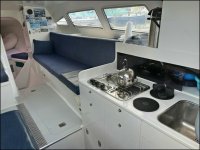
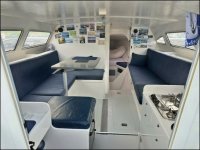
    The accommodation is a double under the cockpit, a galley, dinette and single seat berth in the main saloon with a toilet area forward. There is a single berth toilet area forward in the bow. The layout is practical and would be useful for a month coastal cruising with a couple. Some 30 foot Farriers have crossed oceans but the Farrier trimaran designs were not intended to be regular ocean crossers (exception the F36 and F39 and the Command 10).

    The construction of a F 33 R hulls and deck are glass, carbon and foam in epoxy. Cross beams are glass, carbon and foam in epoxy with crossbeams flanges in carbon fibre and epoxy. Folding struts aluminium. The underwater parts are coated in epoxy. Folks, I have simplified the structure here for 2 reasons, building in “carbon” is not just laying down carbon and painting it with epoxy and letting it dry. You need to know the strength of the carbon used, it fabric thread pattern EG biax or unidirectional, the type of epoxy, the environmental conditions and mixture ratios used and if the epoxy is post cured. As one person said to me, if you are going to use carbon fibre without vacuum bagging or resin infusion you have just wasted your money.

    The F 33 R is a very good design as a fast performance cruiser. I hope the Farrier guys are successful in their discussions with the owner of the Farrier design rights to allow more “home builder plans” to be made available so more people can build and own these fine tris. The jpegs give the idea.
     

    Attached Files:

    guzzis3 likes this.
  4. oldmulti
    Joined: May 2019
    Posts: 3,275
    Likes: 2,378, Points: 113
    Location: australia

    oldmulti Senior Member

    The TCR 45 cruising trimaran was built by Southwest Multihull Construction in Cornwall, UK and designed by Edward Phillips in 1974. The tri is 48 x 30 foot and weighs 14,000 lbs. The 50 foot fixed aluminium speaderless mast carries 1,012 square foot of sail in the cutter rig with a main, self tacking inner jib and outer roller furling genoa. The main hull has a length to beam of 9 to 1. The draft over the skeg rudder and fixed fin keels on the floats is approximately 3 foot. Her diesel is old school, a Norwegian SABB of 18 horsepower that burns 1/3 of a gallon per hour at 5 knots. Peak speed is 7 knots. This engine is heavy but will last 100 years if well maintained.

    The accommodation sleeps 6 in three cabins. 2 in the sterncastle with 2 amidships and 2 in the forward stateroom. The main saloon has a large galley and seating area with an internal helming seat. The toilet is in the aft cabin and the shower is in the bow. The internal fitout is simple, but very practical.

    The structure is all Airex foam core and e-glass unidirectional fiberglass construction probably done in polyester resin. No wood used. The cross beams are box sections with unidirectional glass. The floats are fully foam filled with unidirectional fiberglass skins.

    The performance of the tri is impressive for its design time. This is the “claimed” actual performance data: 11 knots in 11 knots of true wind. 16 knots to windward in 20 knots of true wind. 20 knots off the wind in gale conditions under staysail alone. Canary Islands to Barbados in 19 days. Victoria, BC to Hawaii in 17 days. Cabo San Lucas, Mexico to Victoria, British Columbia in 20 days. This indicates a fast “cruising” boat that sails very well with a limited rig for its size. The rigs size is OK for the tri’s light weight.

    An interesting design that was ahead of its time when built in 1974 (yes, this tri is nearly 50 years old). The jpegs give the idea.
     

    Attached Files:

    SolGato likes this.
  5. oldmulti
    Joined: May 2019
    Posts: 3,275
    Likes: 2,378, Points: 113
    Location: australia

    oldmulti Senior Member

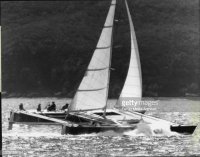
    This will be in 2 parts about the same base boat, “Big Bandicoot”. A group of men were having a chat at a yacht club in 1976 and decided they wanted to have the fastest yacht in the world. In 1977 Geoff Baker had organised Peter Joubert Uni professor part time monohull yacht designer, Warren Anderson spar maker, Peter Antil sail maker with North and Dennis Haywood lead boat builder with several support people to create the boat. Only problem, they did not have enough money to build the design. An Artist was employed to create an image of the cat in full flight which produced enough donations to build the cat. Big Bandicoot was meant to be 70 foot but ended up 55 x 33 foot with an intended weight of 4,500 lbs. The initial 65 foot mast was a “Half ton” monohull mast that was so weak it was replaced by a 70 foot ¾ ton monohull before a sail was even raised on it. The mainsail was one of the first “computer designed” double ply dacron mainsails ever done by North at 1200 square foot with a 300 square foot jib. The first daggerboards were very large and immediately broke on the first speed run. The next set of daggerboards were 25% of the size of the originals. The rudders were large as the cat would need the area to control it.

    OK, you are starting to understand that Peter Joubert as a monohull designer was pushing his understanding of design, he thought in mono terms about foils, bigger sail means bigger foils. What Peter learned was higher speed meant you can have smaller efficient foils. Next the mast section was small but supported by a lot of rigging, the theory being the caps would handle the loads, problem was the diamonds were too small which meant the mast went out of column. All of this was a learning experience. The part that Peter got right was the chine hull shape with a high prismatic coefficient. The hull was good for its time.

    So, in March 1978 the cat was launched and finally tested. In late 1978 the cat was tested over a 500 meter course in Sydney harbour where the cat reached 30 knots (Crossbow at that stage held the record at 32 knots). On the last run the main mast beam collapsed which required a new main beam structure to be developed and built. When the main beam was rebuilt Big Bandicoot was taken to a new location in NSW to do some more speed runs in 1979. It only had 2 issues; they only did a fast clean of hull bottoms of growth on the day of attempt. The second problem was the new bolted main crossbeam was built to low and hit wave tops. The best speed was 27 knots. The people who built the boat ran out of money and time and the cat was sold. What happened next will be the subject of tomorrow story.

    The structure of Big Bandicoot was 6 mm plywood over close set spruce stringers on timber frames. After the hull build a layer of 300 gsm fiberglass cloth was laid inside and outside the ply to “strengthen” the hull. This was a full epoxy build with no metal fastenings. The fore and aft cross beam tubes were mast sections. The main mast beam was a 3 aluminium tube triangular cross section shape with struts between the tubes. These struts and tubes were welded together. On a test run the main beam developed cracks in the welds then the main beam had a stronger bottom tube installed with reinforcing of the welds. This failed on the 1978 speed run. A new bolted beam with gussets of the same concept was installed for the 1979 speed attempt. The rudders were large solid aluminium and not well shaped. The cat had was heavier and ended up being slower.

    Sorry about the limited jpeg. There is a 50 minute film of the build and attempts at:
     

    Attached Files:

    revintage likes this.
  6. oldmulti
    Joined: May 2019
    Posts: 3,275
    Likes: 2,378, Points: 113
    Location: australia

    oldmulti Senior Member

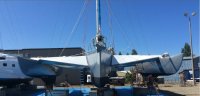
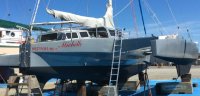
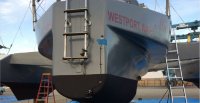
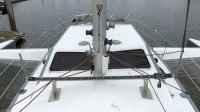
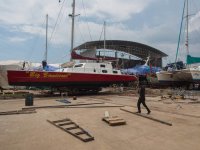
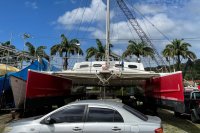
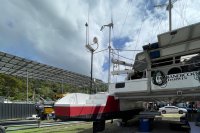
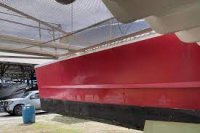
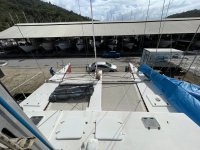
    Part 2 of “Big Bandicoot”. After its failure to become the fastest sailing boat in the world, it was sold to a couple of guys who sailed it for a few years before it was sold to another person who pulled it ashore beside his house to modify it with a bridge deck cabin. Big Bandicoot beam was reduced to 29.5 foot so the cat was now 55 x 29.5 foot. The weight would have increased to at least 11,000 lbs. No mention of the new rig dimensions but the mast would have been replaced by a stronger and probably shorter mast. The sails would probably have been strong enough but cut down in size. The daggerboards were replaced by fixed low aspect ratio keels. There were 2 diesels inboards installed.

    The cat was then sailed from Australia to Malaysia. The next owner then refitted Big Bandicoot and sailed from Malaysia to the Caribbean via Turkey. She was extended from 55 to 60 foot by an extension to the stern and currently sits in the Caribbean.

    The accommodation is 2 double berth cabins forward with toilets, a full width seating cabin then a saloon cabin with seating and galley. There are additional berths in the hulls.

    The boat had the main crossbeam replaced by plywood bulkheads with some of the aluminium from the old main cross beams used to reinforce the beams. The underwing and cabin structure again appears to be plywood. But another change is of interest, the plywood bottom from the water line down is kledgecell foam epoxy sheathed covered with Kevlar and 600 gsm e-glass. The bottom of the fin keels is covered with 3 layers of Kevlar and 4 layers of 600 gsm e-glass. I cannot comment on performance beyond it is seaworthy and has crossed oceans even though it had “lightweight” racing hull structures.

    The jpegs will give the idea of the cats interesting history, that shows you can build in 6 mm plywood if you have a good framing structure that is well built. This cat is over 40 years old and still floating but the advertisement says “The vessel does need some work and this is reflected in the low asking price”.
     

    Attached Files:

  7. oldmulti
    Joined: May 2019
    Posts: 3,275
    Likes: 2,378, Points: 113
    Location: australia

    oldmulti Senior Member

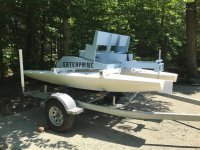
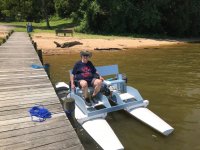
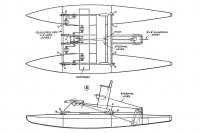
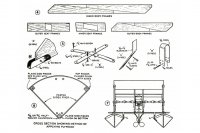
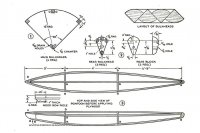
    From a 1948 Popular science magazine, a simple peddle cat for lakes. This cat can be powered by a peddles or a low powered outboard (eg 2 HP). The cat is 8 x 5 foot cat that weighs 230 lbs and support about 300 lbs. The original design was peddle powered but can have a small electric or low HP powered outboard.

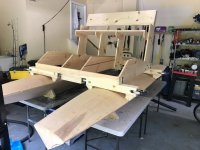
    The plans below will give most of the detail but the hull skins can be 0.020-inch or 0.032-inch aluminium or 3 mm plywood. The framing is mainly 25 x 25 mm framing. A hit to get the curves into the plywood the suggestion was to borrow your wife’s electric iron. Pass the heated iron over the plywood a few times. The heat will make it easier to form a sharp curve. The main bulkheads are 25 x 300 mm white pine. The crossbeams are 4.4 foot long 32 mm outside diameter steel pipes. The peddling gear and propeller shaft is left up to you to connect to the 10 x 14 inch propeller.

    A little fun for exercise or the kids. The jpegs will give the idea. Have fun.
     

    Attached Files:

  8. patzefran
    Joined: Feb 2011
    Posts: 393
    Likes: 69, Points: 28, Legacy Rep: 10
    Location: france

    patzefran patzefran

    Thanks, Old Multi, interesting . Looks that the builder mounted the outriggers on the wrong direction !
    He also omitted the stem and stern shaping pieces.
     
  9. oldmulti
    Joined: May 2019
    Posts: 3,275
    Likes: 2,378, Points: 113
    Location: australia

    oldmulti Senior Member

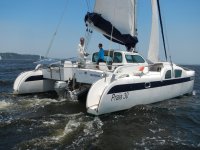
    This is how a basic open bridge deck cat morphs over time into a full bridge deck cabin cruiser. The Praia started out as a 30.2 x 18.3 foot open bridge deck cat with a weight of 3400 lbs. The fixed aluminium mast 7/8 rig carries a 435 square foot mainsail, a 333 square foot genoa and a 630 square foot Code 0. The draft is 2.3 foot over the fixed low aspect ratio keel. The engine was a 10 to 15 HP outboard engine.

    The standard cat could move at 12 knots in 18 knots of wind. In short, a solid cruiser that could sail well.

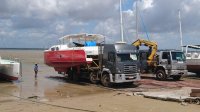
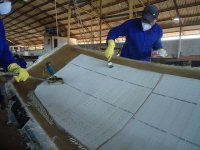
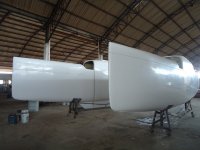
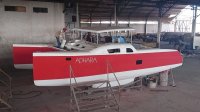
    Next came a guy who wanted to change careers and decided to become a charter boat owner/operator. He went to Praia and wanted a slightly longer cat for charter work. He helped build the boat as the company was heading for bankruptcy. Result the Praia 34. The Praia 30 had the hulls extended to 34 foot to increase displacement and a solid hard top was built over the open cockpit area. The hard top had roll down vinyl side curtains for rainy days etc. Also 2 sterndrive Yanmar engines were installed instead of a central outboard. It also has new entrances and higher headroom on the hulls, extended stern, larger and open center cabin, double berths on the stern.

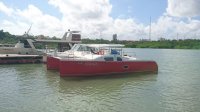
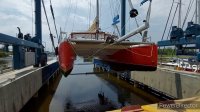
    ADHARA (the 34 foot charter cat) has proven to be a success commercially and can sail reasonably well on all points of sail. This inspired some others to ask the boat production company to do a “cruising” version of the Praia. The Praia 34 cruiser was born. This is a full bridge deck cabin 34 foot catamaran with the same beam as the 30 foot version but an increased weight and displacement.

    The accommodation has 2 bouble berths aft, a main saloon that can contain the galley and seating/table. The cockpit is large for a cat of this size.

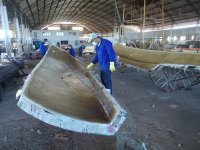
    Construction is foam glass for above the hulls. The hulls appear to be e-glass with a coremat core.

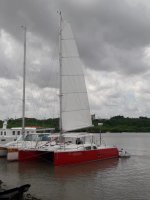
    An interesting development. The first jpeg is the 30 foot, then ADHARA build and cat and finally the cruising 34 footer
     

    Attached Files:

  10. oldmulti
    Joined: May 2019
    Posts: 3,275
    Likes: 2,378, Points: 113
    Location: australia

    oldmulti Senior Member

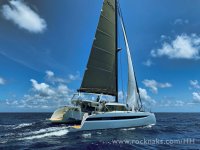
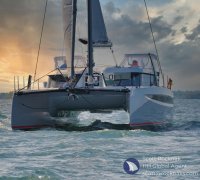
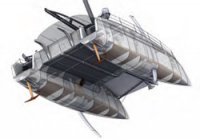
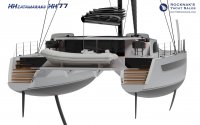
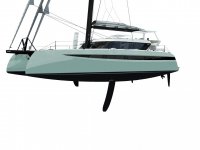
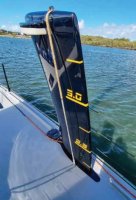
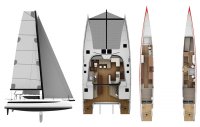
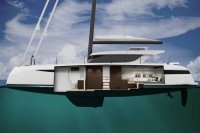
    The HH performance cruiser brand was launched in China during 2012 by Hudson Yachts. HH Catamarans uses Morrelli and Melvin for the design of the HH 50 cat which is 51.8 x 24.4 foot with a weight of 25,700 lbs and a displacement of 35,800 lbs. The 74 foot fixed, tapered, deck-stepped Marstrom carbon spar with a Selden alloy boom held up by Future Fibres ECthree carbon stays carries a 890 square foot mainsail, 406 square foot self tacking jib, 630 square foot genoa and a 1455 square foot code 0/Screecher. There are loadcells to manage the rigging stresses with information feed to the helming positions. The draft can be 5 foot for the fixed keel version or 10.5 foot for the curved carbon daggerboards built into the outer side of the hull to maximise interior space and are operated from the helms by an electric winch and line. The underwing clearance is 3 foot. The engines are 2 x Beta 45hp turbo-charged with ST60 saildrive legs, folding Flexofold propellers. There are drop-down bow thrusters to exit marinas without dramas.

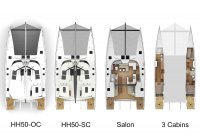
    There are 2 versions of the HH 50. The HH50-OC is a fast, comfortable, family friendly cruiser that skews toward ease of operation for bluewater cruising. It features a carbon reinforced e-glass hull with mini-keels, a single helm station for single-handing and the same interior fit-and-finish as the sportier HH50-SC. The HH50-SC integrates the very latest in race boat technology but remains equally comfortable and family friendly. This is a “no-compromise boat” with full carbon construction, dual helms, C-shaped carbon daggerboards and stunning performance for its size.

    The accommodation has 3 double berth cabins with attached ensuites in the hulls. The main saloon has a large galley, internal helming position, seating/table with a large interconnecting doorway to the external cockpit to form a larger socialisation area. The external helming sail handling positions are on a raised platform in the cockpit. All electric winches are provided to allow this cat to be sailed by a couple.

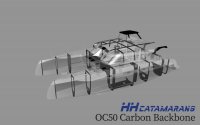
    The underlying bulkhead and crossbeam structure is all carbon foam but the hulls and decks can be either E-glass foam or if the SC version is chosen all carbon fibre foam. In the SC version under the hull floor hatches allows you to see the extensive structure of the hulls, which have wide longitudinal carbon stringers and ribs for stiffness. The carbon fibre hull is pre-impregnated with epoxy over a composite foam sandwich construction that is post-cured in an oven for maximum strength. Cross beams, longeron and a-frame/martingale are all pre-preg carbon, including the longitudinals and ring-frames in each hull, with watertight bulkheads at the bows and in the forward compartments. The deck is cored with Divinycell for insulation. The rudders, rudder shafts and C section boards are all carbon.

    One test showed the following performance: “The sailing numbers showed 8.5 knots SOG hard on the wind at 34 degrees apparent wind in a fading 12.2 knot breeze. Impressive with the self-tacking jib, given the conditions. In the now light breeze of 9.9 knots of true wind, the HH’s mettle was again tested. And it kept on delivering, making an impressive 8.0 knots of boat speed at about 131 degrees – very near its polar chart figures.” This cat is fast a near wind speed cat in moderate conditions and capable of 10 -12 knot averages with peaks close to 25 knots.

    An impressive cat for those who can afford it.
     

    Attached Files:

  11. oldmulti
    Joined: May 2019
    Posts: 3,275
    Likes: 2,378, Points: 113
    Location: australia

    oldmulti Senior Member

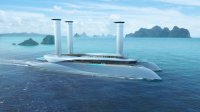
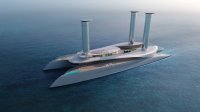
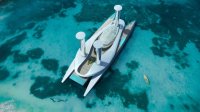
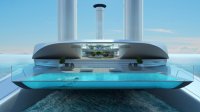
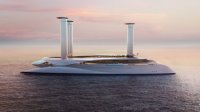
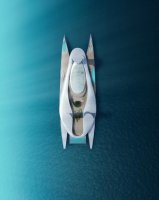
    FY.01 is a Flettner Rotor powered catamaran superyacht designed by the 3deluxe Ocean. The concept cruising catamaran is 328 x 65 foot with an unknown displacement. The rig is three 131 foot high NFC Natural Fiber Composite Flettner Rotors. The 3 rotors are predicted to provide as much sail forces as a full size rig conventional rig. Flettner Rotors use rotating vertical pipes to transform wind energy into a highly efficient transversal force. Very much like a topspin in tennis or a curveball in baseball change direction due to their rotation. Responsible for this effect is the Magnus force. The Flettner Rotors are powered by small electric motors to spin them to create the Magnus effect. The electric motors are powered by the solar array and battery banks. Engine power for the cat is electric hybrid drives installed in the catamaran. The capacity of the high efficiency batteries will also provide the needed energy over a longer period of time.

    The accommodation is vast. The owner has an entire deck. Anyone else has house size bedrooms, saloons for privacy, chef quality galleys etc. There are vertical greenhouse modules integrated into the uppermost deck and provide fresh food for the adjacent open show kitchen. The navigation, helming and Flettner Rotor computer controls allow the skipper to control the ship from several points. The open decks, which might have a free-floating infinity pool spanned between the hulls via a central protected atrium area midships, or the dramatic bow tips that offer a fire-pit lounge and a shallow, salt-water pool, provide attractive spaces in the forward section. The comment by Björn Asmussen, 3deluxe Ocean Director says a lot. “The focus is on sustainability and innovation by the future owner but also for an industry on the forefront changing the mindset towards a sustainable hedonistic future”. Hedonistic future for a very few, this is a several hundred million dollar boat which will require a permanent crew of at least 15 people to “satisfy” the owner.

    There is no indication of the build materials etc but tomorrow I will speak about some interesting comments from builders of 200 foot plus boats about the build materials, life is not all about carbon fibre and epoxy.

    The jpegs give the idea. We are going to all learn something if this cat actually goes sailing.
     

    Attached Files:

  12. oldmulti
    Joined: May 2019
    Posts: 3,275
    Likes: 2,378, Points: 113
    Location: australia

    oldmulti Senior Member

    You don’t need to know how much this boat is worth, its value to us is teaching us about the outer limits of structural design. Sea Eagle 11 is a serious cruising monohull designed Dykstra Naval Architects + Mark Whiteley Design and built by Royal Huisman. It has circumnavigated and done 45,000 miles since its launch in 2020. The monohull is 266 x 40 foot (yes you read it correctly) with a displacement that was kept down to 1,050 tonnes at full load. The 3 x 185 foot carbon fibre masts with carbon rigging, in a schooner rig, that can carry 27,700 square foot upwind and 38,233 square foot down wind. To manage this canvas, 34 winches can all be pushbutton controlled from the helm stations. The blade jib and Yankee’s require much higher sheet loads to maintain leech tension. The sheet loads are still predicted to reach 18 tonnes – but this still allows standard-size captive winches to be used, rather than larger custom-made units. The draft is 20 foot. Sea Eagle has 2 x 1450 HP engines with 2 x 160 HP generators.

    To address the issue of performance I will quote: “In a good breeze, beam reaching, with reefed sails, Sea Eagle II does 20 knots comfortably without pushing it,” designer Erik Wassen reports. And from the commissioning skipper “We comfortably recorded 22 knots in moderate wind conditions. In fact, at 16-18 knots boat speed, I found myself regularly checking the B&G speed displays for confirmation because the motion is so relaxed. Sailing fast with just a gentle heel [typically max 10-15°], she feels very safe.” The theoretical hull speed 22 knots.

    Next accommodation. The main accommodation is for 12 guests, while forward of the foremast is a separate low profile entrance for the 14 crew to reach their quarters. The stowage space for toys is formidable, complete with cranes to launch all with minimal fuss. All I can say is the space is vast in each area with deck space to match.

    Now we get to the aluminium hull construction. The owner wanted a fast light build for his cruising. Royal Huisman did extensive FEA analysis on supercomputers of the structure and reduced the hull structural weight by 11%. Also, the design team Royal Huisman found a construction challenge lay with how to mount such a long, rigid deckhouse structure, which comprises so much laminated glass (windows), onto a more flexible aluminium hull. “When we were doing the FEM [finite element method] analysis, we noticed that the glass mullions would be picking up a lot of the load,” Wassen explains: “the deck is participating in the overall structure and a boat with this beam will deflect and bend in waves.” As glass won’t flex, the build team needed to include some tolerance between the roof and mullions. Aerospace specialists developed an adhesive specially for this project, using it to bond the forward section of the deckhouse to create 2cm of flex. A steel rudder would have weighed 6600 lbs so Royal Huisman’s sister company Rondal, produced the biggest ever carbon rudder, weighing only 2800 lbs, which helps to keep weight out of the ends of the boat

    Royal Huisman are in the planning stages of bigger builds and are finding they may have to build in steel as aluminum is not strong enough for 100 meter (320 foot) plus builds. Quote “We looked at 100 meter as the ultimate size. Above that you might need to go to steel, as aluminum is not strong enough.”

    Are who thought that aluminum would not be strong enough for a large mono. Don’t tell the large passenger ferry builders, they may get worried. The jpegs give the idea.
     

    Attached Files:

  13. oldmulti
    Joined: May 2019
    Posts: 3,275
    Likes: 2,378, Points: 113
    Location: australia

    oldmulti Senior Member

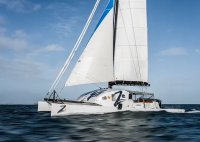
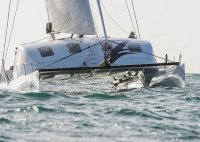
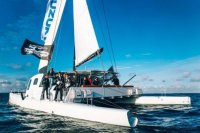
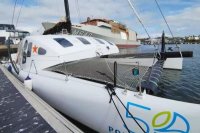
    Back to some form of reality. Michel Desjoyeaux (winner of 2 Golden Globe races) needed a utility boat for America’s cup racing, charter work etc. He decided to use some left over parts he had found to create a catamaran. The “Mer Agitée” catamaran is 60 x 29.5 foot with a displacement of 17,920 lbs. The 75 foot carbon fibre mast carries 1,775 square foot of sail. The hull/rudder draft is 3 foot. The total draft is unknown but the cat has C foil daggerboards and high aspect rudders. The cat is powered by 2 Suzuki DF300AP XX outboard engines of 300 horsepower, mounted on liftable cradles. (Fortunate Suzuki partially sponsored this cat.)

    Michel Desjoyeaux likes performance and under power this cat peaks at 28 knots but it is generally cruises at around 20 knots. At 15 knots, it consumes 3.9 liters per mile. But the cat is more a sailing cat that with moderate wind speeds, sails at almost wind speed and to quote Michel Desjoyeaux "We're between 15 and 20 knots fast. We've peaked at 26 knots."

    So, what were the spare parts that created this cat? Made of composites, the hulls are from the floats from Gitana 10, the mast is Foncia 2010, the beams are a failed Volvo mast, the rudders are also from Foncia. The winches and sheets are also salvaged, and the sails are from Macif." Each of these boats were fast, and any add ons like the bridge deck cabin, were done in light weight foam glass.

    The accommodation is basic with a large main cabin and cockpit and 2 small forward sleeping cabins forward on the bridgedeck. The toilets are in the hulls. The cat is licensed to carry 32 people inshore and 12 people offshore in charter mode.

    The cat was relatively cheap to build and fulfills Michel Desjoyeaux desire to sustainably reuse as much as possible in yachting. With components from some very high performance boats he has achieved his goal. But he also has a final comment "It's a very ugly boat, but it looks very smart!".

    The jpegs give the idea of a fast cheaper cat.
     

    Attached Files:

    Last edited: Jul 3, 2023
    ALL AT SEA, Russell Brown and SolGato like this.
  14. oldmulti
    Joined: May 2019
    Posts: 3,275
    Likes: 2,378, Points: 113
    Location: australia

    oldmulti Senior Member

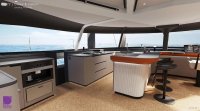
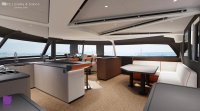
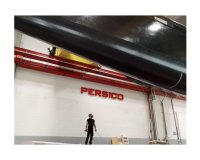
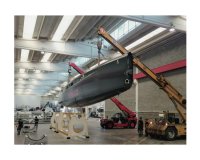
    This cat is being built, this is not a concept. Why do I emphasis this? Because this is a high performance full bridgedeck cruising catamaran that is designed to sail at 40 knots in the right conditions. The Persico Cat 72 is 72 x 31 foot with an overall weight of 45,000 lbs. The sail area and mast height is unknown but a custom designed carbon fibre wing mast and boom was done by Southern Spars. The draft is variable with a set of 23 foot long out facing C foils with automatic rake control, a set of deep daggerboards and a set of T foil rudders. The power for the cat will be Hybrid with a bank of batteries, 2 KW of solar cells and two 25-kW Torqeedo Deep Blue electric motors. A cruising speed of 8 knots is expected under power.

    So why the forty knot speed? Start with the design team Morrelli and Melvin and the build group Persico Marine, both have designed and built high performance designs including America’s Cup cats and mono foilers. Next the Persico Cat 72 is designed to foil from the start. If the design does as intended, its entire hull structure will fly 200 mm above the water depending on the foils for flight control. For the development of the flight system, the owner and designers turned to the same simulation software that was used to design the AC winning AC50 and AC75 by Team NZ. This is the VPP Gomboc optimization software, which acts as a flight controller. Finally, the build structure is very advanced.

    So what sort of performance is expected? The RMFoil becomes effective in as little as 9 knots of wind. Speeds in excess of 20 knots in 13 knots of wind and forecasts of speeds up to 40 knots downwind and 26 knots upwind. For safety and reliability, the fully autonomous foil control system is capable of progressively lowering the hulls and decreasing the speed to the owner's preference, with comfort similar to that expected on a cruising cat.

    The accommodation is not specified but looks like the standard double cabins in the hulls and large saloon with galley and seating. Helming can be done from various positions. Manoeuvring is done from one of the two steering wheel stations located in the large aft cockpit. In addition, all navigation and flight controls can be handled by a small crew of 3 from the helm station. The vessel is also equipped with an inside wheel with flight and mainsail controls to ensure maximum protection and safety at high speeds.

    The cat is built in a sandwich of carbon fiber epoxy prepreg with a Nomex core vacuum bagged and cooked. Carbon was also chosen for the interior, which was designed to be light. This is a quality build using components built in France, Italy and NZ by companies that have a background in AC racing cats. The owner wants one of the fastest real cruising cats in the world and is prepared to pay for it.

    The jpegs give the idea. The last 2 jpegs are of the carbon fibre hulls with final assembly expected in 2024.
     

    Attached Files:

  15. oldmulti
    Joined: May 2019
    Posts: 3,275
    Likes: 2,378, Points: 113
    Location: australia

    oldmulti Senior Member

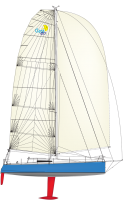
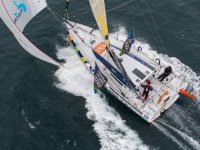
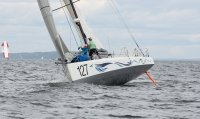
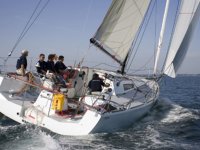
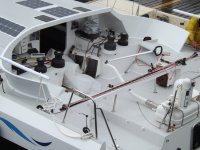
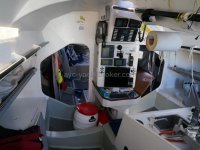
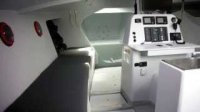
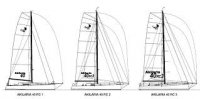
    Back to monohulls to get perspective of multihulls. The inaugural Globe 40 race, is a testing circumnavigation for double-handed Class 40 teams via the three ‘Great Capes’, with diversions into the tropics to Mauritius and Tahiti, sailing 34,000 miles over 8 legs. This is a double handed event for Class 40 boats. The winning boat was designed by Marc Lombard and built in 2007 by MC-Tec shipyard. An Akilaria is a monohull with a fixed fin keel with a bulb and has dual rudders. The boat is 39.96 x 14.73 foot with a displacement of 10,251 lbs and has 3,748 lbs ballast. The boat also has water ballast of 1650 lbs. The draft i9.84 foot. The fixed carbon fibre mast carries 1,237 square foot of sail area upwind. Down wind they can carry spinnakers up to 2052 square foot.

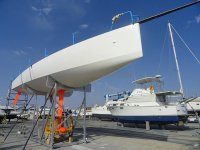
    The hull shape of these monohulls is pure wedge shape with the sterns 93% of the maximum beam and they have very full (but not scow) bows of 26.5% half angle compared to normal monos that have less than 20 degrees half angle. The mast is quite far aft. The Class 40 rule dictates the maximum upwind sail area, mast height and prodder length, but does not limit downwind sail area. So, it pays to have as big a foretriangle as possible so your spinnakers can be bigger. The Akilaria's asymmetrical chute is 2,052 square feet.

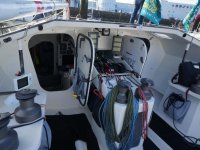
    The accommodation of the race version is focused on sailing efficiency not luxury. There is a cruise version. The cockpit is designed for tiller steering and all winches, sheets etc are in or lead to the cockpit. By the way there have been 3 versions over the years of the same base design that have performance improvements, EG with larger fat head mainsails etc.

    Now we get to the main point of this write up. The performance of the winner of the race is very good. The winning boat a 2007 Akilaria RC1 build did 34000 miles in 176 sailing days or an 8.1 knot average double handed. About 193 miles/day. Not to impressive but then you go deeper into the numbers. Whiskey Jack, a 2013 Akilaria RC3 design, maximum boat speed was 28 knots. In leg 7, from Recife to Grenada, she set the overall 24 hour race record, covering 346.7 miles at an average of 14.48 knots. This was with two reefs in the main, and both the A5 and J2 set. In the final few days before the finish, she notched up a 318-mile 24-hour run, setting the fleet record for that leg. Whiskey Jack’s maximum speed of 28 knots was set in a 45 minute squall with gusts of 40 knots. The female skipper hand-steered through this, using instincts gained from her background as a dinghy racer.

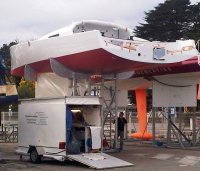
    So how hard were the race fleet pushing? A measure of how hard the winning 2007 Akilaria RC1 pushed is that downwind in breezy conditions the winning skipper reckons a broach “happened at least every hour and sometimes every few minutes.” They only felt the need to hold back on a couple of occasions. The first was on leg 3, upwind in 48 knots south of Australia, with very steep, pointy waves. “We dropped the main and continued with the J2 jib, 55° off the true wind.”

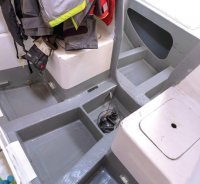
    Why were they so confident to push the winning Class 40 boat. Because they sailed 20,000 miles in training and found any weaknesses in their boat. Akilaria RC1 build is low-tech with a balsa core and laid-up with the infusion method. The deck is PVC foam cored with hardwood inserts in high-load areas. Vinylester resin is used throughout. The keel fin is steel. Again, in keeping with the "no exotic materials" part of the rule, the rudders have solid stainless steel stocks. But in the 20,000 miles of testing the owner noticed flexing in the forward part of boat. He lifted the boat out and on shore wound the backstay tight, the bow lifted. This led to non-destructive testing (NDT) of the hull structure, which confirmed a problem with longitudinal stiffening. The existing 25mm-wide stiffeners forward of the keel were therefore replaced with an 80mm grid, massively increasing strength, while adding only 15-20kg of weight. The result was with a few other modifications the boat could go upwind 10% faster due to the stiffer hull and more rigid forestay.

    Half the Globe 40 fleet were Akilaria RC mono’s that could seriously go fast in the right conditions. I starting to understand why some mono guys don’t think they need to go to multis. The jpegs give the idea.
     

    Attached Files:

    ALL AT SEA likes this.

  • Loading...
    Forum posts represent the experience, opinion, and view of individual users. Boat Design Net does not necessarily endorse nor share the view of each individual post.
    When making potentially dangerous or financial decisions, always employ and consult appropriate professionals. Your circumstances or experience may be different.