In search of the prefect Proa

i should admit to preferring meranti ply these days.

 
The Lindsay Lord method is pretty interesting, though for a cruising vessel I am always worried about wooden cored materials sandwiched between fiberglass. The polymer skin is going to allow some water penetration even if it doesn't get punctured, and even if it gets pinhole sized holes it it, hydrostatic pressure between the inner-fiberglass and outer-fiberglass is going to pump the *%^# out of it, until it is well soaked and macerated and delaminating. Its probably well and good for an amas or above water work though (:

Cheap, strong, and lightweight. All things I like. The cost of structural foam really is out-of-hand though, there isn't much more uninspiring than holding a cube of foam in your hand and then finding out how much that 2-8/lb piece of crap weighs. I suppose Cheap, strong, and lightweight... pick any two.
 
My wood resource lists white pine at 24lbs/cu-ft. and cyprus at 28lbs/cu-ft. Both species are listed as not strong but durable with the cyprus having the edge in rot resistance. However, cyprus can have hard and soft streaks because of the difference between summer and winter wood so if you can't pick through it maybe pine is the best choice. Is it much less expensive where you are? In my part of the woods I usually use red cedar, Douglas Fir and Sitka Spruce depending on the job. Wherever you are local woods are the way to go.

Thank you! I'll definitely get some cyprus and dry it out and weight it. I could live with 28. Right now, the cyprus and white pine is about the same price. All the others you mentioned are considerably higher. I did a kayak in cedar... but they just look at me like I'm in the wrong store if I ask for fir. I've used douglas fir in the past and its all so knot free and uniform. Fortunately, the Lindsay Lord scantling is really tolerant of wood quality.

From "Elements of Boat Strength" by Dave Gerr ... Its core is strip-planked of softwood (eg, pine, cedar or fir). This core serves as just that - a true core - so it can be of quite low-grade lumber. It is simply lightly tacked together as strip-planking (well glued with epoxy grout) over temporary molds...
 
I too, am looking to make this with minimal expense. Although I am in disagreement with many on this forum, I don't include the cost of my labor. I happen to consider my time on this as enjoyable and part of the hobby. If I hated wood working (or this design work for that matter) I guess, I would consider it part of the cost. At which point... this would be a very expensive boat!

But, as I see, we are in similar shoes... you might want to consider the Lindsay Lord strip plank technique as described by Dave Gerr. It proports to make an extremely light and inexpensive hull.

I am not sure if anyone has ever done it for a "large" craft (we are talking 50-80 feet catamaran, tri, pro-a) But if properly engineered you may even be able to build an airolite structure, with Dacron coated in xynole or kevlar or something similar.

What I have had in my mind would be a frame like page 295 in Gerr, in alternative construction in aluminum. Constructed of your material of choice, wood, foam, aluminum, etc. And wrap it in a layer of dakron or similar material (heat shrink-ability is a nice feature) and then laminate the inside and outside with something stronger (but flexible, as the LL strip plank core method)

If properly engineered something like that, esp a cored "webbed-lattice" of say foam or light wood and sheathed in fiberglass could be quite rigid, and even act as a "ripstop" type material in the even of a catastrophic puncture.

Alternatively, a web structure and a material like GLARE, would be brilliant, but I haven't quite (but am working on it) figured out how to do that without serious industrial equipment (presses and molds and such)
 
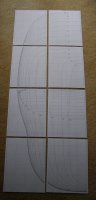
Baby's first steps...

Printed out Lee Hull Stations
 

Attachments

  • P7020002.JPG
    P7020002.JPG
    391.5 KB · Views: 469
I'm sort of leaning towards Cold-Molded, or biting the bullet for foam-cored.

I may adopt something hybrid or experimental though after I do some serious engineering/homework.

I am pretty fearless about trying (and succeeding) on non standard engineering approaches. But, yeah, that is sort of what I do...
 
Tried and tested works too...
 
Tried and tested works too...

But less adventurous.

The easiest and cheapest route would just be to buy a well maintained used boat.

However, if you are an engineer, designer, architect, inventor, tinkerer, or scientist the fabrication and experimentation, is half of it.
 
However, if you are an engineer, designer, architect, inventor, tinkerer, or scientist the fabrication and experimentation, is half of it.
...

Amen
 
The best method is called the blender method.... it looks at al that has gone before - adds what is new , compromises what is yours or new and or crazy and comes out with a result that may work - way out and experimental are interesting and wonderfull if they work and forgotten if they dont.
People have been building boats for a really long time...... you are not the only genius?
Or maybe experience is uncalled for and others are stupid and you are clever.... balance and moderation are not always a waste of time.
There is a reason why people make living from this and most people buy plans...... there's more to it than meets the eye?
Dont discard what has gone before bacause it is boring or doesn't suit you - it has been hard learnt and we learn from it.

It is all about incremental advances (if they can be called advances). Wood has a higher strength to weight ration than most composite or metal construction. It also can rot if not taken care of. Polyester and Gel coats can suck up water, and foams can melt at temperature and outgas (this is why your boat shouldn't be painted black). Aluminum is stiffer than steel, and doesn't rust. It also costs more, and is harder to weld and doesn't have the same load bearing capacity.

Wing sails are great, some wing sails are better than other wing sails. Usntayed masts were all the rage (maybe they still are??) but its hard to beat a Stayed bermuda rig, or gaff rig, or lateen, or even a crab claw.

Here we are in a pro-a thread and being chided into not innovating too far....

A few years before the idea of a multihull itself was madness, pro-a's even more so. Yet the Polynesians were transnavigating the ocean before caravels and sloops ever left the shores.

Sure, stand on the shoulders of giants. They were as clever or cleverer than you or I will ever be. But also, don't be afraid to look, forward or backward, or sidewards for that matter. Physics is more fundamental than the history of engineering, and interesting solutions to everyday problems arise seemingly at random or inspiration out of nowhere.
 
I don't have a dog in this fight...

... but this is clearly wrong!

... Aluminum is stiffer than steel...

Now back to the regularly scheduled show...
 
Fact: for a given weight.... aluminum is stiffer than steel (due to cross-sectional area)

::edited caveat::
As with almost anything, there are exceptions. But the rule of thumb is, if you build 2 things to the same Strength/Stiffness Aluminum will win in weight. You can engineer steel in some cases to be better though, tooling is the obvious one, where aluminum just doens't have it. Or in highly directional beams/tubes strictly in compression/tension. Or say, steel wire.

I apologize for not being clear, I thought what I meant was obvious.
 
Fact: for a given weight.... aluminum is stiffer than steel (due to cross-sectional area)

Ahh! Ok...

In tension/compression... the specific stiffness is within a knats *** of each other. In bending, Aluminum definitely has a better specific bending stiffness.

I should be more understanding for I'm a composites kind of guy... and I'm always fighting the same fight... for the peoples that think carbon is the be-all... end-all.

Sorry, it kind of jumped out at me!
 
Forum posts represent the experience, opinion, and view of individual users. Boat Design Net does not necessarily endorse nor share the view of each individual post.
When making any potentially dangerous or financial decision, always employ and consult appropriate professionals. Your circumstances or experience may be different.

  • Back
    Top