--
Probably the most significant feature of the Fire Arrow is that it uses two completely independent altitude control systems for the first time on any trimaran:
1) UptiP or Welbourn-type ama foils(also a first for any size trimaran*) that control the height of the ama above the water,
*used on this boat way before they were used on any other tri.
2) Wand controlled mainfoil on the daggerboard-controls main hull height above the water which, in turn, sets the angle of heel for the whole boat.The mainfoil also allows the main hull to fly in very light air.(5mph)
But it's the interrelationship between the main and rudder T-foil with the ama foil* that makes the system so significant. The rudder T-foil is a trailing foil and "follows" the main foil. Altitude and angle of heel for the whole boat are set by adjusting the wand length. The angle of heel can be set between 10 degrees and 17 degrees. The boat is extremely stable in pitch because of the bi-foil arrangement on the main hull-the daggerboard foil and rudder foil always work together to control pitch when the boat is foiling. But they also control the ride angle and pitch of the ama foil* which can't pitch on its own-in other words the ama foil can't all of a sudden "go negative" and cause a pitch pole.
* either Welbourn-type ama foil or uptip ama foil
==========================
3) A major advantage of the wand controlled mainfoil is the ability of the wand to cause the foil to create downforce which can add significantly to the righting moment of the boat. It is an automatic response to the boat heeling even a slight amount: the wand will cause the flap to go up as much as is necessary to restore the main hull to its designed flight altitude. That can add a large amount of righting moment to the boat.(40-60% of boat weight or a bit more). Downforce will have just as significant a role on the 14' Fire Arrow Variation using the Welbourn-type foils as it has on the Test Model. The gust response feature of the wand controlled main foil will work exactly the same way on the smaller boat creating nearly instantaneous additional RM as required.The creation of downforce by the main foil flap also results in lift to weather that will help with upwind performance if the boat is sailed with constant down force.(see sketch below)
The use of foil downforce has been well proven on the Trifoiler ,Rave, Skat, Osprey, S9 and Whisper. And the drag caused by doing this is not as much a disadvantage as the extra RM is an advantage.
=======================
4) Two Stage ama(see pix below) : the ama hull is attached to a "curved piece" that adds to the ama buoyancy in knockdown conditions. This "two-stage" design allows for a small planing hull with relatively low drag during incidental contact with the water but provides tremendous buoyancy during a knockdown-enough; combined with the high dihedral crossarm structure, to prevent a capsize in most conditions.The Fire Arrow Variation will use a Two-Stage Ama as well-but with some differences including a relatively longer and narrower hull.
--
5) Oversquare platform: the boat is 1.22 times as wide as it is long. A "normal" tri with that much beam would need at least 15mph of wind to be able to fly the main hull. But because of the wand controlled main foil, this boat will fly the main hull in as little as 5 mph of wind which opens up the effective wind range for the foiling system-way beyond most multihull foilers. For the Fire Arrow Variation one of the advantages is that an oversquare beam is not necessary to achieve high RM since the Welbourn-type foils provide lift equal to more than the weight of the boat substantially to outboard of the lee ama. This in turn, provides tremendous Righting Moment for a relatively narrow platform.
--
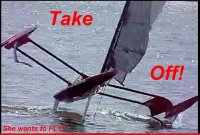
6) Light Air Foiling: from a marketing perspective selling a foiler that only starts to foil in 10-15mph of wind is a mistake but that has been true of many multihull foilers. More and more boats are targeting starting to foil in lighter winds: The Whisper foiling cat and Quant 23 are examples of foilers whose designer/builder has made the commitment to start flying in light air. The Fire Arrow test model was designed to begin to foil in a 5mph wind 5 years ago and reached that design goal on July 24, 2014. The full size version will take off in about the same wind speed.
The Fire Arrow Variation will have the same design goal to take off in very light air as does the larger 19.5' version and as demonstrated by the Test Model.
=====================