Free Anchor Design

Delancey

Junior Member
Joined
Dec 5, 2013
Posts
8
Reaction score
0
Location
NYC
Hello Everyone,

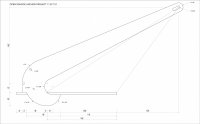
I thought it would be fun to design an anchor and have started an Open Source Anchor Project and invite those interested to participate. The general concept is to develop and distribute a free anchor design that can be made anywhere in the world using commonly available materials and methods. To date I have developed a very robust mechanical connection between the shank and the fluke that opens up the possibility of interchangeable flukes of different styles for different bottom conditions.

I started a thread for it on Cruiser's Forum which you can find easily by searching. Unfortunately, in spite of my best efforts the project has so far failed to attract the talent or participation I had hoped which surprises me because I think it's a worthwhile project. It could be that I am a bad project leader or it could just be that most people on Cruiser's Forum aren't that creative.

I couldn't say either way, but what I can say is that anchor design is really fun. I hope forum members here will think as well and that this site will make for a better home for the project since the focus here is on design.

Cheers!
 

Attachments

  • OSA112713.1.jpg
    OSA112713.1.jpg
    157.1 KB · Views: 1,739
  • OSA1128-1.1.JPG
    OSA1128-1.1.JPG
    164.6 KB · Views: 979
  • OSA1127-1.2.JPG
    OSA1127-1.2.JPG
    181 KB · Views: 1,142
  • OSA112713.1.pdf
    OSA112713.1.pdf
    19 KB · Views: 1,007
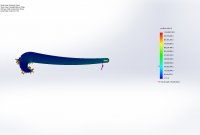
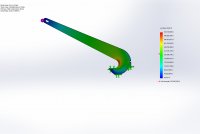
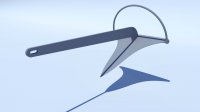
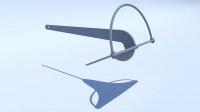
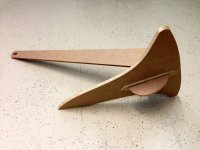
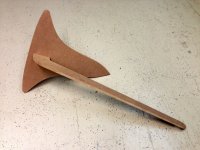
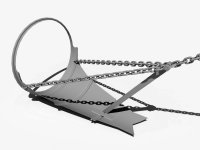
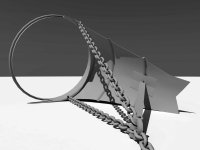
To keep things simple, the present effort is aimed at developing a Bugel inspired design to test and prove the shank connection before moving on to more sophisticated shapes.
 

Attachments

  • OSA1121.1.jpg
    OSA1121.1.jpg
    241.4 KB · Views: 1,020
  • OSA1121.2.jpg
    OSA1121.2.jpg
    245.1 KB · Views: 943
  • OSA1121.5.jpg
    OSA1121.5.jpg
    252.7 KB · Views: 901
  • OSA1122.1.jpg
    OSA1122.1.jpg
    424.2 KB · Views: 1,122
  • OSA1122.2.jpg
    OSA1122.2.jpg
    432.1 KB · Views: 951
I like your starting place.
May I suggest two changes.

First, one problem is that an anchor with a fluke-tip-in-line-with-the-shank
can just slide over a hard surface without digging in.
I therefore suggest that you place a sharp-Y-shape at the tip of your fluke.

Second, the more weight at the tip(s), the better the dig-in.
Anything you can do to increase the tip weight will help.
 
Dunno if there's a need for another version of Rocna. Why not try something different and new. How about something like assymtrical spade? Just a thought but that might be a way to get a good holding in sand as well as on a rocky bottom..
 
I like your starting place.
May I suggest two changes.

First, one problem is that an anchor with a fluke-tip-in-line-with-the-shank
can just slide over a hard surface without digging in.
I therefore suggest that you place a sharp-Y-shape at the tip of your fluke.

Second, the more weight at the tip(s), the better the dig-in.
Anything you can do to increase the tip weight will help.

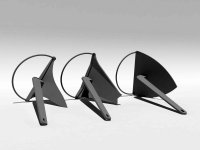
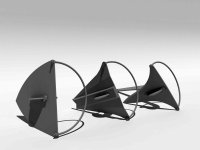
Mantus, Rocna, Spade, Manson, and many others would seem to disagree with you. I, however, tend to agree with you. I did a quickie concept a while back of what three different fluke styles might look like, a Bugel-style for rocky or weedy soils, an concave style for sand, and a flat shovel style for mud. The concave one in the middle has a fluke made from stacking two plates of different thickness, a 1/2" plate from tip to shank for strength and weight where you want it, and a 1/4" for surface area.

Current Bruce anchors use a similar bifurcated fluke as to the one in the middle. Makes a lot of sense to me. Off-setting the tip creates a lever which helps the anchor orient when a load is applied to the shank. Look at the plan view and push on one of the tips while you pull on the shank, see how it wants to turn?
 

Attachments

  • OSA111313.4.jpg
    OSA111313.4.jpg
    263.9 KB · Views: 806
  • OSA111313.5.jpg
    OSA111313.5.jpg
    253.3 KB · Views: 1,092
  • image.jpg
    image.jpg
    282.1 KB · Views: 857
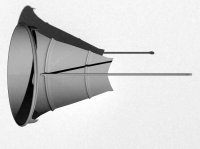
Here's a concept from an oil drum with the bird's beak tip.
 

Attachments

  • OSA1031.4.jpg
    OSA1031.4.jpg
    262.3 KB · Views: 930
  • OSA1031.6.jpg
    OSA1031.6.jpg
    256.3 KB · Views: 838
Dunno if there's a need for another version of Rocna. Why not try something different and new. How about something like assymtrical spade? Just a thought but that might be a way to get a good holding in sand as well as on a rocky bottom..

One of the goals behind the project was to provide consumers the option of having produced something they need locally, rather than having to buy something made in China.

To be a success, that thing needs to be something people want. The market tends to favor the new generation anchors such as the Spade types or the roll-bar types.

Most of the so-called "new-generation" anchors are really just trading off of concepts developed by Peter Bruce and Patented in the early 70's which have since passed into the public realm. I personally see very little true innovation since then. The Bugel didn't appear until after the Bruce Patents expired, the Ronca not until after the Bugel Patent expired.

The Spade is a great anchor, but compound curvature is difficult to produce when compared to shapes cut from flat plate. Since the goal is to produce a free anchor design that can be produced anywhere using common methods and materials, it would seem a roll-bar type would be the way to go.

With the current shank design, welding is not required. At that point anybody with a jig saw and enough time on their hands could theoretically make an anchor. Obviously plasma cutting would be the way to go for those who have that option....
 
The oil drum idea would be to flimsy but keep trying. Want to try designing one myself in the future.

There's one called "bulwagga", three metal triangles with the stock in the middle. Seems like an excellent diy build and supposedly very good hold characteristics. The company that built them is out of business.
 
Typical 20kg/44lbs new gen anchor to deal accommodate a 5,000lbs straight line pull. Most new gen anchors do this with a fluke area of less than a square foot and a single point shank to fluke attachment. The oil drum has about four times as much fluke area with three attachment points, so maybe not that flimsy after all.

I like it as a concept, oil drums are certainly ubiquitous. I think it would be an improvement to ditch the chain bridle and just make three legs out of round bar stock with formed eyes. Less drag, expense, weight. You can form an eye with seized ends that is plenty strong very easily. You can even get stainless steel drums fairly cheaply.

These things said, it's not going to fit on your bow roller or ever look like anything other than what it is, an oil drum repurposed into an anchor so it won't win any fashion contests. I think flat cut plate is a better route for a more practical anchor.


I really like the Bulwagga, BTW. The shank to fluke connection is awesome and obviates the need for a swivel in your gear. The problems I see are the need for welding as well as the fact that, like any symmetrical design, it suffers from the lazy-fluke syndrome. Supposed to be great in weed, that they are out of production or that it was never copied by others should maybe tell you something.
 
I think their big problem was handling issues unless lifted and left stationary at the anchor sprit but then the asthetics were all wrong. Shouldnt bother a true seaman if it works.

Welding would be a fundamental skill to know if you are going to build anchors.
 
Agreed that welding is a great skill to have, but I don't think it requisite to making a great anchor and I would cite the Fortress as an example.

One of the goals is to make the design accessible, so why make a design that is dependent on having the skills and equipment to weld when it is not necessary?
 
Forum posts represent the experience, opinion, and view of individual users. Boat Design Net does not necessarily endorse nor share the view of each individual post.
When making any potentially dangerous or financial decision, always employ and consult appropriate professionals. Your circumstances or experience may be different.

  • Back
    Top