

I have developed a spreadsheet application dedicated to the drag estimation and the speed prediction of rowboats, developed with OpenOffice Calc and open source, here attached.
This application includes a drag estimation with 3 components :
Lwl : waterline length
Bwl : waterline beam
Tc : hull draft
Disp. : boat displacement
Cp : prismatic coefficient
Sw : wetted area
LCB : Longitudinal center of buoyancy (in % of Lwl, from aft Lawl point)
Sa hull : hull frontal area (which can be estimated as bow freeboard x beam)
Srower : rower(s) frontal area
Net power : effective propulsion power (as equal to drag x speed)
The application includes also a speed prediction (on flat sea, but with various head wind forces) through the input of a net power. Question is what power should be introduced to represent the rower effort ? >> I think that for an average rower and an effort of one hour or more, a value of 40 Watt can be a valuable order of magnitude (and so 80 W for 2 rowers). Whatever one may think of this assumption (and you can input any another value), such a value is useful for comparing different designs, or different loads, or different number of rowers, in terms of speed and not just in terms of resistance.
The application also proposes 2 sets of input data (named Hull A and Hull B) in order that you can compared directly, through the curves automatical output, either a same rowboat with 2 loadings or 2 rowboat designs with the same loading.
3 examples are proposed :
** Adirondack Guideboat Ghost
** Monument River Wherry
** Race Drakeboat 18
, thanks to the data provided by @flo-mo in the woodenboat forum.
Fast rowboat inspired by Monument River Wherry and the Drake Rowboats - Page 2 (woodenboat.com)
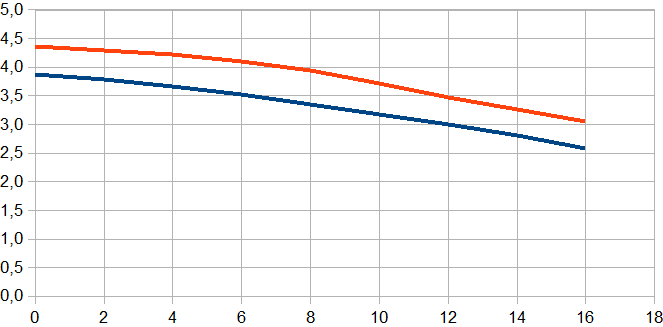
In the figure here under, it is the speed comparison (boat speed in Knots versus head wind speed in knots, assumed flat sea) of the Adirondack Guideboat Ghost at either 125 kg / one rower 40 W (Blue curve) or at 225 kg / 2 rowers 80 W (Red curve).
By hoping this can be helpful for your rowbats projects
This application includes a drag estimation with 3 components :
- residuary drag, based on Delft series (parent models N°1 and N°25), and formulation as reported by Larsson and Eliasson in « Principles of Yacht Design » 2nd edition 2000
- friction drag, based on ITTC57 formulation for the friction coefficient (and L = 0,7 Lwl for the Reynolds number, as also recommended by the above authors).
- aerodynamical drag, with an average Cx= 0,5 applied to both the boat (frontal area estimated like ~ bow freeboard x beam) and the rowers (input the estimated area of rower(s) back(s) )
Lwl : waterline length
Bwl : waterline beam
Tc : hull draft
Disp. : boat displacement
Cp : prismatic coefficient
Sw : wetted area
LCB : Longitudinal center of buoyancy (in % of Lwl, from aft Lawl point)
Sa hull : hull frontal area (which can be estimated as bow freeboard x beam)
Srower : rower(s) frontal area
Net power : effective propulsion power (as equal to drag x speed)
The application includes also a speed prediction (on flat sea, but with various head wind forces) through the input of a net power. Question is what power should be introduced to represent the rower effort ? >> I think that for an average rower and an effort of one hour or more, a value of 40 Watt can be a valuable order of magnitude (and so 80 W for 2 rowers). Whatever one may think of this assumption (and you can input any another value), such a value is useful for comparing different designs, or different loads, or different number of rowers, in terms of speed and not just in terms of resistance.
The application also proposes 2 sets of input data (named Hull A and Hull B) in order that you can compared directly, through the curves automatical output, either a same rowboat with 2 loadings or 2 rowboat designs with the same loading.
3 examples are proposed :
** Adirondack Guideboat Ghost
** Monument River Wherry
** Race Drakeboat 18
, thanks to the data provided by @flo-mo in the woodenboat forum.
Fast rowboat inspired by Monument River Wherry and the Drake Rowboats - Page 2 (woodenboat.com)
In the figure here under, it is the speed comparison (boat speed in Knots versus head wind speed in knots, assumed flat sea) of the Adirondack Guideboat Ghost at either 125 kg / one rower 40 W (Blue curve) or at 225 kg / 2 rowers 80 W (Red curve).
By hoping this can be helpful for your rowbats projects


