Climate change falsehood

Status
Not open for further replies.
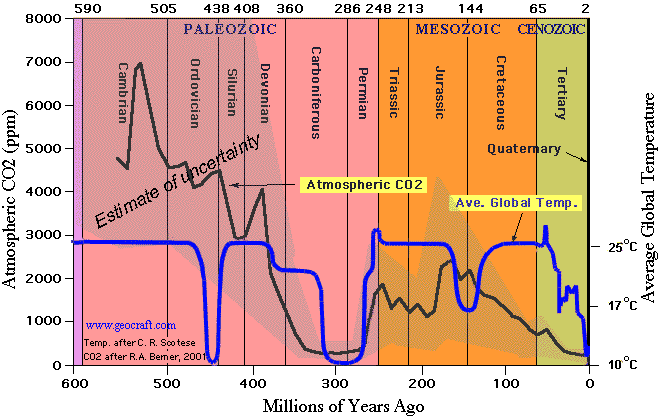
during the last two ice ages CO2 was 1700 percent higher than now (as can be seen on that chart above). If that is typical of the relationship with CO2 and average global climate temps, than an increase in CO2 means what? It will cool the earth?
 
CO2 is what plants need to grow. The Earth is a system with negative feedback. That is, the system tend to stay balanced regardless of temporary changes. The problem is that modern humans are attached to a state closer to the Ice Age than the historical average. As a political issue, proponents of the catastrophic "Climate Change" choose time segments that support their claims. However, they refuse to look at geological eras; the only true and honest way to describe climate.
 
during the last two ice ages CO2 was 1700 percent higher than now (as can be seen on that chart above). If that is typical of the relationship with CO2 and average global climate temps, than an increase in CO2 means what? It will cool the earth?

How did you figure that out from your chart? The last ice age ended about 10,000 years ago. The smallest unit of time on your chart is 100 million years!!

Here is a more relevant chart showing recent ice ages and CO2 concentrations. Notice that even in the inter-glacial periods the CO2 levels didn't rise above 300ppm.

800px-Vostok_Petit_data.svg.png

http://en.wikipedia.org/wiki/Ice_ages
 
CO2 is what plants need to grow. The Earth is a system with negative feedback. That is, the system tend to stay balanced regardless of temporary changes. The problem is that modern humans are attached to a state closer to the Ice Age than the historical average. As a political issue, proponents of the catastrophic "Climate Change" choose time segments that support their claims. However, they refuse to look at geological eras; the only true and honest way to describe climate.

You're making all sorts of assertions without offering a shred of evidence. Maybe you should take Yobarnacle's advice. :D

Or better yet, go stand with your nose in the corner for an indeterminate time. You can let yourself out, AFTER you get your mind right! (penalty I used to give my kids for fractious behavior).
 
there are other more detailed charts that show CO2 levels were higher during the last several ice ages. There was a detailed article about this, with cited studies, in the NY Times science section several years ago. I followed the links to the studies of long term global temps vs. CO2. The chart I posted above can be correlated to major ice ages in the distant past. The chart you posted above of more recent short term temps do not super impose the CO2, but it appears to show a two to ten thousand year lag between temp peaks and valleys, and CO2 peaks and valley. So the CO2 causes the warming that peaks a decade ahead of the CO2 peak?
 
Imaginary Number: your post is the evidence that supports my claim. The Earth is billions of years old, but you complain that Petros shows charts in the millions. You, however, don't want to go beyond 400 years because it would show your claims are invalid.
 
there are other more detailed charts that show CO2 levels were higher during the last several ice ages. There was a detailed article about this, with cited studies, in the NY Times science section several years ago. I followed the links to the studies of long term global temps vs. CO2.
I believe your memory is faulty. You can search the NY Times for past articles by using Google. In the Google search window type your search string, followed by "site:www.nytimes.com", like this:

"ice age" CO2 site:www.nytimes.com

The quotes around "ice age" asks the google search engine to treat the two words as one phrase.


The chart I posted above can be correlated to major ice ages in the distant past.
Again, I believe you are incorrect, but if you have scientific evidence I'd like to see it.

The chart you posted above of more recent short term temps do not super impose the CO2, but it appears to show a two to ten thousand year lag between temp peaks and valleys, and CO2 peaks and valley. So the CO2 causes the warming that peaks a decade ahead of the CO2 peak?

I don't know what you are talking about. Yes, CO2 and temperatures do correlate. We discussed this very topic just a week ago here:

CO2 lags temperature - what does it mean?

and a couple of months ago here:

New York Times | Study of Ice Age Bolsters Carbon and Warming Link
 
Imaginary Number: your post is the evidence that supports my claim. The Earth is billions of years old, but you complain that Petros shows charts in the millions. You, however, don't want to go beyond 400 years because it would show your claims are invalid.

I am astounded that you are acting so dumb! Your boating posts are intelligent-sounding. Why are your posts on this topic so atypical?

Petros said "during the last two ice ages CO2 was 1700 percent higher than now". The last two ice ages were about 50K and 150K years ago. You can't even see the last 150K years on Petro's chart. 150K years is the width of the left-hand border!
 
That perhaps it was not in the NY times, though I was a regular reader of the science section up until about 3 years ago. I also read some CO2 related articles out of Simisonian magazine, and National Geographic as well, perhaps it was there. I think I printed out the article and saved a hard copy somewhere, I will see if I can find it.

here is a chart that show the last three ice ages, two of the three show high CO2 levels. In fact it is difficult to see any kind of a causal link at least in the millions of years range scale. In fact it looks like the earth want to be about 14-17 deg C warmer than it is now. and if the temp treads follow suite from the last 3 ice ages, it appears that indeed we are headed for another ice age. But what do I know, I just want data, and all those smarter than me think data is irrelevant.

image277.gif
 
here is a chart that show the last three ice ages, two of the three show high CO2 levels. In fact it is difficult to see any kind of a causal link at least in the millions of years range scale. In fact it looks like the earth want to be about 14-17 deg C warmer than it is now. and if the temp treads follow suite from the last 3 ice ages, it appears that indeed we are headed for another ice age. But what do I know, I just want data, and all those smarter than me think data is irrelevant.

Okay, I think I'm finally starting to follow you. What you are calling "the last three ice ages" is not referring to the most recent glacial periods (known as the Pleistocene, which had many glacial episodes each about 100K years long) lasting from about 2 million years ago until about 10,000 years ago (and maybe into the future as well). Rather, you are referring to three very extended periods when the earth was (or may have been -- the evidence is sketchy) a virtual snowball for millions of years at a time.

This is from the Wikipedia article on the Ice Ages:
There have been at least five major ice ages in the Earth's past (the Huronian, Cryogenian, Andean-Saharan, Karoo Ice Age and the Quaternary glaciation). Outside these ages, the Earth seems to have been ice-free even in high latitudes.[30][31]

Rocks from the earliest well established ice age, called the Huronian, formed around 2.4 to 2.1 Ga (billion years) ago during the early Proterozoic Eon...

The next well-documented ice age, and probably the most severe of the last billion years, occurred from 850 to 630 million years ago (the Cryogenian period) and may have produced a Snowball Earth in which glacial ice sheets reached the equator,[32] possibly being ended by the accumulation of greenhouse gases such as CO2 produced by volcanoes. "The presence of ice on the continents and pack ice on the oceans would inhibit both silicate weathering and photosynthesis, which are the two major sinks for CO2 at present."...

The Andean-Saharan occurred from 460 to 420 million years ago, during the Late Ordovician and the Silurian period.

The evolution of land plants at the onset of the Devonian period caused a long term increase in planetary oxygen levels and reduction of CO2 levels, which resulted in the Karoo Ice Age...

The current ice age, the Pliocene-Quaternary glaciation, started about 2.58 million years ago during the late Pliocene, when the spread of ice sheets in the Northern Hemisphere began. Since then, the world has seen cycles of glaciation with ice sheets advancing and retreating on 40,000- and 100,000-year time scales called glacial periods, glacials or glacial advances, and interglacial periods, interglacials or glacial retreats. The earth is currently in an interglacial, and the last glacial period ended about 10,000 years ago. All that remains of the continental ice sheets are the Greenland and Antarctic ice sheets and smaller glaciers such as on Baffin Island.

The whole Wikipedia article is too long to post here. There is a section discussing the hypothesizes for the mechanisms that triggered and ended the various ice ages. It is worth noting that the level of CO2 in the atmosphere plays an important role in these calculations: when CO2 levels were higher, temperatures were higher; when CO2 levels were lower, temperatures were lower.

It is also important to note that the conditions on the earth many hundreds of millions of years ago, when these massive glaciation periods happened, were much different from what they are now. Volcanism was at times much more intense; continent and ocean distribution was very different; rates of meteor impacts were different; vegetation was different. I'm not sure that it is very useful to compare present conditions on earth to what they were like way back then.

Below is the Wikipedia chart on temperatures that I posted, and the Geocraft chart that you posted. I think the temperatures shown on the Wikipedia chart more closely reflect the scientific consensus. There appears to be a least a rough correlation between CO2 levels (shown on the Geocraft chart), and Earth temperatures (shown on the Wikipedia chart -- again note the non-linear scale). There certainly is a good correlation between the two in the last 400K years (lowest chart)


800px-All_palaeotemps.png


image277.gif


Milankovitch_Cycles_400000.gif
 
SYDNEY MORNING HERALD | Bonn climate talks fail to close China, US divide

May 6, 2013 | New, more flexible ways to fight climate change were sketched out at the end of a week of talks between 160 nations, but there was no breakthrough in bridging a deep divide between China and the United States.

The meeting of senior officials in Bonn, Germany, aired formulas to resolve disputes between rich and poor on sharing out the burden of curbing greenhouse gas emissions as part of a new U.N. deal, a successor to the 1997 Kyoto Protocol.

Attempts to reach agreement have foundered above all on a failure to agree on the contribution developing countries should make to curbing the industrial emissions responsible for global warming. The next ministerial conference to try to reach a deal is scheduled for Paris in 2015…

The United Nations said there was a broad agreement among delegates in Bonn that any new accord should have flexibility to ratchet up curbs on emissions, without a need for further negotiations, if scientific findings about floods, droughts and rising sea levels worsen in coming years
 
Climate change costs need to be built into the products manufactured by developing countries for use in developed countries. The end user must pay.

Hopefully a carbon tax, when initiated ..will accomplish this.
 
Climate change costs need to be built into the products manufactured by developing countries for use in developed countries. The end user must pay.

Hopefully a carbon tax, when initiated ..will accomplish this.

It's working real well in Australia. We're sending even more manufacturing to China.

PDW
 
WBUR (Boston) | Climate Change Series: The Future Of Fossil Fuels

Mike Jesanis former president and CEO of National Grid USA

Disruptive change in the energy industry is primarily driven by economics…

Put simply, large quantities of cheap, available natural gas from shale is a game-changer for the U.S. energy industry…

The first loser in this new marketplace is nuclear power…

New energy technologies — whether nuclear, wind, biomass or solar — are also losers

Cutler Cleveland Editor-in-chief of the Encyclopedia of Energy

…there’s over 1,200 years worth of oil, natural gas and coal that is “technically recoverable”…

If we put anywhere near that amount of carbon into the atmosphere, we’ll fundamentally alter the planet’s climate system in ways that make the 1 or 2 degree rise of the last century seem almost laughably trivial….

First, there are the enormous — and growing — sunk costs in fossil fuel infrastructure. Second, major energy transitions — from wood to coal, from coal to oil — historically take 30 or more years….

Another major problem is the market sends perverse signals about energy. The environmental and human health externalities — costs not reflected in the price — associated with fossil fuels are staggeringly large….

Finally, there’s the third rail of American energy politics — the demand side. No president since Jimmy Carter has dared talk with the American people about our use of energy. How, and how efficiently, we use energy has to be part of the discussion…

N. Jonathan Peress vice president of the Conservation Law Foundation

This highlights the paradoxical role of natural gas: It’s helping to reduce current carbon emissions in our electric system, while simultaneously delaying our ability to deploy renewable energy sources to reduce future carbon emissions. Natural gas may be on the right side of the “carbon curve” today, but it will be on the wrong side very quickly…

However, recent life-cycle analysis suggests that reductions in greenhouse gas emissions from natural gas
are minimal. A recent study by the National Center for Atmospheric Research concluded “substitution of gas for coal as an energy source results in increased rather than decreased global warming for many decades…”

In our view, it doesn’t make sense — economically or environmentally — to invest in building new natural gas pipelines and power plants that will be shut down in 10-20 years as we complete the transition to a low-carbon energy future…

 
THE ECONOMIC TIMES OF INDIA | Global warming to hit half of plants, a third of animals
PARIS: More than half of common species of plants and a third of animal species are likely to see their living space halved by 2080 on current trends of carbon emissions, a climate study said on Sunday…

Fifty-five percent of plants and 35 percent of animals could see their living space halved by 2080 at current emission growth for CO2, they found. The figures take into account the species' ability to migrate into habitat that may open up as a result of warming.


The species most at risk are amphibians, as well as plants and reptiles, and regions that would lose most are Sub-Saharan Africa, Central America, Amazonia and Australia, the paper said…
 
Forum posts represent the experience, opinion, and view of individual users. Boat Design Net does not necessarily endorse nor share the view of each individual post.
When making any potentially dangerous or financial decision, always employ and consult appropriate professionals. Your circumstances or experience may be different.
Status
Not open for further replies.

  • Back
    Top