MrMillard
Trimaran 7
- Joined
- Dec 1, 2021
- Posts
- 31
- Reaction score
- 3
- Location
- Sweden
Hi!
I'm a complete amateur who got the inspiration some time ago to design a boat I could one day realistically build should the circumstances allow it. After much doodling and many size and hull-shape changes I now have a complete sketch I am brave enough to share. I would like your honest opinions and constructive critique if you have the time and inclination.
I am a novice regarding all things boat related and certainly no naval architect, so no real engineering calculations have been done. Bear all this in mind and try to be nice, please!
First a little background:
Type:
I first decided on a sailboat for the some of the following reasons;
- environmental impact
- autonomy and endurance
- learning opportunities
- romantic charm
Size:
Having read how monumental a task it is to build, own and maintain a boat, especially a large one, I decided that small (subjective) would be most realistic. The smaller that I felt comfortable with, the better. However, I am quite tall and loathe being hunched over and would like to be able to cruise. These are my requirements;
- <11m/35 feet length
- at least 2m/6'6" headroom
- trailerable (<260cm/8'6" beam)
- fits 40 foot container for shipping
- at least 4 berths (preferably 6-8)
- good size galley
- on board shower and head
Hull form:
Except for the most obvious drawback of small boats, lack of space, I've read that they are almost agonizingly slow. This is especially true for cruising as opposed to racing designs.
So how do you make a small trailerable boat faster? You make it a trimaran! That is the conclusion I've found researching sailboats. Unfortunately trimarans tend to be even less spacious than their monohull siblings for a given length, so some out of the box design may be necessary.
Systems/equipment/rig:
A sailboat can be rather complex, and trimaran doubly so. Add in trailerability, easy shipping and cruising comfort and you have a lot to contend with. So whenever and wherever possible I've strived towards simplicity. Given my very basic knowledge, I may have misjudged what "simplicity" entails though. If I have perceived that there is a considerable gain in simplicity of use at the cost of adding some complexity of build, I may deem it a worthy compromise. This has led to the following requirements;
- sliding beam folding (not pretty, but simple and robust)
- all electric systems (cooking/heating/propulsion)
- outboard auxiliary propulsion
- freestanding mast
- Wharram wingsail
- self-tacking jib
- solent rig sloop
- integrated bowsprit
- daggerboards in amas/floats (debatable?)
- transom mounted, tiller controlled cassette or kick-up rudder
I'll go over some of the more unusual design elements here, and some of the reasoning behind them:
- very high freeboard. This is almost unavoidable if you want plenty of space and headroom. The deck is about 1.5m/5feet above the waterline.
- far forward mast-step. The idea is that you push the bottom of the mast through a tiltable collar mounted on the front crossbeams and then use a rope/line to force the bottom of the mast into a groove inside the main cabin/galley. Then you seal the hole left when the mast is in position with a form fitted board. So the mast slides from the bow into the hull through the front of the top structure and when it is ~2m/6'6" feet in you crank it upright in a 90° quarter circle motion. This lets the freestanding mast use the stiffness of the crossbeams for support, which wouldn't be possible if it was located further aft. Stepping a "keel-stepped" mast, freestanding or not, is nearly impossible without a crane if no tilt-mechanism is employed.
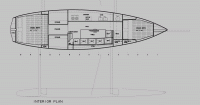
- combination wet head/corridor. A separate enclosed head on a small boat, and especially a trimaran with only standing room in the middle, is a waste of space. Having the area do double, or in this case quadruple duty saves a lot of precious space. The major drawback is that a lot of the boat becomes inaccessible when someone is using the head. That said, the same area now does all of this; gives access between the cockpit and inside, provides entry and dressing space for two mini quarter berth cabins, including stowage, acts as a wet room for showering and getting out of wet gear AND a slide out head. Having a wet capable compartment with drain between the cockpit and galley area also keeps the living area dry.
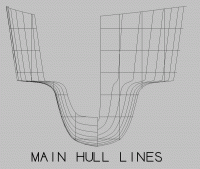
- three stage/section hull. The hull is made up of three distinct widths, like an upside down layer cake. The bottom provides a large length to beam ratio of 10:1 at the waterline and provides space for the demounted amas to lie down in a container. It is 80cm/31.5" in width. The middle part provides maximum beam while leaving enough space for the two amas to be pushed in for trailering without needing to be demounted. It is 180cm/6feet wide. The top part is the maximum beam you can fit in a standard container and provides additional room for stowage and deck space. It is 220cm/7'3" at its widest.
- full sitting height berths/cabins. Maybe not terribly unusual, but definitely not common on boats this size. By providing sufficient room to sit up, you gain a couple advantages; you don't risk hitting your head when walking up, you need a lot smaller lateral opening to get in or out and it is easier. You can use the berth for more than just sleeping, with a fold down worktable you can use your laptop or look at charts etc. The berth becomes an all day space for privacy, a much needed luxury on a small boat. In the front cabin, the ability to seat 6 adults in settee mode eliminates the need for a separate dining/lounge area, something that takes up most of the inside space in a typical small boat.
Some additional numbers (estimates and suggestions):
- waterline length 8m/26feet
- total length including integrated bowsprit 10m/32feet
- beam sailing 6,8m/22'4"
- beam folded 2,6m/8'6"
- main hull total height 215cm/7'1"
- draft 40cm/1'4"
- Ama/float length 8m/26feet
- Ama/float beam 40cm/16"
- Ama/float max height 110cm/3'7"
- Aka/crossbeam diameter 20cm/8"
- total mast length 12m/40feet
- mast above deck level ~10m/32feet
- mast max diameter 20cm/8"
- berth lengths 2m/6'6"
- weight ~1000kg/2200lbs
- displacement ~2000kg/4400lbs
Suggested basic building info:
- 25mm/1" foam sandwich hull
- aluminium/carbon fiber tube crossbeams
- carbon fiber tube mast
That's all I can think of right now! Fell free to ask questions and I'll try to update/answer accordingly. Remember, this is the pipe dream of an amateur, nothing more, nothing less!
P.S. I've drawn a lot of inspiration from other designs and/or designers and I've greatly appreciated this forum. If I were to single one influential source out, I would have to say Kurt Hughes.
Last edited: