America's Cup declining?

Status
Not open for further replies.
sharpii2, why would you say this: "Unless they have very limited area, they seam to be patently unsafe." Wing sails have been used since the 60's in C Class cats and, as far as I know, have a very good safety record.
 
I wouldn't say unsafe. Just highly impractical.
 
I wouldn't say unsafe. Just highly impractical.

The Americas cup and its boats have a very useful purpose.

It is a great way to extract huge amounts of money from the wallets of the ridiculously rich, and spread it around the poorer people.
 
Hi CT.

"Why should AC boats be mutlihulls when the event was created with mono's," is like saying "Why should the AC be externally ballasted sloops when the event was created by internally ballasted cutters and schooners?".

Progress happens and we must move on.

Sharpii, there's a vast difference. No one has ever said (well,afaik) that sailing internal ballast boats is a different discipline to sailing external ballast boats. However, the Tornado association, the UK Cat association, NZ multi association and Olympic cat medallists have all said that multi sailing is a separate discipline to mono sailing.

There is something very different between allowing for progress in design within one discipline, and bringing in a new discipline. For example even a class as open as Moths has banned cats and windsurfers because they are a different discipline. The UK, US and Aus yardsticks, for example, are divided into keelboats, dinghies, boards and multis - not long keelers and fin keelers. Fin keels evolved from full keels and raced in the same classes, cats were separate

Motorbikes have evolved since the 1800s, but that doesn't mean that motorbikes should be thrown out of motorbike races and cars allowed in.


The old 12's served us well, but I remember people complaining that they were getting a bit long of tooth when I was a boy.

I've even read complaints that the race is usually more like a two boat parade, as the boat that gets ahead, in the early part of the race, tends to stay ahead.

I didn't say that 12s should still be in. It is, however, food for though that sailing was in a healthier state when 12s were in.

Multi's have been around for a long time and have proven themselves to be ocean worthy, when sensibly designed and sailed. The are usually 30 to 50% faster than mono's of the same length and technology. The only exceptions I know of are mono's with huge hiking wings, and mono's with canting ballast.

So? Cars have been around for a long time, are safe, and faster than motorbikes. Does that mean that the motorbike world titles should now be raced for by cars?

Powered aircraft have been around for a long time, are safe, and faster than gliders. Does that mean that the glider titles should now be raced for by powered aircraft?

Should hang glider events be open to normal gliders which are safer and faster?

In what sport has the major event been taken over by another discipline?


Multi's also have a wider speed range than mono's, being capable great bursts of speed. This could end the 'two boat parade', as the trailing boat could suddenly become the leading boat, if it gets a zephyr or gust the lead boat doesn't get.

Other than that, I do see your point.

But, having watched the AC for most of my life, I have witnessed very expensive, high technology, being thrown into inherently slow boats. For years, there has been a noticeable giggle effect, for that reason.

So, I think it is much different than the examples you cite.

I think you'll find there is exactly the same thing happening in other sports and in other disciplines in sailing. A Finn dinghy is much slower than a budget International Canoe, for example. You can build a boat that is cheaper and faster than an F18 catamaran, if you don't follow F18 rules.

In the one I know best, cycling, there is a lot of money being thrown into expensive, high tech but inherently slow bikes. A teenage girl can ride an unrestricted bike faster than Lance Armstrong could ride his Tour de France bike. That didn't stop people from watching Lance.

It's the same in triathlon and motor racing (a top-line class-legal engine in Formula Vee, for example, was slower but more expensive than the same basic engine that ignored the rules) and probably in most other sports.

It's good to discuss it with you anyway as you're a well mannered bloke. Thanks!
 
The Americas cup and its boats have a very useful purpose.

It is a great way to extract huge amounts of money from the wallets of the ridiculously rich, and spread it around the poorer people.

Say what?

Most of the money just distributed to high end technicians, whom it would probably go to even if there wasn't an AC.

Maybe it would be different high end technicians.
 
sharpii2, why would you say this: "Unless they have very limited area, they seam to be patently unsafe." Wing sails have been used since the 60's in C Class cats and, as far as I know, have a very good safety record.

I agree.

But they seem to have been sailed in light winds.

A huge wing sail becomes dangerous in strong gusting winds that change direction frequently.

The only way to 'reef' a wing sail is to feather it into the wind.

There have been a number of inventions that facilitate doing this very quickly.

But the wing sails in question are of the articulating kind that seem to be designed to create asymmetrical airfoils.

It is these that I consider dangerous.

And it is these that I consider 'silly' for that reason.

I hope the AC series goes on without any more serious mishaps, but there is a part of me, a very evil, dark part, that wishes one of these monstrosities capsizes in the middle of the series and is totally destroyed (with no serious injuries to the crew or bystanders, of course).

Since the defender picks the boat type, let it be the defender's boat.

Seriously, this whole thing is wonderful to comment on, and I have had a wonderful time commenting, but it is really in the hands of the cup holder to decide on the boat type.

Or at least it seems to be.
 
In the one I know best, cycling, there is a lot of money being thrown into expensive, high tech but inherently slow bikes. A teenage girl can ride an unrestricted bike faster than Lance Armstrong could ride his Tour de France bike. That didn't stop people from watching Lance.

It's good to discuss it with you anyway as you're a well mannered bloke. Thanks!

Thanks for the kind words, CT.

I'm curious about this fast bicycle a teenage girl can beat Lance Armstrong with. Is it one of those that has a streamlined shell around the rider? I forget the fancy name for it.

I bicycle a lot. It's one of the few things I can afford to do. My bicycle is a maid of all work. It hauls groceries, laundry, acts a a shuttle between buildings I watch, and acts a a dinghy for my truck.

Back to the AC.

If it were up to you to choose, what sort of boat would you specify for the AC competition?

A challenging syndicate shall be a 2 boat program. 30 million max budget.

The choosen boat shall be designed for close in match racing.

The sail plan shall force competiors to change sails on legs...no goofy wings.

Crew numbers at absolute minimium.

Shoot for ten syndicates.

Nationality rules in place.
 
At last, an AC topic that's fun :-) Here's my take:

First, the statement of requirements:

1. The boat should be something that ordinary sailors, including radio sailors, can relate to. Forget the Facebook crowd, they will never have the attention span required to appreciate what's going on.

2. The boat should be challenging to sail in a way that requires high end traditional sailing skills of sail handling, sail trim, helm, and match race tactics and it should be unforgiving of error. Spectators with even a nodding acquaintance with sailing should be able to recognize that these boats are operating at the hairy edge of broach or capsize but the risk to the crew should be no more than what is accepted today for high-performance monohulls.

3. Costs should be contained (somehow).

4. Ingenuity should be rewarded.

5. There should be a nationality requirement of some sort, no more "my Kiwis are faster than your Kiwis."

6. It should not be necessary to modify the Deed of Gift (44 ft minimum LWL).

So what would I do? I'd do a big scow, something like an oversized Sonder boat. I'd have a design team design, and a designated manufacturer make, a standard canoe body shell to avoid a hull design race and get the cost advantages of production.

The rule would then be:

Use the standard shell such that the boat without crew floats on a minimum waterline of 44 feet. Scantlings, rig, sail area and appendages are up to you. Any element of any appendage that is wider than any element above it shall be made of a material at least 95% the density of lead. (Forbid foils, allow bulbs).

Soft sails only, rig elements must fit within some maximum diameter circle. (No "that's not a wing, that's my mast. The handkerchief on the back is the sail.)

No stored power of any kind except for devices provided by the organizers to support media coverage. (That's right, you're going to have to find the marks the old-fashioned way).

Maximum crew of six. Any crewmember who touches the helm at any time after entering the start box must have been a member of the Olympic sailing team for the country whose flag the boat flies. The only exception to this rule is when the boat withdraws, either voluntarily or involuntarily as the result of a capsize. (Let the Olympic guys sort out the "who's an XXX" stuff, and give the Olympians a shot at the high-paying jobs).

Properly fiddled with, this rule could face teams with some interesting tradeoff decisions, and to me tradeoffs are the essence and fascination of sailing. And could be fun to watch if you study the old pictures of the Sonders: sailing on your ear to windward, performing while wet and miserable, surfing or planing downwind while getting the fillings pounded out of your teeth, minimum chance of a horizon job. Race on SF Bay whatever the conditions, you're sailors, not hothouse flowers.

Cheers,

Earl

 
Forbid foils?! Sorry, the cats out of the bag-can't go backwards in the 21st Century. And why would you do that anyway for a regatta that is viewed(or should be viewed) as the pinnacle of sailboat design and racing?
Why would you want to stop foiling? Especially when one of the smallest classes and one of the largest classes has shown the beauty and viability of such technology.

click--
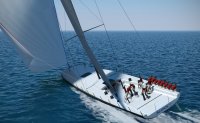
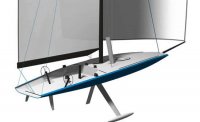
I do like scows, though-a lot: pictures- 1) Thomas Tison scow 1420-- 40 something and 2) Reichel/Pugh 60 footer:
 

Attachments

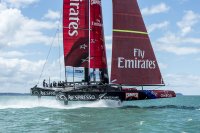
  • AC 72 foils 3.jpg
    AC 72 foils 3.jpg
    773.5 KB · Views: 1,654
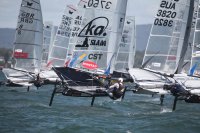
  • Moth veal heel 2011 worlds.jpg
    Moth veal heel 2011 worlds.jpg
    396.9 KB · Views: 931
  • Scow R-P design.jpg
    Scow R-P design.jpg
    1.9 MB · Views: 2,298
  • Scow Thomas Tison Scow 1420.jpg
    Scow Thomas Tison Scow 1420.jpg
    16.6 KB · Views: 902
  • Scow-Thomas Tison.jpg
    Scow-Thomas Tison.jpg
    12.5 KB · Views: 733
Forbid foils?! Sorry, the cats out of the bag-can't go backwards in the 21st Century. And why would you do that anyway for a regatta that is viewed(or should be viewed) as the pinnacle of sailboat design and racing?
Why would you want to stop foiling? Especially when one of the smallest classes and one of the largest classes has shown the beauty and viability of such technology.

click--
I do like scows, though-a lot-pictures- Thomas Tison 40 something and Reichel/Pugh 60 footer:

State of what art? To me, the art of sailboat design and racing is one of artful navigation of a complex tradeoff space. I see foilers as pure brute force engineering, put a wing in the water and a powerful enough sail in the air and off you go. It's like the description I once heard an aerodynamicist make of the old F4 "Rhino:" "You can fly a brick if you have a big enough engine."

For the rest of it, I think I was up front about the SOR I was working to.

Cheers,

Earl
 
At last, an AC topic that's fun :-) Here's my take:

First, the statement of requirements:

Maximum crew of six. Any crewmember who touches the helm at any time after entering the start box must have been a member of the Olympic sailing team for the country whose flag the boat flies. The only exception to this rule is when the boat withdraws, either voluntarily or involuntarily as the result of a capsize.

Earl

Interesting ideas!

My exception would be that the owner would also be allowed to steer

Richard Woods
 
State of what art? To me, the art of sailboat design and racing is one of artful navigation of a complex tradeoff space. I see foilers as pure brute force engineering, put a wing in the water and a powerful enough sail in the air and off you go. It's like the description I once heard an aerodynamicist make of the old F4 "Rhino:" "You can fly a brick if you have a big enough engine."
For the rest of it, I think I was up front about the SOR I was working to.

Cheers,

Earl
====================
I don't get that at all. The Moth is one of the lightest dinghies around-no way anyone would describe that as flying a brick.
Same with the 72-very light weight and manouverable for its length.
No way could either, even remotely, fit the description of "brute force engineering"!! And "brute force engineering" doesn't come close to a description of sailing foiler design-seems like an emotionally based disparaging comment not even closely based on reality.
 
Well, we'll just agree to disagree. And I don't get emotional about these things. In a career of dealing with high-consequence systems I early on learned the value of Elbert Hubbard's remark "Enthusiasm is a kind of heart medicine. It is the digitalis of failure."

Cheers,

Earl
 
Yep, Sharpii, wingsails can be hairy beasts.

Famous transatlantic racer Loic Caradec was lost sailing the biggest wing mast of its time, on the 85 foot Royale, in the '88 Route de Rhum. His last radio calls said that he could not control the mast and the boat was found capsized. Around the same era, both Peter Black and Loick Peyron said that the 2m wide wingmast on the 60' tri Stienlager was dangerous. Such experiences lead to restrictions on wingmast size in the ORMA 60s.

I think that there's been two destroyed wingmasts in Little America's Cup racing. Wingmill capsized and had her wing destroyed before the 10 minute gun for the first race sounded. The same thing happened to the French Opip in 1991 in the challenge trials for the same event. A couple (three, IIRC) of other wingmasts have been destroyed in trials; Fred would know.

Re "I'm curious about this fast bicycle a teenage girl can beat Lance Armstrong with. Is it one of those that has a streamlined shell around the rider? I forget the fancy name for it."

Yep, I'm talking about streamlined recumbents. They are close to twice as fast as a Tour de France bike. The racing ones are very impractical but there are cheaper ones suitable for everyday use that would still leave Lance gasping well behind, EPO and all.

Cycling seems to be the world's most popular "vehicle" sport (judging from census figures in western countries etc) and the fact that it basically ignores the much faster 'bents underlines that even in the 21st century, major sports can and do restrict technology to ensure that pro level gear is pretty much the same stuff that weekend warriors can use easily.

So what would I have as an AC boat? Great question.

First I'd do some independent market research, including an open call for submissions, and find out what the sailors (pro and amateur), public, broadcasters and potential sponsors want. IMHO sailing has a big advantage in that many boats are naturally beautiful and romantic and that is being squandered; the market survey may indicate, for example, that people want to look at boats with graceful overhangs and if so that could be put into the rule.

I'd also look at other major sports and note that the pro gear is generally similar to the normal gear. And I'd try to give back to the sport by taking heed of surveys about the reasons non-sailors do not get into the sport.

Personally I think it's very wrong to take over an event that was created by another discipline, as noted above, and I think it's almost unheard of in other sports. So we're looking at a mono. The survey would have worked out what people want and I'm betting that the perception of speed is NOT something you get from speed alone; my wife is a neuroscientist working in that area and from her I know that the visual perception of moving objects is a complex area and that we very quickly get habituated to something going fast. So going faster does not make for a better spectator sport - if it did we'd spent our time watching fighter jets taking off instead of watching bicycles, ball games, runners and cars. Hell, even production slalom windsurfers get similar speeds to the AC72s so in some ways we're still in the situation we were in with the 12 Metres, where smaller and cheaper boats are quicker.

The Olympic commissions provide a breakdown of ratings during the Games that also show very clearly that there is NO tendency for people to prefer "extreme" or fast sports; instead they watch the sports where it is easy to see who is ahead, the sports that they can relate to, and the sports where their country is doing well.

Any look at the sports section in a bookstore shows that many keen sportswatchers are history nuts. They love being able to relate modern heroes to the great names of the past.

We can also crunch some numbers to see where 21st century sailing is going. So far those numbers indicate that there is NOT a big switch to multis. From Hobies to big boats, numbers do not seem to be growing - that's not great but it is a fact. The situation with canters is similar. What is growing seems to be larger "mainstream" keelboats, small sportsboats and cheap OD dinghies. Only the first of those is AC material.

So with that research and a few extra steps, we end up with a fairly large mono (for visual appeal and a link to the past), new technology to make it easy to know when a boat is leading, and tight budget limits to allow lots of countries in. Personally I'd like a rule like the 5.5 Metre, which is sort of like a sliding box. Displacement should be light but hull construction should be restricted to ensure that boats are tough. Fixed keels for close match racing, reduced cost and maintenance, and to make the boats mainstream so most sailors can appreciate them. Some restrictions to make the boats useable in a second life could go some way to reduce costs or at least get smaller challenges underwritten by owners who could take over the boats later, like the last Aussie Volvo challenge.

Canters remain extremely rare and even in the big offshore boats they are forming a minute percentage of new builds....they're done, a multi is so much faster that building a mono for maximum speed is like breeding a racing daschund or growing a bigger bonsai tree.

I wouldn't mind partly returning the Cup to its very early roots by taking it close to shore and iconic or beautiful areas for good viewing, like the Tour de France does, but that may be contrary to the DoG and may be impractical.

No stored power, race in all conditions (maybe bring the marks right in close if it's very light, or adjust the configuration) and I like Erle's strict crew number limits.

In no way, by the way, am I saying multis should not be highly respected and have high profile events. I've sailed them for years and they are great; it's just that they should not take over an event created by another discipline, especially when the mantra "monos are the future" is disproven by the numbers that show that (sad but true AFAIK) they are not really growing at all.
 
Forum posts represent the experience, opinion, and view of individual users. Boat Design Net does not necessarily endorse nor share the view of each individual post.
When making any potentially dangerous or financial decision, always employ and consult appropriate professionals. Your circumstances or experience may be different.
Status
Not open for further replies.

  • Back
    Top