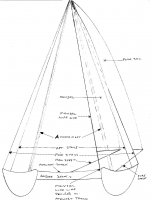
WishBone Sailing Rig

ORCA update

...latest email from owner of Orca (short rigged one)

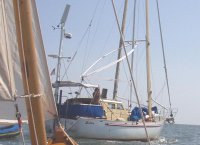
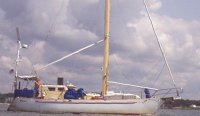
Sorry for not posting directly, running out of time today. I am naturally intersted in talking with new owner of Relentless. We are now locate in Port Angeles after sailing Orca up coast and poking around inside waters this summer and fall. Shakedown went well, at least better than last ship I was on...an icebreaker with a shaft bearing problem in the Arctic - not a lot of fun.

Anyway I found out some interesting things and have had some "experts" on board to help me along and got it into some serious wind with all sails up (force 7-8), paced a few dozen classic yachts at the Port Townsend Wooden Boat Festival races, and from what we could see outpaced them all with just the Genoa up.

Boat is an amazing piece of work. All I can say is my wife would never give it up. She loves it more than I do. And I think congratulations are in order to you. Happy trails and passages. More later. May have a lead on who Fred Greenway was from some locals around here who knew him
 
I have reviewed a lot of the observations and precepts/opinions and most everyone is "correct". Paradoxically, the boat sails well mainly because the hull is a racing hull. So this will never be a popular boat. Slack bilges, close quarters below, and tight deck space - but what a beauty in the slings....
The wishbone legs are bowed (cleverly), and require pre-loading, if you will, by the shrouds at the mid-arc to keep them from springing (they are afterall bows of carbon/kevlar/plastic). The wires do the trick as designed. As such the bowlegs of this mast act as shroudmasts with the wires performing the role of the string on a bow, only this string is attached in the mid-arc.
Shortening sail does result in lee helm but not a lot. I have not yet been able to get it to heave to. Still working on it. Fore reaches fine.
Tension loading is "extreme" I suppose. I have bent the upper mast back a few inches to get high tension of the forestay. Replaced some turnbuckles on aft stays but they were not badly worn. Rig is heavier than I would have liked, but necessarily so for strength. Still not much different from standard Marconi with same sail area and probably a little less weight depending or reefing of the Marconi reefing system. This is all anecdotal from my yard experiments, mainly involving my back, which has been a reliable tool thus far.
Aero-hydrodynamically speaking, the thing works well. I did hang it in the yard but the scale was broken...
Very comfortable ride to wind and on a reach she goes. Ran into the harbor last week with 20 knots of wind doing 8 knots without much fuss. Keeping the staysail boom down is a problem. I like sharpieII's ideas and observations.
Many of the observations of the individuals are right on and I appreciate the spirit of the discussion, unlike so many forums on the web, this one seems to keep it neat and respectful. I appreciate that more the older I get.
This will not likely ever be a "popular" rig for many reasons but primarily because it requires a very lean hull to take advantage. Most people just want real estate below and on deck. I do feel safer on it than on the vintage open 60 however. I know this one will come back up...
 
Hoyt's Manta sailboat

Does anyone remember Hoyt's "Manta" vessel? This vessel had an 'A' frame mast (don't think it was leaning forward) with a 'winged' style hull. I believe this vessel preceded his Delta vessel with the mast aft.

Does anyone have an old brochure of this vessel, or any literature/pictures of same?? I would very much like to receive some photo material on this vessel. The Newport library did not send me anything on this vessel design when I inquired of them on Hoyt's designs.

Over in a another subject tread Deepsix found this reference photo site with some pics of Hoyt's Manta

http://www.geocities.com/starcrew2000/photos/alibi/

...subject thread "Main-less Rig'
http://www.boatdesign.net/forums/showthread.php?t=21274
 
I stumbled onto those pictures while searching for something else. They came from a thread called Performance cats 30-40ft, on Sailing Anarchys' Cruising Anarchy forum. There was only a little discuccion on the Manta, now called Alibi, so I doubt you will learn much more. I have included a link to the first post where the boat was mentioned, there seems to be a few people that know about the boat maybe you can find some info there.

http://forums.sailinganarchy.com/index.php?showtopic=55997&view=findpost&p=1521003
 
Another A-framed Mast

In going thru some older postings related to 'A framed' mast there was a refernce to some photos on a website that had only been recently taken down. I found the reference forum and ask of the poster if he still had the photos he had posted.

He just recently responded. Here are two photos of a vessel that crossed his path.
 

Attachments

  • Bi pod mast rig.jpg
    Bi pod mast rig.jpg
    100.5 KB · Views: 2,655
  • Bipod mast  _ 2.jpg
    Bipod mast _ 2.jpg
    33 KB · Views: 1,932
Brian,

Can you see any benefit in moving the tack and luff of a mainsail to either port or starboard (on a deck mounted track), within the confines of an A frame mast fitted to a catamaran? The John Hitch catamaran has three individual head stays, rather than a track, for use as conditions dictate and I wondered about having the a similar facility for the mainsail.
http://boatdesign.net/forums/attachment.php?attachmentid=18787&d=1202813284

Granted the luff of the mainsail is vertical, whilst the luffs on the head sails are angled aft, but how much would this change in the angle of attack of the sails, within the dimensions of a catamaran, improve the upwind working, that is, if it does? Would such an alteration also remove the need for a boom as the mainsail would need not to be sheeted out so far, when broad reaching. This in turn would permit better site placement for the back stays. Just ideas! :D :D

Regards,

Pericles
 
Tilting Rig Design by Chris White

Brian, Can you see any benefit in moving the tack and luff of a mainsail to either port or starboard (on a deck mounted track)..... Pericles
Sounds a bit like this tilting rig concept from Chris White:
http://www.wingo.com/chriswhite/tiltrig.html

Actually I can not see the benefit of moving the tack, nor luff of the main (Wait a minute, I take that back. There could be some benefits, but it complicates things even more).

If anything the Aero-Rig was pretty efficient at keeping a constant relationship between the jib and main.
 

Attachments

  • Tilting Rig.gif
    Tilting Rig.gif
    15.6 KB · Views: 2,109
  • TiltingRig.jpg
    TiltingRig.jpg
    22.4 KB · Views: 1,036
"wave-piercing" ferry

I could not help but notice a resemblance between Gary Hoyt's Manta and the ferry Damen "wave-piercing" hull design but called a Catamaran. Based on recent experiences of traditional catamaran ferrys here in Puget Sound the lean monohull sandwiched between fast cat hulls seems close to what Gary was doing with his Manta. Had the Washington State Ferry that dove into a "rogue" wave recently with poor results had this configuration it would have come out much better. They travel and the same speed - 30 knots. The one in Kuwait is the Ameer Alkoulous. The best of both worlds - a wave-piercing monohull that lifts out of the water when seas allow for it.
 
In #66 I asked Brian about what might be the result by moving the foot of a mainsail ( either with or without a wishbone boom) to port or starboard on a catamaran. Here is my simply dreadful illustration of what I have in mind. The mainsail is difficult to identify and the ***king scanner is giving gype, so I cannot improve the image. Sorry about that!

If the sails run diagonally across the two hulls rather than down the centre line, could the hulls move through the water and edge more upwind?

It seems possible, but surely someone else has already tried this? All comments gratefully received.

Pericles
 

Attachments

  • sail sketch.jpg
    sail sketch.jpg
    159.7 KB · Views: 5,893
Aftmast, bare poles, and control

Mike Johns posed a very interesting scenario early on in the discussion.
Disclaimer - I am not an engineer of any sort...

Control being the key...I know that many a standard Marconi sloop, ketch, catamaran, and trimaran have flipped in the southern ocean, and that many of them, if not all, were built by engineers who attested to their seaworthiness. None of them had single aftmasts that I know of. Why did they go over? Why did others just like them not go over? Did the bow drive and trip under the force of the pole driving it down? Did the lack of balance result in yawing and eventual broaching? Did the stern lift and the beamy slow boat fail to speed away from it?

Would the windage "right aft" (actually more like 25%) be sufficient to overcome the series drogue, the rudder, and 3/4 keel and deep narrow hull?
If the location of the stick is the primary directional actor in these conditions it might explain why so many boats with the mast 70% forward of the stern broach as they swing wildly about it. It would seem the only safe place to put the stick in such an environment is precisely in the middle where there is no turning force? And even better might be to get rid of the mast altogether, as some boats seem to do for themselves, clearing the decks with a rollover, surviving as a result.

By the assumptions about the location of the mast I guess the Wylie Cats would be good boats to go under bare poles in. Is that the case?

I would tend to agree with the assumption about mast windage and directional control, but I am not sure if it is tautologically correct - other factors being at play. i.e. if a drogue and rudder can keep the yawing to a minimum would the mast aft actually tend to drive a narrow and deep hull with more control than its counterpart with a forward mast? Look forward to other input. K
 
Kojii,
In your posting just above, I'm having trouble discerning what portion of the text applies to Mike John and what portion is yours. I also did not see these 'quotes' from MJ in the previous text of this subject thread, so I would ask to which thread they apply, so I can look at the thread context in which they were made.
Thanks, Brian

...and many thanks for joining the discussions. We all stand to learn something here.
 
MJ's #26 in this thread was what I was referring to. I thought at the time it made a lot of sense.
"I would hate to try helming this running under bare poles. Keep it out of the southern ocean, wouldnt survive."
__________________
Mike Johns.
 
Inherent danger in the aft mast rig?

Sorry Brian, perhaps I could have put that earlier post more eloquently

I think the Achilles heel of this type of rig is that the COE of the bare rig is aft of the CLR of the vessel. I think the designer must consider bare poles as the final shortening of sail and that balance is just as important in this condition (COE relative to CLR) as it is in any other.

Anyone trying to maneuver a sloop in the marina with a strong wind blowing will be aware of the effect of the rig placement.
In severe weather running off under bare poles is a good option, but an aft mast rig may make this option dangerous particularly in conditions such as experienced commonly enough in parts of the world where storms and very large seas can only be safely contended with at certain stages by running and actively helming.

My concern is that with the weather taken on the stern quarter and with the windage aft that it will add significantly to a broaching effect particularly as the vessel rises to the top of the crest as the wave rolls underneath. The vessel meets the breaker if present and also at the same time experiences the full force of the wind. In short I predict a hard time for the helm in the very conditions where astute downwind helming is the only control you have.

I know I’m talking of survival situations where no sail can be carried, but this consideration does not endear me to this rig arrangement. I like your newer rig a lot better.
 
Not sure if my last post got through.
Your observations ring true. Tight marina slip approaches in with a beam wind require non-traditional rates of approach. One chance to get these right, but necessary to maintain directional control.
The prayer flags I ran down the aft edge of the wing masts (4-1 aspect) demonstrate clearly their sail-like qualities.
One non-traditional option with this two-foote mast, deck-stepped, with pin hinges would be to drop the mast on the deck before it becomes a greater hazard erect. Not easy to engineer, but possible. I am thinking airbags and explosive turnbuckles ...just kidding. Thanks for input. K
 
Mike,

In a situation of running before a storm with bare poles, I would stream a drogue, so as to allow the following waves to slide under the catamaran. In those circumstances I don't think the aft mast will encourage broaching.

http://www.seaanchor.com/deltadrogue.htm

http://www.multihullpages.com/heavy_weather.html

Read Gary Pearce's answers questions about "Zazen", after his voyage from England to Australia. http://www.john-shuttleworth.com/owner.html He mentions a downwind leg.

Regards,

Pericles
 
Forum posts represent the experience, opinion, and view of individual users. Boat Design Net does not necessarily endorse nor share the view of each individual post.
When making any potentially dangerous or financial decision, always employ and consult appropriate professionals. Your circumstances or experience may be different.

  • Back
    Top