
The Boat Design & Boatbuilding Site
Install the app
How to install the app on iOS
To install this app on your iPhone:
- Tap the Share button at the bottom of Safari.
Tap ... if Share is not visible, then Share - Tap Add to Home Screen
Tap View More and scroll down if needed to see Add to Home Screen, then Add to Home Screen. - Tap Add on the top right to confirm.
Note: This feature may not be available in some browsers.
You are using an out of date browser. It may not display this or other websites correctly.
You should upgrade or use an alternative browser.
You should upgrade or use an alternative browser.
What makes the best offshore cruising yacht
- Thread starter LEADGlobal
- Start date

PAR
Yacht Designer/Builder
- Joined
- Nov 12, 2003
- Messages
- 19,126
- Reaction score
- 508
- Location
- Eustis, FL
This is a cruiser's nightmare get your act together
Which Swan 44 are you talking about? I been on a few different ones, though I've never been on the MK2, I have the MK1 and the S&S. The MK1 Frers version is good sea boat. The S&S 44 is a two decades older design, with it's shark fin appendages and pinched stern, typical of the early IOR era. It's also a good sea boat, though dated, by today's standards, very comfortable in a rough slosh.
You beat me to the post, but the cheap Chinese made compressor pulleys are well known to break with very few hours. They don't like heat, they usually are very poor castings, with internal defects, some of which can be seen on close inspection, especially true of the aluminum versions, etc., etc., etc. In fact, the best thing you can do when you find one of these pulleys is "deflash" it and have it shot peened or blasted, so you can get a good look at the casting, maybe die (aluminum) or magnaflux it, looking for cracks.

Angélique
aka Angel (only by name)
- Joined
- Feb 15, 2009
- Messages
- 3,003
- Reaction score
- 338
- Location
- Belgium ⇄ The Netherlands
I'll guess that's why the Chinese offer the compressor pulleys in wholesale of 8 pieces minimum per order, so you'll have some spares . . 
Too bad that for the purpose of a prop shaft powered alternator all the pulleys need to be machined to fit the purpose made mounting system on the prop shaft, then the prop shaft needs to be pulled back to mount the spare pulley I think, so a lot of work to do when the pulley on the prop shaft breaks . .
Too bad that for the purpose of a prop shaft powered alternator all the pulleys need to be machined to fit the purpose made mounting system on the prop shaft, then the prop shaft needs to be pulled back to mount the spare pulley I think, so a lot of work to do when the pulley on the prop shaft breaks . .
I did a couple of trips on a then (about 2002) very new Oyster 55. Frankly, I wasn't impressed. As a harbour live-aboard it would have been a nice boat but for sailing on...no, not for me (lucky that, as I'd never be able to buy one anyhow). The effort to maximise space inside, which, agreed is effective resulted in helm positions (pt&stbd) which were perched up on top of the boat and felt exposed and unsafe. At the helm you looked down over the life lines at the water. It was heavy to steer and as I remember, unpleasantly dead on the helm too. It was a 'push button boat' with a button for everything; the only technology it lacked was a video control so that you could sail from the comfort and convenience of home.The Oyster on the otherhand i believe truely maximizes the space and makes a great layout for a cruising livaboard.
That's why they call it the "Wild Atlantic way"It's a nice day in the pilothouse at Tory Is Ireland its only blowing 45 knots as the spray and seaweed fly across the boat tomorrow's looking better.
 With good timing, the signs appeared just after a ferocious gale a few years back that felled trees everywhere.
Have you looked at this site?
earth :: a global map of wind, weather, and ocean conditions https://earth.nullschool.net/#current/wind/surface/level/orthographic=-26.04,46.71,1024
Angélique
aka Angel (only by name)
- Joined
- Feb 15, 2009
- Messages
- 3,003
- Reaction score
- 338
- Location
- Belgium ⇄ The Netherlands
Done: Prop shaft powered alternator for cruising sailboats !I'll start a split off thread for the prop shaft powered alternator, hang on please, I'll post a link here soon.
To avoid further thread drifting here, any new postings about this topic please on the linked thread.
Thanks . .

LEADGlobal
Junior Member
- Joined
- Apr 26, 2017
- Messages
- 34
- Reaction score
- 0
- Location
- US
I did a couple of trips on a then (about 2002) very new Oyster 55. Frankly, I wasn't impressed. As a harbour live-aboard it would have been a nice boat but for sailing on...no, not for me (lucky that, as I'd never be able to buy one anyhow). The effort to maximise space inside, which, agreed is effective resulted in helm positions (pt&stbd) which were perched up on top of the boat and felt exposed and unsafe. At the helm you looked down over the life lines at the water. It was heavy to steer and as I remember, unpleasantly dead on the helm too. It was a 'push button boat' with a button for everything; the only technology it lacked was a video control so that you could sail from the comfort and convenience of home.
Sure that was an Oyster? Maybe very customized? All the ones i have seen are single helms and fairly well protected with a wrap around cockpit
LEADGlobal
Junior Member
- Joined
- Apr 26, 2017
- Messages
- 34
- Reaction score
- 0
- Location
- US
here is a Oyster 55 Helm

I'm sure it was an Oyster but I may be mistaken about the length. The cockpit was rather like this O-625 but the boat wasn't that big. In any case, you can see from this photo my point about helm exposure.Sure that was an Oyster?

As a contrast, I really like the look and philosophy of Dick Koopmans designs, though I yet have to go sailing on one.
For serious short handed off shore sailing, how about this:
http://www.dickkoopmans.nl/designs/5989/.html

Many of their designs have shallow draft with lifting keels.
LEADGlobal
Junior Member
- Joined
- Apr 26, 2017
- Messages
- 34
- Reaction score
- 0
- Location
- US
I'm sure it was an Oyster but I may be mistaken about the length. The cockpit was rather like this O-625 but the boat wasn't that big. In any case, you can see from this photo my point about helm exposure.
As a contrast, I really like the look and philosophy of Dick Koopmans designs, though I yet have to go sailing on one.
For serious short handed off shore sailing, how about this:
http://www.dickkoopmans.nl/designs/5989/.html
Many of their designs have shallow draft with lifting keels.
Yes the first photo is not a very safe helm. Unfortunately, most of the new yachts are going this direction. It may look cool but hate to be at the helm in heavey weather.
Yes Dick Koopmans design much more inline with what I am thinking. I really prefer the protection of a center cockpit, and the hard dodger is always a benifit.
I really prefer the protection of a center cockpit, and the hard dodger is always a benifit
I'm ambivalent about centre cockpits. If you look at the path of the spray when beating in heavy conditions, it typically blows back and across until about two thirds of the hull length, often the stern stays relatively dry. In these conditions an open centre cockpit is a poor place to be. Another personal thing is that I find aft cockpits easier to steer from. In a centre cockpit I feel deprived of some of the sense of the boat's movement.
My ideal arrangement would be a low deckhouse leading aft to a partially covered cockpit from where you could steer and watch under shelter but there would be an external steering position too. I don't know the most common mechanism for centre located steering but from experience, for steering feel, nothing beats a cable and quadrant. For a true offshore boat, precise and pleasurable steering is absolutely essential IMO.
Iv'e done a few thousand miles on a seventies Nicholson 48, this has a deep centre cockpit with a permanent dodger and removable hard-top, you could be out in conditions like Phil had yesterday and stay perfectly dry underneath (the sea kindly hull helps). It's also close to the centre of movement for pitch and roll, so a nice place to be in big waves... but I miss an outside steering position and at night faint lights are hard to see from behind glass. The Nic has a complicated shaft and cog box steering system but even after forty years there is no stiffness or free play and it has surprisingly good feel.
LEADGlobal
Junior Member
- Joined
- Apr 26, 2017
- Messages
- 34
- Reaction score
- 0
- Location
- US
Now if we can figure out how to design a interior of a aft cockpit boat with the same space as a center cockpit then we would really have something, oh and do it without the owners cabin in the bow. I have tried sleeping in the bow before and after levitating every time the bow took a wave, I decided I would never want it to be my cabin, let alone the sound of waves beating against my ear every few seconds...
I have seen a few layouts with the owners cabin centrally located, but it always seams a bit tight. In my boat, I found the most comfortable bed was on the sofa bench across from the settee, of course it gets a little awkward when guests show up
I have seen a few layouts with the owners cabin centrally located, but it always seams a bit tight. In my boat, I found the most comfortable bed was on the sofa bench across from the settee, of course it gets a little awkward when guests show up
Angélique
aka Angel (only by name)
- Joined
- Feb 15, 2009
- Messages
- 3,003
- Reaction score
- 338
- Location
- Belgium ⇄ The Netherlands
Here's the hefty lifting keel of a Hallig 43 going in, far as I know all Hallig lifting keel versions have a 2" thick solid steel keel sole on the hull as a part of the ballast, and to keep the dagger in place. A rock solid boat with a fail-safe dagger must have been the top priorities on her SOR I think. They're designed by Helmut Koch in Schiffdorf, Germany.


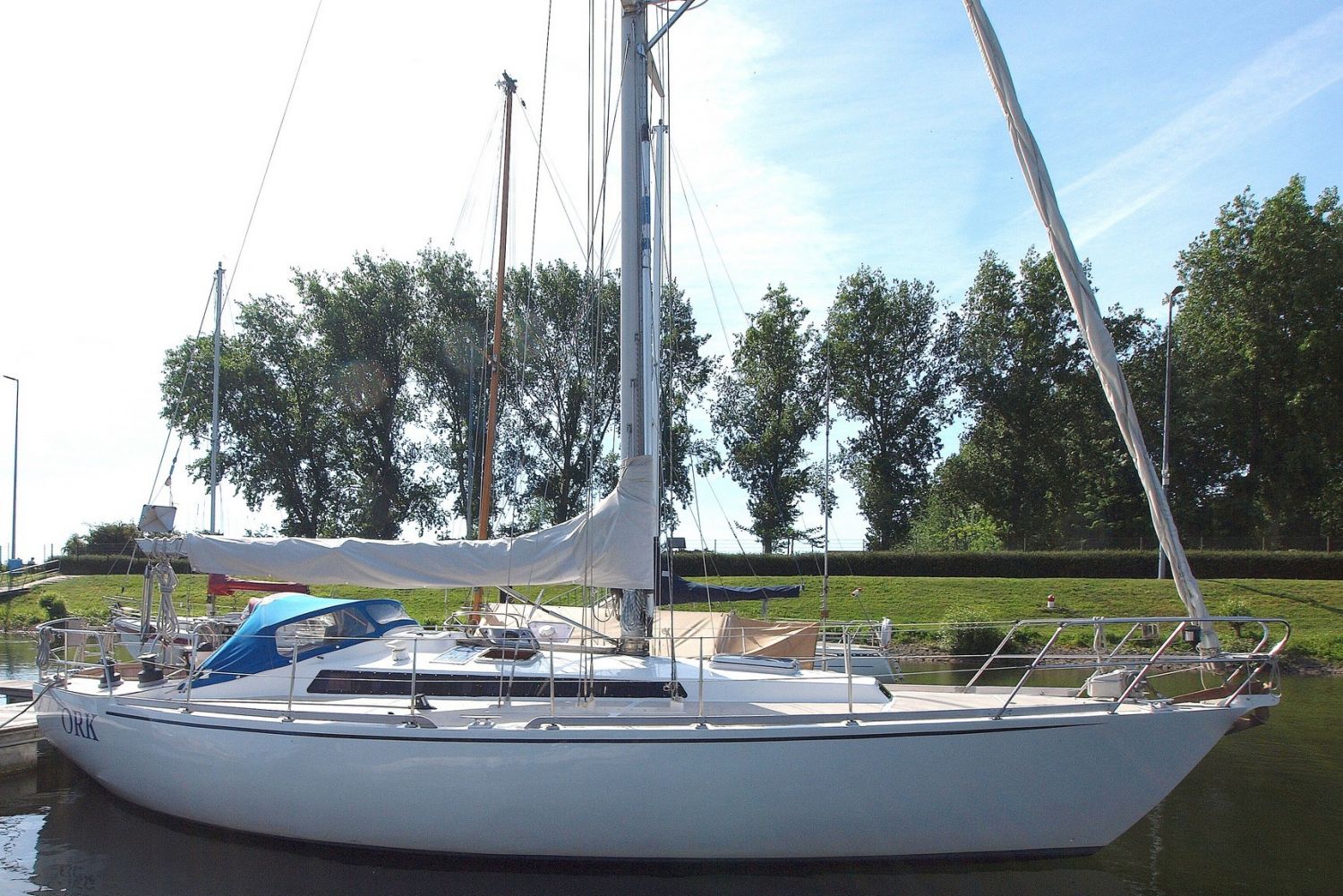

P.S. - Just found some more info → PDF: Hallig 35 C lifting keel, interior layout + some specs + designer and yard info.
For some data from sale sites, the above Hallig 43 is for sale in Germany, and the below Hallig 35 C lifting keel is for sale in the Netherlands.
Draft keel up = 0.8 m (2' 7 1/2"), draft keel down = 1.9 m (6' 2 13/16") - - I've seen them dried out unsupported a few times.
P.S. - Just found some more info → PDF: Hallig 35 C lifting keel, interior layout + some specs + designer and yard info.
Last edited:

Phil Christieso
Junior Member
- Joined
- Jun 1, 2016
- Messages
- 83
- Reaction score
- 4
- Location
- Nelson NZ
This has become the forum to find ugly white boats
I feel sorry for leadglobal
I feel sorry for leadglobal
Forum posts represent the experience, opinion, and view of individual users. Boat Design Net does not necessarily endorse nor share the view of each individual post.
When making any potentially dangerous or financial decision, always employ and consult appropriate professionals. Your circumstances or experience may be different.
When making any potentially dangerous or financial decision, always employ and consult appropriate professionals. Your circumstances or experience may be different.
Advertisement:
Similar threads


- Replies
- 24
- Views
- 8,404
- Replies
- 2
- Views
- 6,078
- Replies
- 11
- Views
- 9,982