Rave V Foiling Trimaran.

Doug Lord

Flight Ready
Joined
May 26, 2009
Posts
16,679
Reaction score
354
Location
Cocoa, Florida
This is an entirely new boat being done by Windrider with "V" foils and dual side to side rigs. More below.
read the article here: http://smalltrimarans.com/blog/?p=12549

WindRider revolutionized hydrofoil sailing in 1998 with the original RAVE hydrofoil trimaran. Based on feedback from RAVE owners, WindRider has created the RAVE V, an innovative design which addresses requested improvements through updated technology with these key objectives:

Easy to trailer, assemble and handle at launch, dock and beach
Capable of being sailed by sailors of all abilities
Self-trimming and leveling
Lower retail price compared to other foiling sailboats in comparable category
Ability to foil in lighter winds and enjoyable sailing experience when not foiling
Foiling speeds below 8 knots and upwards of 30 knots
Ability to point higher (closer to the wind) than most multihulls
Rugged light weight design ability to carry over 400 pounds of crew and gear.
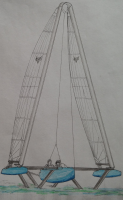
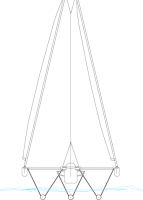
RAVE V accomplishes these objectives by combining the original RAVE ergonomic design including face-forward seating and foot pedal steering with: 1) retractable V shape foils, 2) A-frame dual mainsail rigging and 3) light-weight durable composite construction.
Now in pre-production, RAVE V will be built in Sandusky, Ohio under the leadership of Larry Knauer, RAVE V lead designer and project manager. Formerly with Lockheed Martin, Larry brings a combined 40 years of aerospace engineering and equivalent trimaran sailing experience to his role as Director of WindRider RAVE V.

WindRider has created a crowdfunding campaign which provides participants with a test sail, deposit on future purchase or discounted pre-sale on the first RAVE V production run. Visit https://www.fundable.com/windrider to learn more about pricing, availability and becoming a supporter.


https://www.youtube.com/watch?v=6YiiFqyeZls
 
Rave V

More info: price est: $27,500
Here are specifications in the design:

Overall boat length including rudder is 18.3 feet
Overall boat beam is 14.4 feet, outside the Amas, there is no underwater width outside the Amas simplifying docking
Total sail area is 320.6 Square feet, 160.3 square feet per sail
Total boat height is 31 feet from bottom of sonic tube to top of mast. Mast height above the deck is 26.1 feet.
Freeboard height is 1.95 feet
Draft with V foils extended is 3.4 feet
Draft with V foils pulled up is 0.6 feet
------
Boat length before the rudder mechanism 17 feet
Boat length with rudder removed is 17.6 feet
Main hull (Waka) max width is 2.47 feet
Waka width in seating area is 1.87 feet
Ama width is .75 feet
Ama length is 14.9 feet
Each mast is 26 feet long and a chord of 10 inches
The semicircle mast top is 20 inches in diameter and a 10 inch cord designed to eliminate sail top spillage and drag losses.
Total foil length each leg is 5.2 feet foil cord is 0.47 feet 13% thickness
Sonic tube is 0.736 feet outside diameter and 0.95 feet long
Boat is designed so that with 400 lbs standing on the ama the waterline is at the top of the submerged ama
Sail foot is 7.2 feet with a boom of 7.5 feet.
Sail is loose footed to the boom and is full battened elliptical plan form
Amas will telescope in to a trailer width of 8.4 feet
Semicircle mast top is removed for trailering
For greater detail on the design by Larry Knauer, we have posted extensive notes on the WindRider blog(see link in first post)
 
Interesting and only 1 hours to Sandusky for me. I hope the "sonic tubes" are providing a lot lift because the foil angles don't look good.
 
Rave V

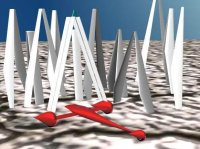
Tom Speer has studied the rig concept for solid wings-see below. I'm not at all sure that his findings below would apply to the new Rave rig but it is worth considering:

http://www.tspeer.com/landyachts/twin/dragstudy.htm
Tom says:
When compared on the basis of equal rig heights, the twin wing was superior in nearly every respect to a comparable analysis performed on a single wing rig. However, the actual performance may differ because of Reynolds number effects (the twin wing's Reynolds number is less than half that of the single wing) and compromises necessay to provide adequate structural stiffness to the twin wing's long, slender panels.

http://www.tspeer.com/landyachts/twin/dragstudy.htm

Illustration from Tom Speer:
 

Attachments

  • Twin Wing-Tom Speer.jpg
    Twin Wing-Tom Speer.jpg
    40.1 KB · Views: 952
Can anyone explain what a "sonic lifting tube" is and how it is applied?
 
Rave V

No, not really. I can , however, say that it is a 100% useless appendage on a foiler of this size whose primary contribution will be enormous drag. A boat this size doesn't even get close to cavitation speed until it approaches 40+ knots. On the other hand the foils might experience ventilation much sooner than cavitation.
The designer says:

Design foiling speed to start about or below 7 knots at the design boat and passenger weights. Design V foils to unload as the boat accelerates and lifts out of the water. This is accomplished by the decrease in the lifting area as well as a change in foils design along the length of the foil to be optimized based on speed (Reynolds number) and lifting force out of the water. The lowest point of the v foil is a connecting sonic tube lifting cylinder that has a diameter between 1 and 1.5 time the cord of the foil legs. The sonic tube should have a length about 1.5 to 2 times the diameter of the tube. The center of lift of the tube and the foil legs should be aligned but we may consider the sail forces in trading the center of lift of the tube with the foil legs to optimize the center of foiling lift with sail forces and speed variability.
 
Broomstick

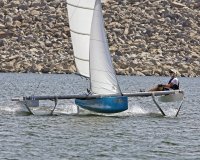
This foiler belongs to and was designed and is being developed by Doug Halsey. It is 15' long,17' wide, weighs 210lb. and uses "V" foils.Broomsticks sail area is between 108 and a max of 143 sq.ft.. Maybe Doug can add the correct figure? You can see the difference in foil spacing as compared to the Rave V:

left picture courtesy of Doug Halsey, right sketch of Rave V from their site:
 

Attachments

  • Broomstick_4.jpg
    Broomstick_4.jpg
    717.3 KB · Views: 3,541
  • Rave V Sketch.png
    Rave V Sketch.png
    1 MB · Views: 1,413
  • Rave V Sketch3.png
    Rave V Sketch3.png
    34.5 KB · Views: 989
No, not really. I can , however, say that it is a 100% useless appendage on a foiler of this size whose primary contribution will be enormous drag. A boat this size doesn't even get close to cavitation speed until it approaches 40+ knots. On the other hand the foils might experience ventilation much sooner than cavitation.
The designer says:

Design foiling speed to start about or below 7 knots at the design boat and passenger weights. Design V foils to unload as the boat accelerates and lifts out of the water. This is accomplished by the decrease in the lifting area as well as a change in foils design along the length of the foil to be optimized based on speed (Reynolds number) and lifting force out of the water. The lowest point of the v foil is a connecting sonic tube lifting cylinder that has a diameter between 1 and 1.5 time the cord of the foil legs. The sonic tube should have a length about 1.5 to 2 times the diameter of the tube. The center of lift of the tube and the foil legs should be aligned but we may consider the sail forces in trading the center of lift of the tube with the foil legs to optimize the center of foiling lift with sail forces and speed variability.

That was my first impression, but I hesitate to draw conclusion given his greater experience and education. I think it is safe to say that it is not adding credibility to their campaign and it needs explanation to say the least.
 
Rave V

Using an estimated boat weight of 300lb and an all up sailing weight of 700lbs, I found the approx. max pressure this boat can sail in is .58lb.sq.ft.. For reference an F18 with two guys on trapezes can sail in 1.8lb./sq.ft. pressure before having to depower or reef.
 
Dual side by side rig ?
Has any one had any experience with this rig ?
Any one have any educated guesses about how this rig might perform on a tri designed for speed ?

http://www.tspeer.com/landyachts/twin/dragstudy.htm
Tom says:
When compared on the basis of equal rig heights, the twin wing was superior in nearly every respect to a comparable analysis performed on a single wing rig.

http://www.tspeer.com/landyachts/twin/dragstudy.htm

OK, but this isn't exactly a wing sail.
I wish i knew what it is about this dual side to side rig that impresses the folks at RAVE.
 
Rave II

I went to the link below and left a couple of questions for the designer-one of which is about the projected all up boat weight.
http://www.windrider.com/blog/rave-v-designer-notes/?comment=16231

Checked today and it says: "Your comment is awaiting moderation".
=================
Just checked again and my question about weight was answered. I think the designer wants this thing to work-his heart is in the right place: his idea of helping to provide a high speed experience for disabled folks is notable. I still have major questions about this design but I hope it works well!
 
I still have major questions about this design but I hope it works well!

Is it the choice of V-foils and sonic tubes that cause you major questions, or is it the dual side by side rig ?

Using an estimated boat weight of 300lb and an all up sailing weight of 700lbs, I found the approx. max pressure this boat can sail in is .58lb.sq.ft.. For reference an F18 with two guys on trapezes can sail in 1.8lb./sq.ft. pressure before having to depower or reef.

.58lbs/sq.ft.,,, because of the righting moment ?
Don't we have to know the lift of those V-foils at various speeds to calculate the righting moment at those speeds ?
Or was the equation just beam, buoyancy and gravity VS. sq. sail area and wind pressure the calculation factors ?
__________________
 
Is it the choice of V-foils and sonic tubes that cause you major questions, or is it the dual side by side rig ?

.58lbs/sq.ft.,,, because of the righting moment ?
Don't we have to know the lift of those V-foils at various speeds to calculate the righting moment at those speeds ?
Or was the equation just beam, buoyancy and gravity VS. sq. sail area and wind pressure the calculation factors ?
__________________
=========================
I roughly estimated RM and HM on the basis that the foils would keep the boat relatively level , which has to be the plan because there is no way to move the crew to weather. The estimated righting arm is very short assuming that there is no way to create downforce with the windward foil. So RA = the distance from the center of lift of the lee foil to the CG of the boat. I'm not sure I included the lift from the windward foil* at all, since, giving the benefit of the doubt, the max possible RM w/o downforce is what I suggested-and could be less.
---
* would reduce righting moment. The original Rave had widely spaced wand controlled T-foils that caused the weather foil to develop massive downforce as the boat began to heel which created virtually unlimited righting moment.
---
I could be wrong, but I don't think the "sonic tubes" will offer a thing. There are many examples in the last three years of foilers developed with a virtually unlimited budget --and no sonic tubes. I think they will be a major handicap to getting the boat foiling.
Doug Halsey designed, built and flew a 15' "V" foiler with no sonic tubes and and a cursory glance at the separation of his "V" foils vs the Rave V foils is cause for question especially considering that the Rave has much more SA than Dougs boat. See post #7.
I wish them luck-perhaps they're on to the next big thing.......
 
Forum posts represent the experience, opinion, and view of individual users. Boat Design Net does not necessarily endorse nor share the view of each individual post.
When making any potentially dangerous or financial decision, always employ and consult appropriate professionals. Your circumstances or experience may be different.

  • Back
    Top