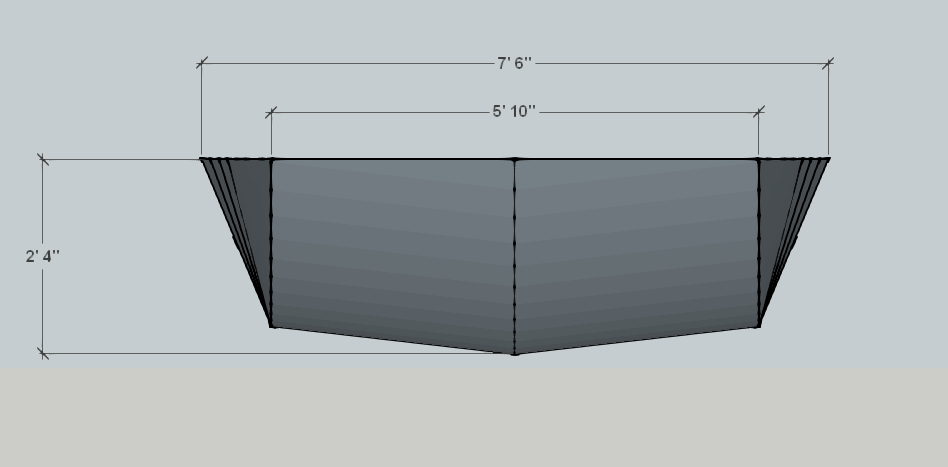
Just messing around in sketchup designing hulls, wondering what you guys think about it and whether or not it would actually handle well. I am still trying to learning about stability and hydrodynamics.



To install this app on your iPhone:
Note: This feature may not be available in some browsers.
Shrimpkin: The respondents would need far more information about the boat to answer your question adequately. You have not detailed the forward stations, have not given displacement figures, expected operating speeds, power of the propulsion unit, what kind of water it would be operating in, and more.
Designing boats that faithfully satisfy the intended use is not a casual exercise.


FreeShip will run the hydrostatics on this hull form, but it will not tell you if it's well suited to your needs. This is a garvey hull and there are lots of these designs available, for 'glass, plywood and metal construction. You'd be well advised to get a set of plans, so there's no guessing about hydrodynamic suitability for your needs.
This is the Glen-L "Bass Boat " and a very modest dead rise garvey design, in plywood. It can be built at 17', which is a stretch of their 15' 6" version, but a stretch to 18' is certainly possible too. Plans are 135 bucks, so . . .
Unless you are competent at welding alloy, which is tricky, then it may not be such a good idea, and with the added complication of a design error(s) you may make, could be a more costly mistake. The fact that your drawing has a vertical transom suggests you aren't across all the requirements.
I'd say it does not have to be within precise dimensions, or something horrible will happen, an eighth inch out here or there will make no discernible difference in a relatively sedately moving boat. If you are intending to use unswaged light gauge material, you will need an elaborate framing set-up, or have "dishing" galore, so you don't really save weight, or cost, or time, by using it. In the absence of equipment to press longitudinal ribs into the sheeting, most cottage builds resort to heavier plate construction. I have never seen an alloy welded boat made with plain flat sheet of very light gauge material, it makes little sense to try.
So the strakes longitudinally along a boat like an alumacraft pro 185 are pressed into the sheet, they aren't angle strips formed to the underside of the hull and welded in place? My current boat is a custom aluminum boat my grandfather had made in 1985 and it has pieces of angle welded like I described. I know as I can see inside the hull and it is not press formed. Granted, it is of heavier gauge material than I plan on using. My plan was to have a plywood "mold" to lay the sheeting across, tack the hull together, and then have form cut ribs on the inside to hold the structure rigid with angle welded along the bottom side to keep the plate from what I believe you described as dishing and what I would call malforming. I have a 6'x12' plasma cnc and a 5'x10' waterjet at my disposal as well to cut all of these things to within .005" accuracy. I agree that form pressed strakes would be not only lighter but easier to create given you have the machine.
I have no idea how that brand name boat is constructed, but in this country only plate (read 3mm or more) would have stiffeners or strakes welded on. Mass manufacturers would have pressings in 3mm (1/8") even. You are using much lighter material than that. By malforming I take it you mean distortion from welding heat, dishing of relatively unsupported flat panel is more to do with water pressure on the panel from wave impact, even the wakes of other boats. It looks sh*t-house, and if bad enough can effect the performance of the boat.


You don't want bulkheads contacting the sheeting, unless you have comprehensive longitudinal stiffenings in conjunction with it, or it will create hard points, and/ or will dish.

