Multiple headsail, "mainless" sailplan

A few thoughts:

1.) As shown, this rig is not strong enough. the reason is that the back shrouds do not have enough angle. To get enough of this angle, you will probably have to resort to at least one aft facing spreader, maybe two.
2.) You would probably do better with just two jibs. It will be a lot easier to adjust them in relation to each other than it would be with three. The mast, its shrouds and its spreaders will produce a lot of drag aft, which will make the boat want to point up wind. When sailing down wind in windy conditions the inner jib could be struck and the outer one could be roller reefed as much as necessary. When sailing upwind in such conditions, the outer jib could be struck and the inner one be used. Reaching in such conditions both sails could be roller reefed to get nearly the precise balance needed.
3.) I agree with the others that this is not very efficient rig, because the two jibs will almost never be ideally set. There is also the issue of a lot of staying and spars per given amount of sail area. These shrouds and spars must be set up under great tension to get the best out of this rig. But, this being said, it may turn out to be a very good cruising rig, as the boat will ride at anchor much better than one with a more forward stepped mast would. With all the sails in front of the mast and the mast stepped perhaps three quarters of the deck length aft, the halyards will be very easy to get to. With really high quality roller furling gear, handling the sails will be quite easy to manage, except during short tacks. Even with less than ideal shroud tensions and sheeting angles, it will work reasonable well, but would likely be roundly shown up by a boat with a more conventional fractional rig of the same sail area.
4.) Another disadvantage of this type of rig is that it would be much more difficult than usual to add large light air sails, as there is not much room for the clew to go aft past the mast. To get the added area, such light air sail would have to be cut with a relatively large shoulder and maybe set from a sprit in front of the jib stay.

Using high rake (10...20 degrees) combined with moving the mast step a little forward would reduce structural loads substantially, while allowing same size jibs with same aspect ratio. Position of center of mast would remain the same, upper part moves aft and lower part forward. Also no spreaders would be needed for back shrouds as angle to the mast would be quite reasonable without them.
 
An interesting idea, but I think the OP was looking for a rig with no moving spars. And except for its suggestive shape, a Lateen has little in common with a head sail only one.
 
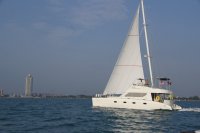
This photo captured on the net, shot in 2010, it is actually a Baranquilla motor yacht equiped with a mast and two jibs on furls :
Cata with jib.jpeg
https://thailand-yachts.com/yachts/catamarans/barranquilla/
 
Another view of the Caravell from my previous post

Caravel1.jpg
 
Another view of the Caravell from my previous post

View attachment 138271

This rig is interesting to me for a number of reasons. The question I have is whether the aft sheet position on transom (or is it a canoe stern - worse!) would induce an undesirable curvature in the aft sail, on a reach or more downwind? Or does he shift the tack of the aft sail to windward? And what about downwind? - is the rig set up in a 'tradewinds' arrangement, both jibs poled out?
 
No canoe stern, thank goodness.

The problem with all loose foot sails, is that you are restricted to the deck geometry.

I have never spoken to the owner of the local Caravelle, but the original article did suggest poling out options for down wind.
I have always been curious how the sheeting of the 2nd sail copes with the near vertical shrouds at the stern.

This design would not be competitive in racing. It makes ease of operation the boss of the design, at the expense of sail optimization abilities.
 
I'd been toying with a very small sailing cat with parallel masts on each hull but the fiddli-ness of twin masts, booms, and associated rigging in any plan put me off on the idea. Mostly in how the booms and traveller(s) encroach upon the center cockpit/deck. Dispensing with them and "simply" going with a pair of headsails fwd' reduces the complication to simply managing the controlling lines.
Hmmm.... where did I put those drawings.
 
No canoe stern, thank goodness.
The problem with all loose foot sails, is that you are restricted to the deck geometry.
I have never spoken to the owner of the local Caravelle, but the original article did suggest poling out options for down wind.
I have always been curious how the sheeting of the 2nd sail copes with the near vertical shrouds at the stern.
This design would not be competitive in racing. It makes ease of operation the boss of the design, at the expense of sail optimization abilities.

"The problem with all loose foot sails, is that you are restricted to the deck geometry".
unless you've got two or more hulls :)
"I have always been curious how the sheeting of the 2nd sail copes with the near vertical shrouds at the stern."
pulling the tack to windward is an obvious solution, you've got the breadth of the deck there
 
I'd been toying with a very small sailing cat with parallel masts on each hull

usually called a 'biplane' rig, The idea has a history. It seems obvious for a cat, but in practice I believe there are aerodynamic limitations - like any rig..
 
"I have always been curious how the sheeting of the 2nd sail copes with the near vertical shrouds at the stern."
pulling the tack to windward is an obvious solution, you've got the breadth of the deck there

Well yeah, but Naaah.

On a beat to windward, the sheet would be under the shroud, and cleated to the stern rail.

When you go on a reach, and you either pole it out, or try to shape it with the sheet end out past the rail, you would either have to have a second sheet, or unclip and re-clip the sheet to avoid it wrapping around the stay.

Very inelegant and a safety issue when flogging in heavier winds.
 
I get the shroud problem, blind Freddy could see that :)
But - in principle - what is the different between pulling the clew to leeward on a track (if there was a track and the shroud wasn't there) and pulling the tack to windward? I mean, what (theoretically) is the drive and balance effect of moving the tack off the centerline? The curve of the foot is just moved to windward. The sail is a little more vertical. The luff now assumes a dihedral line wrt mast. ...
 
usually called a 'biplane' rig,

I hate that term.
The idea has a history. It seems obvious for a cat, but in practice I believe there are aerodynamic limitations - like any rig..
True.

Was going to say/speculate more, but I need to ponder on this a bit.
 
I get the shroud problem, blind Freddy could see that :)
But - in principle - what is the different between pulling the clew to leeward on a track (if there was a track and the shroud wasn't there) and pulling the tack to windward? I mean, what (theoretically) is the drive and balance effect of moving the tack off the centerline? The curve of the foot is just moved to windward. The sail is a little more vertical. The luff now assumes a dihedral line wrt mast. ...

Because a luff has to be tighter than the leach, and it's extremely hard to achieve that when the luff is being moved around.
 
Don't know if the OP is still following this thread, but John Hitch has designed some catamarans that were powered only by head sails. This one is X-IT.

X-_IT.jpg
 
Forum posts represent the experience, opinion, and view of individual users. Boat Design Net does not necessarily endorse nor share the view of each individual post.
When making any potentially dangerous or financial decision, always employ and consult appropriate professionals. Your circumstances or experience may be different.

  • Back
    Top