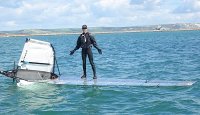
Moth on Foils: 35.9 knots(41.29 mph)

  • Thread starter Thread starter Doug Lord
  • Start date Start date
Moth on Foils!- Aussie Nationals(pre-Worlds)

For the USA: Bergen 7th gulari 8th. Apparently(see next post) Charlie McKee used The Wing. Just plain amazing....
1-Outteridge
2-Babbage
3-Turner
4-Burling NZ
5-Harris
6-AMAC(!)

USA:
7-Bergen
8-Gulari
15-Peet
25-Funk
40-Bergen
42-McKee(The Wing)
61-Rast
90-Knowles
 

Attachments

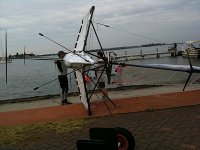
Moth on Foils! The Wing (and weed)

From Matt Knowles blog:

"A lot of people have been asking about (or speculating about) the wings. Bora is busy working hard on his final push to try to regain his world title, so I'll clarify things a bit. Since we've arrived our container has been an open shop. We've given full and honest answers to all the questions people have had. We're trying to help the class gain the data it needs to make an intelligent decision about wings in the long term. There's no gamesmanship going on. The three identical wings the US team brought to Belmont have shown great promise in certain conditions, but also considerable weakness. The biggest weakness is light air (marginal foiling). The wings also struggle at times downwind; if they are not set up and trimmed perfectly, they are quite slow downhill. In breeze, they are very hard to beat upwind. Nevertheless, the plan right now is for Bora and Bear to run soft sails for the Worlds. Charlie McKee is going to sail with a wing for the whole event. As he puts it, "someone has to do it" to help the class see what we're dealing with".

Read the whole comment(incl. the weeds) here: http://knowlesmoth.blogspot.com/
===================
Question for anyone that knows: Is the weed problem at Belmont something that was known about ahead of time or is it just an odd occurence that is infrequent at this venue?

--------------------
UPDATE1/9/11-more on weeds from Scuttlebutt:

STRATEGIC CAPSIZING AND ZIGZAGGING
Belmont, NSW, Australia (January 9, 2011) - With two days of racing under
its belt, the 110 competitors at the 2011 Zhik Moth Worlds have come to
realize that success at this event will prove no different than any other
big championship. You can’t be tactically smart unless you are among the
fastest, and you can’t maintain speed throughout the course unless you are
at an elite boat handling level.

However, with the inordinate amount of weed on the course, the boat handling
toolbox must include a new technique: the intentional weed-clearing capsize.
There is no other means to clear the blades. “I had one beat where I needed
to flip five times to clear weed,” shared American Matt Knowles. “Really
frustrating to flip and watch the boats you've worked hard to pass sail away
from you, but on the other hand it is hard to keep your boat in the air if
you don't clear the weed.”

Lighter winds on Saturday kept the fleet mixed, but with stronger winds on
Sunday seeing some gusts up to 25 and above, the top guys had big smiles on
their faces as it was a boat handling day that separated the boys from the
men. And the big man on campus continues to be Australian National Champion
Nathan Outteridge, whose first race fifth has since been overshadowed by
five straight bullets.

 
Last edited:
Bora has been a focal point in the wing discussion and he has been pretty level headed and practical in what he has said. It looks to me like Bora, Bear and a few others have really treated the wing as a team effort. However, given the small time on the water, I would by no means expect the wing to be "dialed in" for optimum performance. If Bora does not wing it, but others do, we may get a more honest assessment of how good they are at this point.

If Bora won with a wing, we would really not know if it was the wing or it was Bora, but many would want to follow just because of his results. If the results were mixed, we would be just plain confused. If Bora did poorly with the wing, it would turn a lot of people off regardless of any reality.

If the non-Bora wing equipped boats do better than would be expected normally, the wings will look to be a plus even though Bora chose not to use one.

If the wing equipped boats give mixed results, we will probably assume that more tweaking is needed.

If the wing equipped boats do worse than would be expected normally, the wing looks to be well short of where it needs to be in terms of optimizing for moth use.

Given the people who did the wing design and their accomplishments (C Class champs, Magnus working for Oracle etc.) I do not think the current Moth wing design to be very far off the target. Rather I think we are seeing the issues of boat speed (Moths being faster than C Class cats on the top end), disaster (capsize and weed) recovery becoming far more of an issue than in C Class and large fleet (100+) racing versus C Class match racing (or six C Class cats at once).

Just like the wing experiment hasn't proven success in the A Class cats, the Moth just may not be the right platform. The reality of class racing is that it isn't an optimal condition speed trial and winds vary from race to race. Light wind days happen, and races have to be done to meet schedules. This is a point I've been making for a long time now regarding all the nonsense performance claims made based on optimal conditions - disregarding sub-optimal days. The Moth is not the fastest boat under 20' in all conditions - it is sheer misery on zero-3 knot wind days, when just about anything else will be faster and more comfortable. Portsmouth handicaps require reporting across all conditions, and there are often different ratings for different conditions.

It will be interesting to see how things pan out going forward - maybe the wings will be a success when conditions are right. The other issue to consider is how well the wings respond to unavoidable crashes, weed clearing and fleet starts. If wings turn out to make a run-of-the-mill capsize a DNF (perhaps an expensive DNF if they need to have panels cut to drain), the economics will become an issue.

I agree that Bora has been a true sportsman in his handling of this issue and the controversy around it. The US has shown teamwork in a sport where teamwork isn't an asset under normal "every-man-for-himself" rules.

--
CutOnce
 
Moth on Foils!

After digesting what Matt says above and thinking of Halls A Class experience I'm wondering if the C Class might not benefit from the super high tech soft sail/rigs used in the Moth Class and A Class? When the "C's" switched to wings the soft sails were no where near what they've become today so it makes you think.

Video from Mottenfieber Sailing TV:

Race two start: -noticed Moth with twin bow wands just a few seconds in*: http://www.youtube.com/watch?v=EiCNSFZTO0o&feature=player_embedded#!

Race two finish: http://www.youtube.com/watch?v=nYlwhIqL8lo&feature=player_embedded
-----------------


Chris Rast blog- http://fasterandhigher.blogspot.com/
Rast, apparently speaking for the American team:" That Nathan pulled off 5 bullets is nothing less than frightening from our perspective."

* Twin wands , Rast picture:

(click on image)
 

Attachments

  • Moth double wand Rast picture.jpg
    Moth double wand Rast picture.jpg
    30.2 KB · Views: 1,288
Broken Wing

From Chris Rast's blog:

broken.jpg


Text with the picture:

"Breaking" news...

"I was doing 24 knots downwind when I stuffed the bow and stopped radically. The leading edge buckled and the rest, well the rest you can see..." was Charlie's recap of what happened.

About an hour after Charlie had given an interview to media guys at the event and launched for another sail with wing #2, we saw Rob Patterson towing Charlie back into shore with the wing folded in half on top of the coachboat. "That doesn't look good.." said Bora. We retrieved all pieces and brought them back to the container for further inspection. (We believe the FAA is coming by tomorrow for a more thorough analysis.) This was wing #2 which had shown some buckling early on and we had fixed it... or so we thought. The leading edge buckled again a couple of inches below our repair. Charlie opted to sail again with it today in order to validate it and pushed it pretty hard. As far as we can tell the failure is due to inconsistent bonding with the core. The 75 gsm prepreg that we used is extremly "dry" with minimum resin content. While building the elements we did our best to maximise pressure in the molds in order to ensure proper bonding, but in the end obviously an autoclave would have been best. Lets make this clear, there is not a problem with the pre-preg. This TPT stuff is awesome, we just didn't quite give it the proper attention it needs.

Yes, this is a set back for us but we will take some valuable lessons away from it and we are confident that we are on the right track. Charlie will continue sailing with wing #1 and #3 for the worlds.

This is exactly what I've been talking about in regards to cost and what wing failures will do to racing. There goes some serious dollars and serious time (if you make it yourself). If you bought it, there goes a couple thousand dollars or more. To keep the costs reasonable, they used prepreg and didn't use an autoclave to cure it. Big mistake. Note the two remaining wings have been made the same way. Extreme light weight and building things to the edge of technology has high risks.

Armchair "experts" on forums like this dismiss these real world issues with comments like "If you read what Steve Clark has said or particularly what Adam May has said(and done)-both very experienced with wings-you would realize that, at best, your analysis of the wings for the Moth is flawed.". My analysis stands up quite well given the evidence from the current Moth Worlds.

Reality - 1. Hype - 0. Proving common sense trumps gibbering Internet fanboys? Priceless.

I do not think the Moth class is done with wing sails, and I think there will be further refinement of the concept. Wing sails may have a place setting records in the right conditions, and this year's worlds certainly prepares the ground for acceptance within the class rules. I feel a lot of sympathy for Bora Gulari who has probably invested tens of thousands of dollars into this experiment - and will have to spend a lot more going forward.

--
CutOnce
 
Moth on Foils! The Wing

This is exactly what I've been talking about in regards to cost and what wing failures will do to racingCutOnce

=============
It is absolutely ridiculous to ascribe characteristics to wing technology based on a wing that was obviously built with a flaw! That shows an abysmal appreciation of the realities of the situation as described by Rast. Adam May stood on his wing in addition to repeatedly pitchpoling it without failure. Failure can occur, theoretically, with a well made wing built to the edge-with a poorly made wing failure is likely and means nothing as to the viability of a wing on a Moth!
---
That being said I've never thought the wing was the end all be all of sails for every boat and have pointed out repeatedly the Ben Hall experience in the A Class and the high level of sophistication of the current crop of soft sails. It is highly likely that the Moth rules may prohibit a wing being designed to take full advantage of what is possible under a rule like the C Class or on landyachts.

From Tom Speer( http://www.boatdesign.net/forums/multihulls/understanding-wing-technology-34697.html posts 11 and 90) :

"As a practical matter, I believe it is possible to design a wingmast & sail that is competitive with a rigid wing under most conditions. The A-class catamarans seem to have settled on soft sails while the C-class cats have settled on rigid wings. From what I've seen, a single slotted flap is probably comparable in maximum lift and a double slotted flap will probably have a higher maximum lift than a wingmast & sail. However, the wingmast may have less drag at high lift and will most likely be lighter than the rigid wing and better able to accommodate a wide range of conditions. In landyachts, the best of the rigid wing rigs and the best of the wingmast rigs are neck-and-neck with each other".
-------------------


"The fixed luff length of the Moth will neutralize one of the advantages wings have enjoyed, which is the ability to have a taller rig and still maintain accurate control of twist and camber. So you may not see as big a difference between wings and soft sails in the Moth class as you do in other classes."

Pix: Adam May intentionally wingwalking-no damage:
(click on image)
 

Attachments

  • Moth May wingwalking.jpg
    Moth May wingwalking.jpg
    31.5 KB · Views: 926
Although their wing was built using technology from the C Class boats, I have maintained that I would never expect the first try to be well sorted out for this application. The moth application is a lot different than the C Class application.

On the performance side, the wings are going up against soft rigs that are not shabby at all. Top performers probably keep there sails trimmed as much by routine and feel as anything else. It will probably take quite a bit of re-learning to make a wing work as well. In addition to improved trimming that should come with experience, there are a lot of other items that have potential room for improvement (planform, aspect ratio, airfoils sections, gap, front to rear side offset).

Just compare the man-hours of experience that have contributed to the current state of knowledge for optimizing moth sized soft rigs, to the number of man-hours of experience with the the O2 wings. I am not surprised at all by the results thus far and I found the statement below to be encouraging:


we will take some valuable lessons away from it and we are confident that we are on the right track. Charlie will continue sailing with wing #1 and #3 for the worlds.


As far as the failure, I would consider building in some more strength unless they are absolutely convinced that the problem was only a bad build. The cost of failures is just too high and it is better to start more rugged than required and work your way down to just good enough. Remember that crashing is common and some will just be harder than others. With the windward heel on the moth, some extra rig weight is probably not much of a penalty as long as ease of use (getting back upright for example) does not become a problem.

I'm pretty much in agreement with you. I don't think it a bad build so much as they built to the standard set for the C Class. C Class cats are not intended to be dumped, and their rigs are not designed for regular capsize & recovery. A capsize on a C Cat is the end of the day, while on the Moth it is a regular experience. The deceleration of a Moth going from >=24 knots on foils to 0 knots on a stuffed bow is not a planned stress level for O2. It would be interesting to know if Charlie bailed or hit the shrouds. Even a glancing shock to the stays could have an effect on the columnar strength of the rig.

Guessing at things so far, it appears that a fair amount of the pre-fabricated parts were from O2. I'd guess Bora and Bear drove up the 401 from Detroit to Toronto (4 hours), got things going and learned what they needed - then they went back to Detroit and did the final assembly, skins, leading edge and integration work. Bora is an experienced aeronautical engineer who knows composite fabrication, so I'm pretty sure it wasn't beginner mistakes. I'd bet the O2 wings are built to exactly the same standard. Sheer between core and skin isn't a usual failure mode.

The other thing is that this was a wing that had prior buckling on the leading edge. There may be a design issue with the location and/or loading of the stays. Charlie McKee was intentionally stressing this wing, so the failure wasn't a surprise. All aplastic deformation is cumulative and doesn't have to be visible.

In regards to experience, I watched the McKee brothers sailing GP 18 footers in Australia and New Zealand probably before Bora Gulari was out of Optis, so I think the wing could not have been in better hands. Guys who sail at this level are so far past my experience that I'm not qualified to question them at all.

It's fun to be able to watch others go through the development roller coaster I've spent a lot of my life riding. It's also interesting to know that even these guys have to deal with speed bumps and setbacks. If this stuff were easy, it would already have been done.

--
CutOnce
 
Moth on Foils!

Worlds has started!

Race 1 --- Yellow Fleet --- Iain Jensen takes the first race of the day followed by Burling, Sare, Rast, Slingsby, Gulari, Outteridge


Race 2 Yellow --- Provisional Results
Nathan lands first to big cheers from the spectator boats.
2 - Slingsby
3 - Burling
4 - Crockett
5 - Payne
6 - Bora
7 - Harris
8 - Funk
9 - Jensen


http://www.mothworlds.org/belmont/
 
Moth on Foils!

Day One-nobody from US in top ten(!) http://www.mothworlds.org/belmont/

Top Ten for the day:

1 – Joe Turner (AUS) —- 4

2 – Nathan Outteridge (AUS) —- 7

3 – Rob Gough (AUS) —- 7

4 – Peter Burling (NZL) —- 7

5 – Scott Babbage (AUS) — 10

6 – Arnaud Psarofaghis (SUI) —- 14

7 – Tom Slingsby (AUS) —- 14

8 – Matt Crockett (AUS) —- 15

9 – Iain Jensen (AUS) —- 17

10 – John Harris (AUS) —- 19

http://www.mothworlds.org/belmont/wp-content/uploads/2011/01/worlds-after-3-races1.pdf

Bergan USA 11th
gulari USA 15th
McKee( The Wing) 21st
 
Moth on Foils! foil tips

A long time ago I came up with the idea of removable foil tips that could be used to reconfigure a Moth(or Peoples Foiler) for the conditions. A short while ago I asked a good guy and former member to check if there would be a net gain for a 180lb person vs a 147lb person if the heavy guy used removable tips to add span/foil area in light air/marginal conditions. His answer was that yes the heavy guy would be more competitive with the increased span and lower foil loading. Hmmmm......
Such a system would be relatively easy to make.

================

================
So,wind,you have two identical Mach ii's one with Bora and one with,say Simon Payne. Lets assume there is a 15kg(33lb) difference. We know the SA is identical.
Lets assume that each boat weighs 66lb and that ,just for the heck of it, the mainfoil supports a nominal 80% of the all up weight. Guessing that Bora is 180 + 66=246lb then 80% =196.8. If Payne is 33lb lighter,then (180-33)+66=213lb. then 80% = 170.4lb.
If both mainfoils are identical at, say 1.1 sq', then Boras mainfoil loading= 178.9lb/sq.ft. and Payne 154.9.
196.8/"X"=154.9 and solving for "X" it can be seen that for Bora to have the exact same foil loading his mainfoil are would have to = 1.27 sq. ft.. which is .17 sq.ft. or 24 sq. inches more area or 12 sq. in. added each side. For a 4.75" chord foil that would be 2.5" added to each tip. Adding that area in light air would also increase the span, probably reducing drag. This is just an example-it might turn out after research that adding a small amount to the rudder foil as well would be beneficial.
---

===============================


A while back I asked Rick to look at the figures in this post to see if my supposition regarding adding tips to a "standard" foil would help a heavy guy in light conditions. His conclusions show that the heavy guy would benefit from the tips (and resulting span increase) both when on foils and at takeoff. The structural integrity of the wider foil was not considered and it was assumed there would be negligible difference in wave making between the two foils.

Note: I have Ricks permission to post this and his worksheets but I can't seem to post them. If anybody would like to see them e-mail me and I'll send you a copy.
===================

From Simon Payne 1/12/11:


On gear? Well Nathan and some of the other Aussie Moth Squad have cut 60mm off the tips of their main foils and accordingly it's our intention to make a smaller foil for big winds, so dont get the saw out just yet! can do in these winds when you light the blue touch paper. And fast it was! I went through the line in the 2nd race with 28.6 knots on the clock.

http://sipayne.blogspot.com/2011/01/darling-leave-light-on-for-me.html
 
Last edited:
Moth on Foils!

Results of worlds after 6 races-Team USA not looking too good sorry to say:
From the little I've found there was ,apparently, good wind on Day 2 for the last three races. Forcast: even more wind for todays racing.
From Matt Knowles-
Despite the forecast for 10-15 knots and dying, the wind cranked up today. Sustained speed was probably in the high teens with some gusts up to 25 and above. We started off on the outer trapezoid course, meaning we had a wild reach across the top. Was having a pretty solid race until I blew a tack and the boat ended up turtled upside down with the bow facing downwind

http://www.mothworlds.org/belmont/wp-content/uploads/2011/01/Results-after-6-races.pdf

Brad Funks blog: http://www.funksailing.com/index.ph...1-zhik-moth-worlds&catid=1:2011-news&Itemid=6

Nathan Outteridge(AUS) 5 firsts, one 5th!

Team USA:

Funk 9th
Bergan 12th
gulari 15th
Rast 19th
McKee (The Wing) 22nd
Peet 25th
===================
Sail-World article: http://www.sail-world.com/USA/Zhik-Moth-Worlds-2011---Have-the-Australians-stepped-up-a-gear?/78942

pix from sail-world.com
 
Sort of cruised through this thread and the video on SA. Don't really know much about anything. Got to thinking about whether wings should be allowed by the class. Then I thought what would happen to the average Moth guy if his wing blew up like McKee's? He's not going to have a spare so he's off the water for a long time while he makes or buys a new wing. If soft sail guy if he trashes his sail, or even a mast, he's likely to have another sail he could use, might not be the best but it keeps him on the water.
I guess they have to balance what is allowed by the rules with what's best for the class.
Like I said, an idle thought from someone that doesn't know anything.

Sensible post. Many people get caught up in the whirlwind of technology and forget what the sport is actually about and who is actually sailing the boats. Many of the current Moth enthusiasts started building and sailing Moths as high school students, back when you home built scows and skiff Moths in plywood. Now these same folks (now financially secure) are in their 40s and 50s buying $25K US carbon Moths from McConaghy. The economic hurdles to get into the class have been raised so much the original entry level Moth sailors are now priced out of the game.

It says a lot that people can sail Moths for decades and not leave the class, but the financial ante to start up in the class is a problem. Adding wings would make this problem worse.

I think thing are working out as they should - with prominent people voicing their opinions to the negative as well as positive. I know there are a lot of interested fans sitting in the bleachers wanting to see unrestricted development in the Moth class for their own amusement and education, but for the people that race the boats not setting boundaries on the development will certainly have an effect.

I think that regardless of the Moth class' decisions regarding wing sails, the wing sail development will proceed, even if they can't be sailed in regattas. It is just too cool not to. To gain traction in the class, the wing sails need to be able to prove superior performance anyway - which isn't a given at this point.

--
CutOnce
 
Forum posts represent the experience, opinion, and view of individual users. Boat Design Net does not necessarily endorse nor share the view of each individual post.
When making any potentially dangerous or financial decision, always employ and consult appropriate professionals. Your circumstances or experience may be different.

  • Back
    Top