
Low Maintenance Boat Interiors - Anyone used TEDLAR from DuPont ?

rwatson

Senior Member
Joined
Aug 2, 2007
Messages
6,278
Reaction score
544
Location
Tasmania,Australia
Stains, mould, marks etc are the bane of boat interiors.
I just heard of TEDLAR, which seems to be what most commercial aircraft use for interior lining.
Has anyone used used it in a marine environment ?
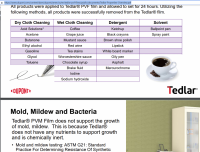
TEDLAR.png

https://www.dupont.com/content/dam/...blic/documents/Tedlar-Properties-Overview.pdf
 
Thank you Mr Watson for the heads up about this material - it certainly has very impressive properties.
It is probably relatively expensive (compared to other materials commonly used as linings on boats), but it certainly does appear to be ideally suited for use in a marine environment.
 
The RV industry has used it for a very long time, like everything else though, it has its place. It hasn't really caught on for marine applications, probably due to it being a bit fragile, sort like a vinyl wrap.
 
Oh, i love that idea; Having run a solar installation company, i've been very impressed how these thin films keep out the humidity that would destroy the cells, and protect the clients from the 400-500 V DC for up to 40 years despite the huge temperature differentials between winter nights and summer working temperatures, plus all the mechanical aggression from dust, plant growth and little animals.

I'm wondering if the glue thickness in the autoadhesive variants and the shrinking behavior might allow to use them on the outer side of infused panels without much surface prep? Also curious about what Dupont's marketing mentions for wind turbine blade fabrication: they seem to use the Tedlar as release film and blade coating "at the same time"..? If someone has worked with it i'd be all ears.
 
Last edited:
The RV industry has used it for a very long time, like everything else though, it has its place. It hasn't really caught on for marine applications, probably due to it being a bit fragile, sort like a vinyl wrap.

Fragile ? That's not the impression I got from their brochure. Have you actually seen any in the "flesh" ?
 
Here is the full website.

DuPont™ Tedlar® Provides Superior Surface Protection for Interior and Exterior Surfaces https://www.dupont.com/brands/tedlar.html

So basically, as rwatson says, this is the "headliner" material you see inside modern aircraft. It is a glue-on material designed for smooth surfaces. I'm really not seeing a place for it except in mid-size and up motor yacht construction or cabin liner material on ships.. From the point of view of small yacht construction, a gel-coated liner is probably more durable and a better production choice (i.e. less cost & work). From high end construction, the surface material and texture (think varnished mahogany raised paneling) is more important that the "easy clean" needed for mass transportation. This leaves the 'Winnebagos"...i.e. mid-sized cabin cruisers that have large smooth interior partitions that are not part of a moulded liner that you don't want to be visibly decorative. I think the long term issues will be with the adhesive and panel surface rather than the liner material, as has been shown in many cases; I know I've pulled out my share liner material from boats.
 
So its basically wallpaper?I can imagine some uses and it won't have the drying time or fumes associated with paint or varnish.Will it stay bonded?Wrapping round edges might be a challenge.For those who haven't discovered Tygavac PTFE coated glass for releasing,it may be handy for releasing components from simple tooling.Resisting various solvents may be a strong point in the event of another pandemic that has us wiping surfaces with strong alcohol based sanitiser.Which,incidentally I thought might have brought about the end of the vogue for interior joinery featuring shadow gaps.A trend I believe to be less of a design statement than a way of using an edgebander to rapidly edge panels and then having to justify the result in terms of "style".Not that it really matters,unless a visitor to your boat sneezes,is later found to be infected and then you have to go around all the shadow gaps with cotton buds dipped in sanitiser.....

I think I'll hold off for a while and look out for reports of it's successful use for a few seasons by one or other of the large charter operators.If it can cope with that kind of use it will be worth trying.
 
Fragile ? That's not the impression I got from their brochure. Have you actually seen any in the "flesh" ?

It is a thin film on the surface that isn't easy to repair, so damaged panels are commonly marked as seconds. It has been used on large commercial trucks and trailers, motor home side walls, house boats, etc for more than two decades. It has good UV and general weathering characteristics, so people have made great efforts to encorporate it into composites.

The cost and hassle limit its use for cost sensitive products though.
 
It is a thin film on the surface that isn't easy to repair, so damaged panels are commonly marked as seconds. It has been used on large commercial trucks and trailers, motor home side walls, house boats, etc for more than two decades. It has good UV and general weathering characteristics, so people have made great efforts to encorporate it into composites.

The cost and hassle limit its use for cost sensitive products though.

But Fragile ??
Up to 150 MPascal pressure ?

Tedlar.png
 
Forum posts represent the experience, opinion, and view of individual users. Boat Design Net does not necessarily endorse nor share the view of each individual post.
When making any potentially dangerous or financial decision, always employ and consult appropriate professionals. Your circumstances or experience may be different.

  • Back
    Top