
The Boat Design & Boatbuilding Site
Install the app
How to install the app on iOS
To install this app on your iPhone:
- Tap the Share button at the bottom of Safari.
Tap ... if Share is not visible, then Share - Tap Add to Home Screen
Tap View More and scroll down if needed to see Add to Home Screen, then Add to Home Screen. - Tap Add on the top right to confirm.
Note: This feature may not be available in some browsers.
You are using an out of date browser. It may not display this or other websites correctly.
You should upgrade or use an alternative browser.
You should upgrade or use an alternative browser.
Keel rocker aft for LDL powerboat
- Thread starter huibes
- Start date

fallguy
Boat Builder
- Joined
- Dec 7, 2016
- Posts
- 9,010
- Reaction score
- 2,115
- Location
- usa
The high trust version would be ideal, but not available with short shaft, which is preferred because the outboard is placed in a well
I think you need to reconsider the well height. What's another 5"?
Also, I am not an expert, but have seen these as double wedge hulls. Have you considered? Why not?
Also, you don't want to plane a 22-25' boat, right?

huibes
Sittin' on the dock of the bay
- Joined
- Mar 5, 2010
- Posts
- 40
- Reaction score
- 1
- Location
- The Netherlands
This article shows the various curves of areas for particular S/L ratios.....http://www.tadroberts.ca/about/pdf/power-boat-design-form-and-function.pdf
Again, thanks so much for this!
Starting from my calculated midsection area and following your percentages given for S/L 2.2, the total volume and Cp are exactly correct!
However, I have more weight in the bow sections. Pls see image. So you recommend to make the bow finer?
And what do you think about the (minimal) aft keel rocker?
Another thing: She will much more often used at 8 knots. So should I aim a little more towards S/L 1.6 in your graph?
Thanks in advance!
Attachments


Last edited:
fallguy
Boat Builder
- Joined
- Dec 7, 2016
- Posts
- 9,010
- Reaction score
- 2,115
- Location
- usa
Here is a not so wonderful thread on the double wedge.
Please Review Hull Form https://www.boatdesign.net/threads/please-review-hull-form.63559/
Please Review Hull Form https://www.boatdesign.net/threads/please-review-hull-form.63559/

Doug Halsey
Senior Member
- Joined
- Feb 7, 2007
- Posts
- 664
- Reaction score
- 232
- Location
- California, USA
What's an "LDL"?
Mr Efficiency
Senior Member
- Joined
- Oct 17, 2010
- Posts
- 10,374
- Reaction score
- 1,051
- Location
- Australia
When you say you have seen them, can you access them now ?Indeed, very light. And the right shape, which is why I'm checking for assistance here.
Over the years I've seen a few nice examples that proof it is possible. Just have to get it right!
Mr Efficiency
Senior Member
- Joined
- Oct 17, 2010
- Posts
- 10,374
- Reaction score
- 1,051
- Location
- Australia
Low displacement to length ratio, presumably.What's an "LDL"?
Displacement–length ratio - Wikipedia https://en.wikipedia.org/wiki/Displacement%E2%80%93length_ratio#:~:text=The%20displacement%E2%80%93length%20ratio%20%28DLR%20or%20D%2FL%20ratio%29%20is,Ships%3A%20A%20Manual%20of%20Marine%20Propulsion.%20p.%2099.
Mr Efficiency
Senior Member
- Joined
- Oct 17, 2010
- Posts
- 10,374
- Reaction score
- 1,051
- Location
- Australia
The mere fact that this boat is to be built in alloy, and I expect plate, and regardless of what thickness plate, there will be a fair bit of weight in the structure, as you will need more framing if lighter plate, I feel you are grappling with diverging factors that are going to difficult to co-ordinate. You might be better to build in foam sandwich to an existing plan for a semi-displacement hull. You can't build super-light in thin plate, and not see framing sticking out like ribs on a greyhound. Swaged thin alloy, is a different story. As for the motor being in a well, and needing short shaft for that reason, I feel you have handicapped yourself, I see little hope of you getting the performance at those speeds.
huibes
Sittin' on the dock of the bay
- Joined
- Mar 5, 2010
- Posts
- 40
- Reaction score
- 1
- Location
- The Netherlands
When you say you have seen them, can you access them now ?
Haha good question! Afraid not...seen most online. I do believe from mostly reliable sources though...
And I once owned something similar to the article I started this thread with. That would plane with very little effort.
huibes
Sittin' on the dock of the bay
- Joined
- Mar 5, 2010
- Posts
- 40
- Reaction score
- 1
- Location
- The Netherlands
The mere fact that this boat is to be built in alloy, and I expect plate, and regardless of what thickness plate, there will be a fair bit of weight in the structure, as you will need more framing if lighter plate, I feel you are grappling with diverging factors that are going to difficult to co-ordinate. You might be better to build in foam sandwich to an existing plan for a semi-displacement hull. You can't build super-light in thin plate, and not see framing sticking out like ribs on a greyhound. Swaged thin alloy, is a different story. As for the motor being in a well, and needing short shaft for that reason, I feel you have handicapped yourself, I see little hope of you getting the performance at those speeds.
I would like to build in wood epoxy but my dad prefers less maintenance and no paint job.
I've been on a 4 mm alloy boat of 7x2 meters, hull weighing only 350 kg, running 11 kn with 10 hp. 40 hp max. Didn't feel or look flimsy. Of course she didn't have structure for offshore or very high speed usage.
That design is close to perfect. Except its multi chine and my dad doesnt like the looks (I disagree...)...pls see image.
Looks like the buttocks aft are straight, and the transom is minimally immersed. But how to combine this with a little more displacement around the midsection....?
Attachments


huibes
Sittin' on the dock of the bay
- Joined
- Mar 5, 2010
- Posts
- 40
- Reaction score
- 1
- Location
- The Netherlands
And about the article I started this thread with:
Ross states that Flint has an ideal speed of 5,5 knots. So I wonder how Fleet would perform at that speed....Ideas anyone?
As in the lower speed regions, Flint has better properties. Properties that we would like on our launch too.
Ross states that Flint has an ideal speed of 5,5 knots. So I wonder how Fleet would perform at that speed....Ideas anyone?
As in the lower speed regions, Flint has better properties. Properties that we would like on our launch too.
Mr Efficiency
Senior Member
- Joined
- Oct 17, 2010
- Posts
- 10,374
- Reaction score
- 1,051
- Location
- Australia
It is generally the case that the semi-planing boat does not develop full waterline beam till well aft, and is probably better without a hard chine, but that rules out alloy. I will take a look at Atkins boats again, and see what seems close to your requirements. I think there was a thread on this forum about an Atkins "Rescue Minor" converted to outboard, that certainly meets your speed range.
Mr Efficiency
Senior Member
- Joined
- Oct 17, 2010
- Posts
- 10,374
- Reaction score
- 1,051
- Location
- Australia
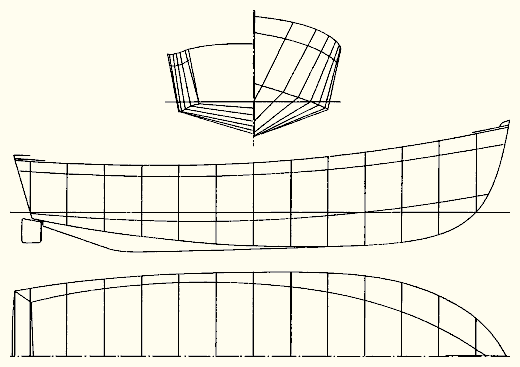
Gawd, some of those Atkins boats are a blast from the past, this one is "Jog-along" designed to be powered by 2 x 18 hp outboards, giving a "comfortable" 12 mph , I don't know whether that is flat-out, but you wouldn't want that. Remarkably, it is designed for "wrought" iron construction, though the lines drawn seem not to be developable as shown

DCockey
Participant
- Joined
- Oct 24, 2009
- Posts
- 5,309
- Reaction score
- 682
- Location
- Midcoast Maine
As "hull speed" (S/L=1.34) is approached and exceeded a boat with a straight run aft will have lower resistance than a boat with significant rocker aft. At lower speeds the boat with significant rocker will have lower resistance though at those speeds total resistance for either boat will be less than at higher speeds. A boat optimized for slower speeds will be a terrible boat at higher speeds.
CG location, trim angle and displacement distribution in light, open small boats is very dependent on the location of passengers and gear. It is a mistake to use the large vessel assumption of a fixed CG location when designing a light, open small boat.
One approach is to start with the design for the maximum speed, then make changes to the design so that it will be satisfactory at slower speeds but still satisfactory at maximum speed.
CG location, trim angle and displacement distribution in light, open small boats is very dependent on the location of passengers and gear. It is a mistake to use the large vessel assumption of a fixed CG location when designing a light, open small boat.
Why do you need to design a little more displacement around the midsection. Just move passengers and gear forward.Looks like the buttocks aft are straight, and the transom is minimally immersed. But how to combine this with a little more displacement around the midsection....?
One approach is to start with the design for the maximum speed, then make changes to the design so that it will be satisfactory at slower speeds but still satisfactory at maximum speed.
Forum posts represent the experience, opinion, and view of individual users. Boat Design Net does not necessarily endorse nor share the view of each individual post.
When making any potentially dangerous or financial decision, always employ and consult appropriate professionals. Your circumstances or experience may be different.
When making any potentially dangerous or financial decision, always employ and consult appropriate professionals. Your circumstances or experience may be different.
Advertisement:
Similar threads
- Replies
- 20
- Views
- 2,740
- Replies
- 30
- Views
- 5,859


