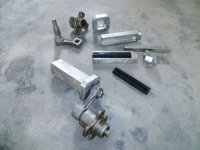
Japanese liftable propellor shaft.

A few weeks ago I delivered a load of steel to the alco suspension factory In melbourne. I am pretty sure they would disagree with your claim.

 
The experts say you can not do it, they get very upset and quite abusive .When you have a Pivotal Drive fitted in a trailer boat in practice when the boat is on the trailer it is lifted up automatically by being put on the trailer and when you launch the boat the drive drops down by itself down 20 degrees shaft angle or more.

When the boat is in the water just start the motor and away you go and you can adjust the depth from the helm if you wish. You do not need a clutch because you can lift the prop up from the water. When you go in shallow water the skeg lifts the drive automatically. With twin rudders that work like a kitchener rudder you do not need reverse as the boat turns in its own length right or left.

The drive does not need to be locked down as it trailes behind the boat and finds it`s own operating depth. You can use the drive as a surface drive with the suitable prop
and lock the drive at any depth you choose. It can be used in a Hydroplane if the rules allowed for cornering and speed control and braking.

If you spent a lot of money you could have all sorts of inovative things like automatic detection of object strike and lifting. The list goes on and on.
 
Whitepointer finger
Stop stalking me including sending your nasty troll messages to my email and stop getting very upset and quite abusive, how ever keep up the good work delivering steel.
 
The experts say you can not do it, they get very upset and quite abusive .When you have a Pivotal Drive fitted in a trailer boat in practice when the boat is on the trailer it is lifted up automatically by being put on the trailer and when you launch the boat the drive drops down by itself down 20 degrees shaft angle or more.

When the boat is in the water just start the motor and away you go and you can adjust the depth from the helm if you wish. You do not need a clutch because you can lift the prop up from the water. When you go in shallow water the skeg lifts the drive automatically. With twin rudders that work like a kitchener rudder you do not need reverse as the boat turns in its own length right or left.

The drive does not need to be locked down as it trailes behind the boat and finds it`s own operating depth. You can use the drive as a surface drive with the suitable prop
and lock the drive at any depth you choose. It can be used in a Hydroplane if the rules allowed for cornering and speed control and braking.

If you spent a lot of money you could have all sorts of inovative things like automatic detection of object strike and lifting. The list goes on and on.

Also the pivotal drive prop turns shallow water weeds into thrust
 
Whitepointer finger
Stop stalking me including sending your nasty troll messages to my email and stop getting very upset and quite abusive, how ever keep up the good work delivering steel.

Your not being stalked. You have copied alco suspension and called it your own. We had the same argument a while ago . china is the only place you can get away with that sort of thing.
 
The steering is embedded into the front pontoon is most suited because its not going to plane with car on top and is controlled from the vehicle steering.

Pictured is a proto type rubber self-maintenance titanium torsion suspension.
Steering in the front of a pontoon would seem to get in the way of beaching it and also make for slow, inefficient steering.

The suspension uses the same technology as the AL-KO does, but there are differences that would seem patentable, if a patent is pursued.

http://www.alko.com.au/vehicle-technology/product-catalogue/axels/independent-rubber-suspension-irs/

irs.jpg
 
The experts say you can not do it, they get very upset and quite abusive .When you have a Pivotal Drive fitted in a trailer boat in practice when the boat is on the trailer it is lifted up automatically by being put on the trailer and when you launch the boat the drive drops down by itself down 20 degrees shaft angle or more.

When the boat is in the water just start the motor and away you go and you can adjust the depth from the helm if you wish. You do not need a clutch because you can lift the prop up from the water. When you go in shallow water the skeg lifts the drive automatically. With twin rudders that work like a kitchener rudder you do not need reverse as the boat turns in its own length right or left.

The drive does not need to be locked down as it trailes behind the boat and finds it`s own operating depth. You can use the drive as a surface drive with the suitable prop
and lock the drive at any depth you choose. It can be used in a Hydroplane if the rules allowed for cornering and speed control and braking.

If you spent a lot of money you could have all sorts of inovative things like automatic detection of object strike and lifting. The list goes on and on.

All the advantages of the pivotal drive suits the high performance Myark catamaran, for example the centre wedges towards the back bottom one meter short of the two hulls and then kicks up slightly level with water when planning so it’s skipping across the water like a hydrofoil.
This centre back part allows better floatation for the compact 160hp inboard to be adapted to the pivotal drive which the pivotal drive that can be imbedded into the back centre hull region that allows to have the Myark torsion suspensions plugged in the sides that have guard shape into the hulls similar to a car and then towed.
I would not use the conventional torsions as they are heavy, rust and unreliable rubbers that when ware they have to be thrown out, so I have designed the rubber cord to be DIY replaced as well as a grease nipple deep into the titanium axle so it does not damage and keeps weight down,
This greasing system is superior to bearing buddies.
Pictured is the grease nipple imbedded in the titanium axle and the other picture shows the rubber cords, and how simple it’s to replace them.
 

Attachments

  • Myark%20titanium%20torsion%20suspension%20with%20bearing%20greasing%20system.JPG
    Myark%20titanium%20torsion%20suspension%20with%20bearing%20greasing%20system.JPG
    223.4 KB · Views: 487
  • P1010086.jpg
    P1010086.jpg
    75 KB · Views: 507
Steering in the front of a pontoon would seem to get in the way of beaching it and also make for slow, inefficient steering.

The suspension uses the same technology as the AL-KO does, but there are differences that would seem patentable, if a patent is pursued.

http://www.alko.com.au/vehicle-technology/product-catalogue/axels/independent-rubber-suspension-irs/

irs.jpg

The rudders are built into the front hull structures placed slightly back for the hinge structure as you may imagine a rudder on plane but set backwards.
The pontoon does not plan so this is very easy to do as also they will have knife shaped cutting edge.
It would look space age and heavy duty.
As far as torsions suspension, they invented are 60 odd years ago as father brought a new caravan in 1969 with the exact ones they use today.
 
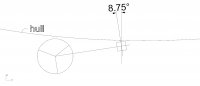
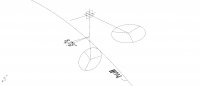
Why not mount the engine transversely (athwartship) and use a right angle gearbox with an outboard bottom unit (or marine transmission - rt angle drive - Sillette Sonic bottom arrangement)? If offset from directly right angle to fore/aft line by say 8 or 9 degrees (engine drive shaft +8...bottom unit -8) the unit will swing up clear of the hull yet maintain fore/aft alignment of prop in down position. The rotation for kick-up will not require a universal...the unit rotates around the engine drive line. The required seal would be above waterline (O-ring) that has to handle only the kick-up rotation...no need for a seal on the drive shaft other than that in the leg below. The whole point being the ability to use an efficient diesel engine protected from exposure above waterline inside the hull.

Two of these mounted on inner hull sides of a catamaran would require no steering mechanism. Steering is by a combination of kick-up rudders and motors.
 

Attachments

  • cat_drive_1.jpg
    cat_drive_1.jpg
    53.3 KB · Views: 453
  • cat_drive_2.jpg
    cat_drive_2.jpg
    56.1 KB · Views: 448
  • cat_drive_3.jpg
    cat_drive_3.jpg
    32.4 KB · Views: 414
The first technical solution is not going to be good because at the stern of the canoe has a small displacement. It can not be heavier than the solution, which I did. The diesel engine is a lot heavier. The second your suggestion is good but it is only possible when the canoe is connected to the proa (catamarans) And I wanted so much on this engine could not see, I wanted to engine was hidden.
 
The first technical solution is not going to be good because at the stern of the canoe has a small displacement. It can not be heavier than the solution, which I did. The diesel engine is a lot heavier. The second your suggestion is good but it is only possible when the canoe is connected to the proa (catamarans) And I wanted so much on this engine could not see, I wanted to engine was hidden.

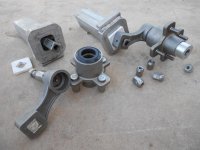
Right. I was replying more to the earlier posts showing installations in heavier craft. I am planning on trying the arrangement I described above on a motorsailer catamaran design...not suitable for a canoe.
 
You have a good idea BobH but why don`t you build it or do you have the same problem of financing the project like most of us.
When you start building then the pitfalls and critics become more obvious.
Retractable shaft drives make power boating so much more easier on operators and machines and should have been universal years ago.
 
Forum posts represent the experience, opinion, and view of individual users. Boat Design Net does not necessarily endorse nor share the view of each individual post.
When making any potentially dangerous or financial decision, always employ and consult appropriate professionals. Your circumstances or experience may be different.

  • Back
    Top