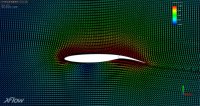
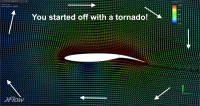
Is circulation real?

The shear layer rolls into the spiral "starting vortex", and the starting vortex creates the circulation in the opposite direction, around the foil, while itself being left behind.
At the risk of further accusations of "trolling" and "sealioning" I would like to revive the initial question of this thread and to examine this theory that the circulation is initiated by the starting vortex.
It is well established and acknowledged in this thread that circulation is a mathematical concept and is something like the line integral of the field around a closed circuit.
1) How does the "starting vortex" create the circulation?
Most theories invoke Kelvin to explain how the starting vortex initiates the circulation, but Kelvin’s Circulation Theorem applies to systems of conservative forces such as gravity and electro-magnetism. Since the forces at play on an aerofoil, namely friction and viscosity are not conservative, Kelvin’s Theorem cannot be invoked to conserve circulation when describing vortices on an aerofoil.
2) How does circulation persist? If the circulation, which is responsible for generating lift, is initiated by the starting vortex, and this starting vortex trails off behind the foil, how does the lift-creating circulation persist for hours?
3) What happens if the starting vortex is tiny? The aircraft is at rest at the start of the takeoff, there's no breeze, "clear to take off", the aircraft accelerates. The air starts to flow over the wing. When does the starting vortex occur?
 
Sailor Al, I am giving you the benefit of the doubt. I hope I am not sorry for doing so.

1) How does the "starting vortex" create the circulation?
The very simple answer is the starting vortex does not "create" circulation. This is fundamentally different from a magnetic field caused by an electric current flowing through a conductor. The equations for analyzing a magnetic field are the same (with several assumptions which are valid for boats and low speed aircraft) as the equations for external flow outside of boundary layers and wakes but the physics are fundamentally different.

Most theories invoke Kelvin to explain how the starting vortex initiates the circulation, but Kelvin’s Circulation Theorem applies to systems of conservative forces such as gravity and electro-magnetism. Since the forces at play on an aerofoil, namely friction and viscosity are not conservative, Kelvin’s Theorem cannot be invoked to conserve circulation when describing vortices on an aerofoil.
For a body such as an airfoil with attached flow viscous forces are negligable outside of the boundary layer and wake. The flow outside of the boundary layer and wake can be modeled as having constant energy for aerodynamic and hydrodynamic analysis. (Exception is very, very, very slow flow where there is not a thin boundary layer.)

3) What happens if the starting vortex is tiny? The aircraft is at rest at the start of the takeoff, there's no breeze, "clear to take off", the aircraft accelerates. The air starts to flow over the wing. When does the starting vortex occur?
Unless the the is a sudden change in the flow, such as a very rapid change in angle of attack or a very sudden acceleration, there is not a single starting vortex. Instead there is a thin wake sheet trailing behind the airfoil which can be thought of as an infinite number of infinitesimally small vortices side by side. Added: For a two dimension airfoil the vorticity in the wake is non-zero as the airfoil is accelerating and zero after the airfoil speed becomes constant the flow around the airfoil reaches steady state.

Again, neither a "starting vortex" nor a "vortex sheet" create circulation.

Let's go back the the title of the thread: "Is circulation real". The answer is unequivocally yes. If the flow past an airfoil which is producing lift is measured there will be circulation. What causes the flow to be such that the circulation is non-zero is a much more complicated question for which not "perfect" answer exists.
 
Last edited:
I had forgotten about this thread. It is worth reading in it's entirety by anyone interested in understanding some of the basics of 2D airfoil theory.

The prominence of the "starting vortex" in lifting airfoil theory arose in the very early years of aerodynamic theory as part of the resolution of an apparent theoretical contradiction. Potential flow models of 2D lifting airfoils require non-zero circulation for lift, which would appear to mean the total net vorticity in the flow was non-zero. But the steady state model did not have a mechanism for the non-zero vorticity and circulation around the airfoil to arise when circulation in the upstream flow as zero. The solution to the apparent contradiction was convection of vorticity downstream which exactly offset the change in circulation as the lift changed with results in the total net vorticity remaining zero. The simplest version of the vorticity being convected downstream is the the case of an impulsive change in lift with a concentrated vortex convected downstream.
 
The prominence of the "starting vortex" in lifting airfoil theory arose in the very early years of aerodynamic theory as part of the resolution of an apparent theoretical contradiction. Potential flow models of 2D lifting airfoils require non-zero circulation for lift, which would appear to mean the total net vorticity in the flow was non-zero. But the steady state model did not have a mechanism for the non-zero vorticity and circulation around the airfoil to arise when circulation in the upstream flow as zero. The solution to the apparent contradiction was convection of vorticity downstream which exactly offset the change in circulation as the lift changed with results in the total net vorticity remaining zero. The simplest version of the vorticity being convected downstream is the the case of an impulsive change in lift with a concentrated vortex convected downstream.

Rather than follow the thread of responding to points I raised by the previous post, you have offered an explanation that I read as:

In the early years a theory was developed (by Lanchester, Prandtl et.al) to explain the physical generation of lift on an aerofoil, but, as you point out, it contained a theoretical contradiction. Instead of taking the logical step of abandoning the theory, they introduced a phenomenon, called the starting vortex, to "balance the books".

Shouldn't the fact that this phenomenon is not experimentally detectable and has to be explained in terms of an "infinite number of infinitesimally small vortices" have started to ring bells?

And, to be frank, doesn't your statement: "If the flow past an airfoil which is producing lift is measured there will be circulation." smack of post hoc ergo propter hoc?

Is it not time to abandon this theory?

If you do chose to support the theory, then would you like to revisit the three conundrums that I raised in post #181
You dismissed my first point by denying the basis of my claim which I believe I justified with a direct quote.

Please, let us continue the debate in the Socratic method.
 
Sailor Al, I am giving you the benefit of the doubt. I hope I am not sorry for doing so.
And yes, I hope you are not sorry, but the subject is pretty important to me, so be prepared for a vigorous debate!
 
Last edited:
I have zero interest in debating a scientific theory which has been accepted for a century, and which has been used innumerable times in the design of aircraft and other devices.

I made a mistake in responding above.
 
I made a mistake in responding above.

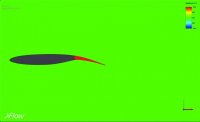
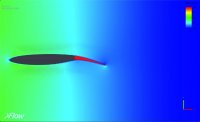
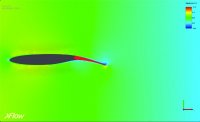
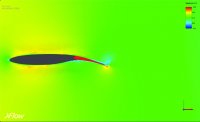
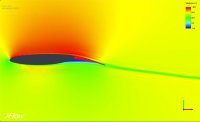
@DCockey I beg to disagree. Once again, you've educated us in the art of aerodynamics, corrected my misinterpretation with regard to the necessity of a starting vortex, and inspired me into running some new simulations around the topic of circulation. I enclose some screenshots, more later when I find the time. This is in an accelerating flow, from 0 to 20 m/s, the number at the end of is flow speed at the inlet of the flow domain. The profile is courtesy @tspeer, one he designed to study cavitation on the latest AC75 foils, I mean to do some more work with it later.
 

Attachments

  • SpeerH143AcceleratingZoom 0.jpg
    SpeerH143AcceleratingZoom 0.jpg
    54.6 KB · Views: 305
  • SpeerH143AcceleratingZoom 1.jpg
    SpeerH143AcceleratingZoom 1.jpg
    79.3 KB · Views: 403
  • SpeerH143AcceleratingZoom 1,5.jpg
    SpeerH143AcceleratingZoom 1,5.jpg
    69.1 KB · Views: 290
  • SpeerH143AcceleratingZoom 2.jpg
    SpeerH143AcceleratingZoom 2.jpg
    66.8 KB · Views: 274
  • SpeerH143AcceleratingZoom 20.jpg
    SpeerH143AcceleratingZoom 20.jpg
    78.3 KB · Views: 303
@Mikko Brummer Initially you said:
..and the starting vortex creates the circulation in the opposite direction, around the foil, while itself being left behind.
Then
The very simple answer is the starting vortex does not "create" circulation.
And now you reply:
@DCockey ...you've educated us in the art of aerodynamics, corrected my misinterpretation with regard to the necessity of a starting vortex, ...

@Mikko Brummer Having had the foundation of your interpretation ("the starting vortex creates the circulation") identified as a misinterpretation by @DCockey, I just don't see how you can continue to claim validity of the circulation theory.

Are we still talking about circulation as the mathematical construct from vector calculus ( "the line integral of the vector field around a closed circuit") or are we talking about something more general that can be measured and observed?
 
Having had the foundation of your interpretation ("the starting vortex creates the circulation") identified as a misinterpretation by @DCockey, I just don't see how you can continue to claim the validity of the circulation theory.

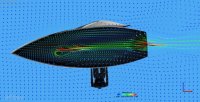
The starting vortex is by no means "the foundation of my interpretation of the circulation theory" ;-). I used to think it was just a mathematical theory, but during the years I've learned through simulation that the physical flow around a lifting surface actually has a resemblance to what the mathematical model of circulation theory describes. Please read my first few postings at the beginning of this thread (and then all of the thread). Attached see "circulation" around the flat centreboard of a Finn dinghy. The simulation software (XFlow, the state-of-the-art Lattice-Boltzmann flow code) has nothing to do with the theory of circulation, yet it shows a similar flow pattern.
 

Attachments

  • FinnWaterChannel2BoatsSideSternEven6.jpeg
    FinnWaterChannel2BoatsSideSternEven6.jpeg
    280.9 KB · Views: 309
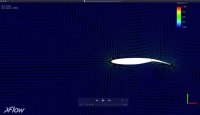
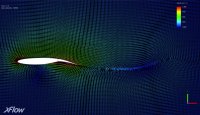
Here's from a simulation of the Speer profile, accelerating from the rest in still air (or water), at the rate of acceleration time^2. In the first pic, the speed of the profile is 0,09 m/s, in the second 1,7 m/s. Something is happening at the trailing edge of the profile, and something is left spinning in the location of the starting of the motion. The little arrows are velocity vectors of weightless "markers" moving with the flow.
 

Attachments

  • SpeerH143AcceleratingMotionMarkers.jpg
    SpeerH143AcceleratingMotionMarkers.jpg
    405.6 KB · Views: 308
  • SpeerH143AcceleratingMotionMarkers2.jpg
    SpeerH143AcceleratingMotionMarkers2.jpg
    632.6 KB · Views: 283
One more about the fully developed flow at 10 m/s. Note that the "circulation" velocities of the markers are not huge - red colour is 2 m/s.
 

Attachments

  • SpeerH143AcceleratingMotionMarkers3.jpg
    SpeerH143AcceleratingMotionMarkers3.jpg
    703.3 KB · Views: 305
Attached see "circulation" around the flat centreboard of a Finn dinghy. The simulation software (XFlow, the state-of-the-art Lattice-Boltzmann flow code) has nothing to do with the theory of circulation, yet it shows a similar flow pattern.
Mikko, the velocity that the picture shows must be the perturbation velocity. That is the snapshot of the velocity, that an observer at rest sees, when the boat moves past him. If you superimpose to the perturbation the boat speed, you get a picture that is more like the ones, that we are used to see in a wind tunnel, or when we move with the boat. If my interpretation is right, then I would think, that the vortex at the tip of the centreboard shows a separation bubble. This separation vortex can create a lifting force through the pressure field at the leading edge, if the leading edge is sharp and the flow reattaches (see Leading-edge-suction-analogy by E. Polhamus). The total circulation, created by the centreboard's sharp trailing edge, is difficult to spot, because it is disguised in this picture by the drag of the hull, which creates a perturbation towards the front (slowing the incoming flow) and to the sides (displacing the incoming flow).
Your last picture #193 is much better suited to show the circulation. All the arrows in the picture, the complete perturbation velocity field that is created by the moving airfoil, are describing a circle around the foil. The further away from the foil, the more perfect is the circle. This is exactly the potential flow solution of an airfoil that creates lift. The equations for potential flow enable us to calculate the lift-force if we know the strength of the circulation, or vice versa we can determine the strength of the circulation if we know the lift-force. If you add the vectors (arrows) in the picture to the vector of the incoming flow, you get the picture that you see, when you are sitting on the foil. So the circulation is real. The total flow is the superposition of the incoming flow and the circulation around the foil.
Thank you for posting pictures here in the forum, they are always fascinating and tell a story.
Uli
 
Forum posts represent the experience, opinion, and view of individual users. Boat Design Net does not necessarily endorse nor share the view of each individual post.
When making any potentially dangerous or financial decision, always employ and consult appropriate professionals. Your circumstances or experience may be different.

  • Back
    Top