
The primary purpose of measuring the engine timing chain is to determine whether it has excessive wear or elongation, which could affect the accuracy of the engine's valve timing and lead to engine failure.
Follow these steps to measure the timing chain:
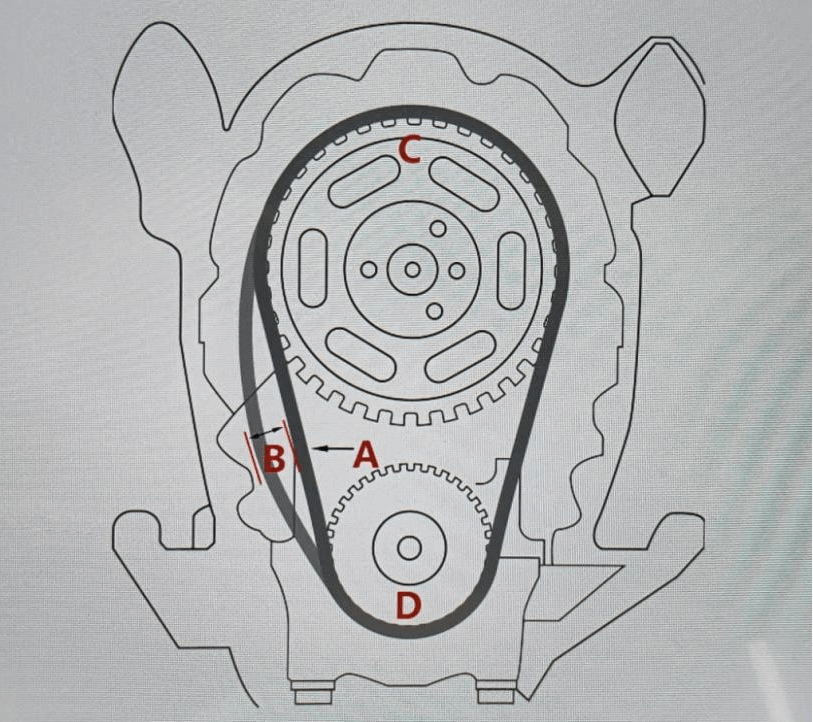
1. Rotate the engine clockwise until the left side of the timing chain (as viewed from the front) is fully tensioned.
2. Mark a reference point on the engine block (on the tensioned side of the chain, marked in red on the diagram).
3. Rotate the engine in the opposite direction to relax the timing chain (be careful not to lose the engine’s timing).
4. Push the timing chain outward at point A, which is located between the crankshaft gear and the camshaft gear.
5. Measure the distance to point B.
6. If the timing chain exceeds the maximum allowable elongation, replace the chain and gears C and D.
Follow these steps to measure the timing chain:
1. Rotate the engine clockwise until the left side of the timing chain (as viewed from the front) is fully tensioned.
2. Mark a reference point on the engine block (on the tensioned side of the chain, marked in red on the diagram).
3. Rotate the engine in the opposite direction to relax the timing chain (be careful not to lose the engine’s timing).
4. Push the timing chain outward at point A, which is located between the crankshaft gear and the camshaft gear.
5. Measure the distance to point B.
6. If the timing chain exceeds the maximum allowable elongation, replace the chain and gears C and D.
