
The Boat Design & Boatbuilding Site
Install the app
How to install the app on iOS
To install this app on your iPhone:
- Tap the Share button at the bottom of Safari.
Tap ... if Share is not visible, then Share - Tap Add to Home Screen
Tap View More and scroll down if needed to see Add to Home Screen, then Add to Home Screen. - Tap Add on the top right to confirm.
Note: This feature may not be available in some browsers.
You are using an out of date browser. It may not display this or other websites correctly.
You should upgrade or use an alternative browser.
You should upgrade or use an alternative browser.
High Performance MPX Foil/Self-righting Trimaran-The Test Model
- Thread starter Doug Lord
- Start date

Doug Lord
Flight Ready
- Joined
- May 26, 2009
- Posts
- 16,679
- Reaction score
- 354
- Location
- Cocoa, Florida
Fire Arrow Test Model and Foil System Specifications---latest update: 5/14/16
A) Name- Fire Arrow
B) LOA-79" (6.58')-including bowsprit
1. mainhull-66.19" (5.52') (The reasoning behind and the story of the added hull length can be found in posts 1177,1187-88,1195-1198)4/30/14
2. mainhull+ rudder and gantry(no bowsprit)- 69.125" (5.76')
3.planing portion of ama=34in. (2.83')
4.ama LOA=50.75in.(4.23')
C) Beam-81.6"(6.8')
D) Mast 103in. (1.75"chord wing mast / 8.58')5/1/14
E) Sail Area:
1. Main+ Mast + Jib= 3390.9sq.in.( 23.5 sq.ft.)5/1/14
2. Main+ Mast + Code Zero=4087sq.in.(28.38 sq.ft.)5/1/14
3. Main(reefed) + Jib=2767.4 sq.in.(19.2 sq.ft.- current sailing configuration)9/11/15
F) Foils:
1. Mainfoil(wand controlled flap)-Span=23.75in., Area=79.4sq.in.
a. Daggerboard span-12.625"
b. Daggerboard area-41sq.in
2. Rudder foil-Span=22.75 in., Area=50.6 sq.in.
a. Rudder span-10.75"
b.Rudder area-28.9 sq.in.
3. UptiP ama foil(One used at a time,except at takeoff. Inspired by TNZ with refinements that will allow a wide speed range w/o AOI adjustment. Works with and without leeway coupling)-9/11/15
a. Span(from bottom of ama)=20.625 in.,
b. Area(from bottom of ama)=68 sq.in.
a. Vertical portion-24 sq.in.
b. Uptip portion-44sq.in.
c.Projected lifting area at max loading: 47.5sq. in.
G) Weight- 21.13lb. 5/1/14
H) Foil loading at takeoff*(75%= 15.85)=.199lb/sq.in.9/11/15
* foil loading is actually less: at the early stages of takeoff both ama foils lift a little. Right at takeoff the ama foil
adds about 44 sq.in. with very low loading , reducing overall foil loading slightly.(F3 was .188lb/sq. in.) After takeoff, the main foil begins to unload as pressure builds on the rig reducing mainfoil loading significantly. The ama foil begins to carry the majority of the load(max loading about 85%=17.96lb.=.378lb/sq.in).
I) SA/Lb(21.13lb displ ) with Code Zero=193.4sq.in.,with main +jib=160sq.in(F3-208.5)(more=better)5/1/14
J) SA(incl Code Zero) per sq.in. of mainfoil group area(89.125sq.in) at takeoff=45.85 sq.in./per sq.in.(F3-49 sq.in/per sq.in)(higher=better)5/1/14
K) SA/WS(with Code Zero)= same as F3 after takeoff--7/1 seahugging, 12/1 foiling(max SA).9/18/15
===================================
===================================
FIRE ARROW FOIL SYSTEM
--added #6 below 12/8/13 and modified 12/9/13
--added to #3 below on 12/13/13
--added f.,g.,h. and i., 5/1/14
Here is a brief summary of what makes the Fire Arrow Foil System unique and why that is important:
1) The boat has four foils total. On the fullsize version, only three foils are used at any one time. On the model, since the ama foils will not be retractable(at least initially), they both contribute to vertical lift at take off with the majority of lift coming from the main wand controlled foil and the lee ama foil.
---
2) Here are the unique characteristics of the ama foil:
See page 73, post 1090 for much more on the theory that applies to the unique ama UptiP foil. It has just been updated with a link to Dario Valenza's experiments on A Class cats with "uptip" foils where he found that the foil will function w/o leeway coupling for heave stability --using the breaching of the inboard tip for altitude control when leeway is low.
a. The Uptip ama foil is designed to only lift vertically(no downforce) and horizontally,
b. The ama foil is targeted to perform throughout the speed range with no adjustment. It is anticipated that the angle of incidence may have to be changed once, as speed increases, if it is changed at all.
c. The ama foil is designed to carry 80% of the weight of the boat with the rudder foil carrying 20%. The ama foil loads up as the mainfoil unloads.
d. The ride angle of the ama foil is controlled by the action of the main foil and rudder foil together.
e. The ama foil was inspired by the new type of foil designed by Morrelli and Melvin for TNZ except that this foil has a wider range of speed before angle of incidence adjustment might be required.
f. The ama foil angle of incidence of the vertical lifting "L" portion of the foil for the first sail is 3.75 degrees relative to the static waterline.5/1/14
g. The ama foil angle of incidence of the vertical portion of the foil is set at +2.25 degrees, relative to the boat centerline, for the first sail. This will unload the daggerboard and provide leeway coupling to help with altitude control.5/1/14
h. The main foil angle of incidence for the first sail is +2.5 degrees relative to the static waterline.5/1/14
i. The rudder foil angle of incidence for the first sail is zero degrees relative to the static waterline.5/1/14
--
3) The main foil has a flap and the flap angle is controlled by a wand*. This allows the boat to fly the main hull in very light air which is a big advantage for an oversquare trimaran-particularly a tri under 20' which would, likely, not be able to fly the main hull in these conditions. As soon as the main hull lifts off, the boat accelerates to roughly twice windspeed in a 5mph wind. As the boat speeds up and heels, the mainfoil unloads as the wand causes the flap to rise. At a certain point the flap causes the main foil to not produce any lift with all the load automatically shifted to the ama foil. If the main hull rises above this point(about 10 degrees angle of heel initially), the flap will continue to rise causing the main foil to create down force(unless this facility is disabled). When the main foil is developing downforce it is also developing lift to weather, similarly to the lift to weather when a Moth is using Veal Heel(except on this boat it is a function of the "normal" heel of the boat and the downforce on the mainfoil). See post 532 for an illustration of how this works.
* The boat actually has dual wands but they act on a single axle acting as a single wand.The reason for that is to allow the wand to work when the boat is heeled. The lee wand is nearly vertical(viewed from forward) when the boat is heeled 10 degrees and acts to maintain an angle of heel of about 10 degrees and an altitude of the main hull of about 3". See the sketch below showing the heeled waterlines. Also see posts 512 and 514 for more on the wand system. See page 40, post 597 for a video of the MPX wand activating the main foil flap.
---
4) The rudder foil is a trailing foil that automatically develops 20% of the lift required at takeoff, then gradually unloads until it begins,again automatically, to pull down.
---
5) As best I can tell there is no other trimaran in the world using a foil system like the Fire Arrow Foil System. Having a wand controlled mainfoil on the main hull and an ama foil that flies the ama(nominally a few inches above the water) with no control input other than that of the leeway coupling component of the foil and the effect of leeway on the "L" portion of the foil(however small) is a significant development for full flying trimaran foiling systems. The whole foil concept is significant because:
a. it allows an oversquare tri to fly the main hull in light air,
b. it unloads the mainfoil allowing it to become,with the rudder, primarily a pitch control system which controls the running angle of the ama foil.
c. it allows the mainfoil to contribute to righting moment with downforce,
d. it allows the mainfoil to develop lift to weather when it is developing downforce.
e. the deep main foils acting to control pitch prevent the main hull from bottoming out and allow the angle of heel to be varied between approximately 10 degrees and 17 degrees(or a bit more) by adjusting the wand length.5/1/14
f. the planing ama design serves as back up in rough and/or gusty conditions when the foil might be momentarily overpowered.
---
6) Speed- Top end speed is NOT the priority of the Fire Arrow Foil System-light air speed resulting from the unique ability to fly the main hull in light air is. The Fire Arrow Foil System's main claim to relevance are the two lifting foils on the main hull which allow an oversquare platform to fly the main hull when a wide trimaran,particularly 20' or under, w/o these foils would not. To make a 1.2-1.3 oversquare tri fly the main hull (without foils) requires excessive sail area(or wind) and impairs the pitch stability of such a boat . The two main foils work together to provide pitch stability way in excess of any "normal" trimaran and control the running angle of the planing ama and ama foil. The system should work well with a planing ama using foil assist and does work well in light air, so far, using an ama foil that allows the ama to fly when the main hull does(the current test model configuration).5/1/14
Top end speed is enhanced by the initial configuration being tested which has the light air advantage intrinsic to the system with the added speed potential in heavy air due to the reduced ama wetted surface and the fact that the main foil will develop downforce adding to the righting moment. Further, the foil that fly's the ama is designed to support 100% of the boats weight as the boat speeds up, unloading the mainfoil and reducing drag substantially.
======================================
======================================
>Preliminary testing has encompassed testing all foils to 3 times their calculated maximum load(estimated 150% reserve above that before breaking).
> Boat was originally designed as a scale test model of an 18 footer based on a full size hull I used to have(donated to a friend).Since the stern extension it is longer-19.5' fullsize.5/14/16
>See post 1242 that confirms the ability of my first foiler design(F3), about 15 years ago, to do foiling tacks and gybes!5/9/14
> See post 2312, page 155 for a post describing a concept of the Fire Arrow System on a 70 foot trimaran.5/14/16
> See post 2315, page 155 for a "prototype" short description of the Fire Arrow System.5/14/16
------------------------
First day the foil system worked at 100%: July 24th, 2014:
PerthMini40man
Senior Member
- Joined
- Jan 13, 2014
- Posts
- 117
- Reaction score
- 35
- Location
- Australia
Ongoing experiments with Outboard foils from Sunday is here
https://youtu.be/Y170e-hmT38
The Z foil is obviously slow at displacement speed but when the horizontal wing pops out then the boat changes gear.
https://youtu.be/Y170e-hmT38
The Z foil is obviously slow at displacement speed but when the horizontal wing pops out then the boat changes gear.
PerthMini40man
Senior Member
- Joined
- Jan 13, 2014
- Posts
- 117
- Reaction score
- 35
- Location
- Australia
Yes - the horizontal section is a necessary evil, to push the foil further outboard, and the foil is designed for a decent breeze so that hopefully the horizontal section will spend much of its time out of the water. It took a week to work out how to make the mould for the one-piece foil so I am reluctant to ask my builder to make a new shape! Curving the joint would be an improvement but I'll live with what I have got for now
Doug Lord
Flight Ready
- Joined
- May 26, 2009
- Posts
- 16,679
- Reaction score
- 354
- Location
- Cocoa, Florida
Fire Arrow Foiling System Testing and Development / Rotating Ama
This is an a rotating hull ama that converts from a displacement, high L/B, hull to a stepped planing hull. I came up with this in 2007 way before the Fire Arrow. I accidentally saw the old pictures today and was thinking how the concept could be used on a version of the Fire Arrow but there's a problem: I had never figured out how foils could be used with the thing. The Fire Arrow "skips" the stage where a displacement hull would have value by foiling in very light air which is why the amas are planing amas. They are designed for incidental contact with the water after takeoff.
So, I'm just showing the rotating ama here in case there is a way it might be able to be adapted to the Fire Arrow concept....
The way it works is the forward and aft section are simply rotated 180 degrees.
Displacement Version:

Stepped Planing Version:

This is an a rotating hull ama that converts from a displacement, high L/B, hull to a stepped planing hull. I came up with this in 2007 way before the Fire Arrow. I accidentally saw the old pictures today and was thinking how the concept could be used on a version of the Fire Arrow but there's a problem: I had never figured out how foils could be used with the thing. The Fire Arrow "skips" the stage where a displacement hull would have value by foiling in very light air which is why the amas are planing amas. They are designed for incidental contact with the water after takeoff.
So, I'm just showing the rotating ama here in case there is a way it might be able to be adapted to the Fire Arrow concept....
The way it works is the forward and aft section are simply rotated 180 degrees.
Displacement Version:
Stepped Planing Version:
Last edited:
Doug Lord
Flight Ready
- Joined
- May 26, 2009
- Posts
- 16,679
- Reaction score
- 354
- Location
- Cocoa, Florida
Sewall
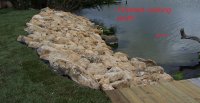
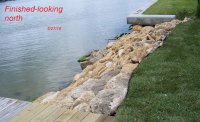
The seawall is done-a lot different than I was led to believe-and the steps are ridiculous-very, very unfortunate. The last step is a lulu: I tried to get it changed but no luck. Imagine putting a step in place already covered with grass! Just absurd. These are so bad I'm afraid they could be considered an "attractive nuisance"!
See the "before" pictures of the shore line, p154, post 2304.

click on image for best view of the finished seawall:
======================After almost one years delay they actually started today. Supposed to take just two weeks. Theoretically (all else being equal) I should be able to launch my boats right here when they are done.
The seawall is done-a lot different than I was led to believe-and the steps are ridiculous-very, very unfortunate. The last step is a lulu: I tried to get it changed but no luck. Imagine putting a step in place already covered with grass! Just absurd. These are so bad I'm afraid they could be considered an "attractive nuisance"!
See the "before" pictures of the shore line, p154, post 2304.
click on image for best view of the finished seawall:
Attachments
Doug Lord
Flight Ready
- Joined
- May 26, 2009
- Posts
- 16,679
- Reaction score
- 354
- Location
- Cocoa, Florida
Dominion 2-HW / Foils
This is a model that I've designed and built inspired by Hugh Welbourn's Quant 23. I wanted to show what the unfinished boat and foils look like because they may eventually be tested on a version of the Fire Arrow. These outward pointing surface piercing foils could work on a trimaran designed specifically for them, or in the Fire Arrow case, modified specifically to test them.
The D2, if it works, will be the first RC foiler keelboat designed specifically to be self-righting. The Fire Arrow, if it was built lighter, could also be self-righting as was originally intended.
(Also see posts 2295 and 2317 on previous pages)

===================================================
The top photo, of the two below, shows the minimum extension of the foil and the minimum cant. Notice the the position of the foil tip and compare it with the bottom picture. The foil can be adjusted vertically(min. extension to max extension*) and can be pivoted(min. cant and max cant).
* extension misspelled in the photos


This is a model that I've designed and built inspired by Hugh Welbourn's Quant 23. I wanted to show what the unfinished boat and foils look like because they may eventually be tested on a version of the Fire Arrow. These outward pointing surface piercing foils could work on a trimaran designed specifically for them, or in the Fire Arrow case, modified specifically to test them.
The D2, if it works, will be the first RC foiler keelboat designed specifically to be self-righting. The Fire Arrow, if it was built lighter, could also be self-righting as was originally intended.
(Also see posts 2295 and 2317 on previous pages)
===================================================
The top photo, of the two below, shows the minimum extension of the foil and the minimum cant. Notice the the position of the foil tip and compare it with the bottom picture. The foil can be adjusted vertically(min. extension to max extension*) and can be pivoted(min. cant and max cant).
* extension misspelled in the photos
PerthMini40man
Senior Member
- Joined
- Jan 13, 2014
- Posts
- 117
- Reaction score
- 35
- Location
- Australia
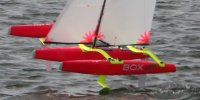
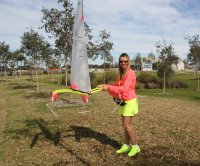
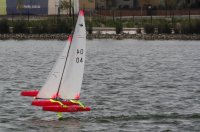
Z foils
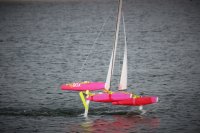
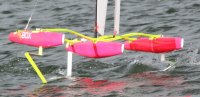
We have made some good progress with our Z foils, and now have moulds for port and starboard. These are a definite improvement for strong winds
Video is here
https://youtu.be/Qqfh3PTWqtI
Ian
We have made some good progress with our Z foils, and now have moulds for port and starboard. These are a definite improvement for strong winds
Video is here
https://youtu.be/Qqfh3PTWqtI
Ian
Attachments
Doug Lord
Flight Ready
- Joined
- May 26, 2009
- Posts
- 16,679
- Reaction score
- 354
- Location
- Cocoa, Florida
Z foils
Ian, have you two boat tested-one with the "normal" surface piercing foils and one with the "Z" foils?
Also, the MultiOne* class allows over square platforms-have you considered that?
*One meter multihull class with max beam of 48"
Ian, have you two boat tested-one with the "normal" surface piercing foils and one with the "Z" foils?
Also, the MultiOne* class allows over square platforms-have you considered that?
*One meter multihull class with max beam of 48"
David Cooper
Senior Member
- Joined
- Jan 17, 2015
- Posts
- 184
- Reaction score
- 23
- Location
- Scotland
The steps look potentially lethal. Are you allowed to modify them by adding your own concrete (and ideally a handrail)?
David Cooper
Senior Member
- Joined
- Jan 17, 2015
- Posts
- 184
- Reaction score
- 23
- Location
- Scotland
Your best bet then may be to build a removable set of wooden steps that you can rest on top of the stone ones, wheeling them into place whenever you need them. Hopefully the stone steps are stable enough for that.
Forum posts represent the experience, opinion, and view of individual users. Boat Design Net does not necessarily endorse nor share the view of each individual post.
When making any potentially dangerous or financial decision, always employ and consult appropriate professionals. Your circumstances or experience may be different.
When making any potentially dangerous or financial decision, always employ and consult appropriate professionals. Your circumstances or experience may be different.
Advertisement:
Similar threads

- Replies
- 319
- Views
- 84,400
- Replies
- 3
- Views
- 4,333


