keysdisease
Senior Member
- Joined
- Mar 17, 2006
- Messages
- 794
- Reaction score
- 45
- Location
- South Florida USA

To install this app on your iPhone:
Note: This feature may not be available in some browsers.
Class will not be a requirement, USCG inspected vessel status should suffice for insurance purposes.
Given how you plan to operate a self powered barge sounds like a good bet. Steel construction will make CG inspection easier, a stability test should be no problem. Keep it under 100 tons and less than 49 passengers and it will be easier, those are the cutoffs before there are additional requirements.
Here's a USCG inspected self powered barge in Miami approved for 150 pax
http://www.tikkibeach.com/tikki.html
It has a dedicated tug to power it, which may make inspected vessel status easier because the machinery space is technically a separate vessel, I think. Would have to do some digging in the regs but plausible.
You would need to hire a NA to be sure that any barge you might use was built in the US, and had scantlings that would meet CG requirements. After that as a steel (non combustible) vessel the rest should not be too difficult.


Tad: does those numbers 97/78 equate to loaded/empty?
At sea tonnage refers to volume not weight. A ton is 100 cubic feet. In theory the gross tonnage is all the volume below the main deck, and it may or may not include deckhouses. The gross tonnage is used for regulations and crew certificates. The net tonnage is (again in theory) a measure of the cargo capacity (in volume) of the vessel. This is used for harbour or canal dues, towage and salvage assessments, etc. Depending on the flag state and vessel use there are lots of ways to juggle these figures. Locally we have 60' by 24' tugs that should be 200 gross tons registered at 14.9!
Dead Weight Tonnage (DWT) is the usual way to refer to the cargo capacity in weight terms.
For a new build, one of these catamarans might be the most cost effective way to go, pick your model sketch your configuration, write a check:
www.coopermarine.com
These guys been building USCG inspected vessels for a long time and their platforms are all pretty much tested and known, and in Florida for convenience.
I was a Helicopter Control Officer (HCO) on 2 US Navy ships. From the tower seat I was part of over 500 landings and launches at sea, including re-fueling on deck and while hovering (HIFR). Navy ships performing Helicopter operations drive into the wind to create favorable relative winds on deck, i.e. reduce cross winds and gain stability in swells. You mentioned that your operations would be in calm sea states, sheltered waters, and the vessel would operate within a 100 mile range. If that is the case your vessel will probably not be capable to the speed required to create favorable relative wind conditions. Operating in calm weather is fine, but without that forward movement and some stand-off from the water surface you will create a significant amount of rotor wash causing salt spray to enter the engine intakes. US Navy SH60 Seahawks are designed to withstand this, and we fresh water wash the turbines while they are running. I'm no expert on the turbines in Commercial Rotorcraft so I'm not certain about thier tolerance of salt spray and hot-washing.
I'm fairly certain you will not attempt in flight refueling the way we do in the Navy, but the systems and safety mechanisms for on deck refuling of AVGAS can be pretty extensive. A salt water fire main is complex enough, but add to it the ability to douse the deck with AFFF (foam), and the $$$ start adding up. Next, add to it the need for a fresh water system for the salt in the engines.
In general, considering the limited range you mentioned, I just think the cost of the vessel and crewing, maintaining, and operations will cost far more than land based launching and recovery of your helicopters.
Aircoastal
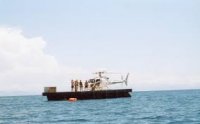
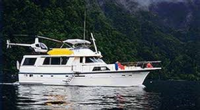
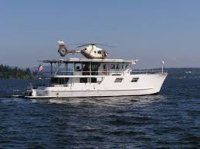
Here are some pics of the smallest carrier in the USN to which might be what you are looking for in terms of a heli carrier for your business venture.
Thanks keysdiease but doesn't this go against your previous recommendation of steel?
Aircoastal
Here are some pics of the smallest carrier in the USN to which might be what you are looking for in terms of a heli carrier for your business venture.
Steel, as a non combustible makes conversion to inspected vessel easier. The Cooper Catamarans are built as inspected vessels from the keel up, are probably one of the best values in inspected vessels of this size/ type, and have very low operating costs.
You also get, within the confines of the basic design, exactly what you want.
Aircoastal
Here are some pics of the smallest carrier in the USN to which might be what you are looking for in terms of a heli carrier for your business venture.


(IX-514) Specifications:Thanks Joz, that's the concept, cant tell how big that vessel is but the aircraft landing on it is same model as one of mine