

RMA
Junior Member
- Joined
- Sep 3, 2019
- Messages
- 26
- Reaction score
- 16
- Location
- Old Saybrook, CT
I see a lot of comments and threads discussing some variation of adding/constructing hard dodgers. A common challenge in older boats is that adding a hard dodger often complicates or downright obstructs main sail sheeting. Depending on the existing configuration, the dodger ends up providing little shelter or sacrifices the sheeting ability. That said, everything is a compromise. Given the recurring interest in this topic, I offer my solution for my boat. Take from it what you will.
This is a fully cored composite structure, engineered to take all of the force from the main sail (plus a hefty safety factor of 5x). For my needs and wants, it works great and I think it fits the boat well. The compromise is the loss of a traveller but since removing that, I've never looked back.
There are lots of itterations that one could adapt for their own needs, for example, if bringing the boom to windward in a close haul makes a big difference on your boat, you could easily adapt my system to German sheeting.
For the technically oriented:
The arch and dodger were build seperately.
The arch is 75mm (3") balsa cored, tapering to 125mm (5") at the legs. Its fore and aft width is 150mm (6") and tapers to 200mm (8") at the bases. The beam span is 1500mm (60") and the span at the legs is 2235mm (88"). The laminate schedule is 4 layers 955g/m2 (28oz/yd2) unidirectional e-glass and 3 layers 350g/m2 (9oz/yd2) unidirectional carbon on the top and bottom skins. The entire arch is then wrapped in 3 layers of 440g/m2 (12oz/yd2) biaxial (-45/45) e-glass. It weighs ~32 kg (70lbs) and my rough engineering estimates that it should hold ~44kN (10,000 lbs force) in core shear. The laminate schedule is overkill, as the core would shear long before the skins would yield but I wanted it to be bullet proof in case the boom (or worse, the mast!) ever fell on it. It is attached to the 30mm (1.25") thick cockpit coamings with thickened epoxy, and a substantial amount of uni and biax tabbing, as well as two 15mm (5/8") stainless threaded rods embedded into each leg that bolt through the coaming and are secured with a 10mm (3/8") aluminum backing plate 150mm x 300mm (6" x 12"), nuts, and washers. If this sounds over kill, it is. In theory, the surface area of the base of each leg should be able to hold the loads just with epoxy gluing it. The swivel blocks are mounted through the arch with stainless backing plates. Each bolt hole was drilled out and filled with 25mm (1") G11 rod the thickness of the arch. These rods were epoxied into the core before glassing. Once glassed, I drilled the plugs for the bolts. This way, the plugs are bonded to the core and fixed by the glass. The plugs take the compression of the bolts and ensure that the balsa is well protected.
The dodger top was contrusted using 2 layers of 20mm (3/4") Nida Core for a total thickness of 40mm (1.5") and yes I'm aware that it can just be bought in thicker sizes but this was not available in my area. It has a single layer of 1200g/m2 (32oz/yd2) triaxial e-glass with the 0 degree orientation running athwardship. These curved structures are very easy to build. I built this top and the hard bimini in a weekend each. Fairing could take a month...
The dodger sides are built from 20mm (3/4") divinycell with a single layer of 1200g/m2 (32oz/yd2) triaxial e-glass on each side. The 0 degree fibers run vertically here.
Windows are 6mm (1/4") polycarbonate. To avoid showing fasteners on the inside, I made G11 plugs and embedded them into the foam sides before glassing. These plugs were then drilled and tapped to except flat head machine screws.
The carbon handrails were built by forming 3/4" PVC pipe around a mold with hot sand. Once set, the sand is removed and the pipe is skined in 2 layers of 8 oz carbon braid sleeve. To keep the carbon look and protect the epoxy from UV, I put about 10 layers of polyurethane varnish on them. I'll probably have to varnish these yearly to keep them looking nice. These grab rails are epoxied into the structures with G11 rods. I can do pull ups on them but they do flex a little bit, FYI.
I can jump up and down on the dodger and it doesn't flex at all. All in, the arch and dodger weigh ~58kg (130 lbs) so, less than a crew member. It took me about 500 hours and I had help from my wife and friends at times.
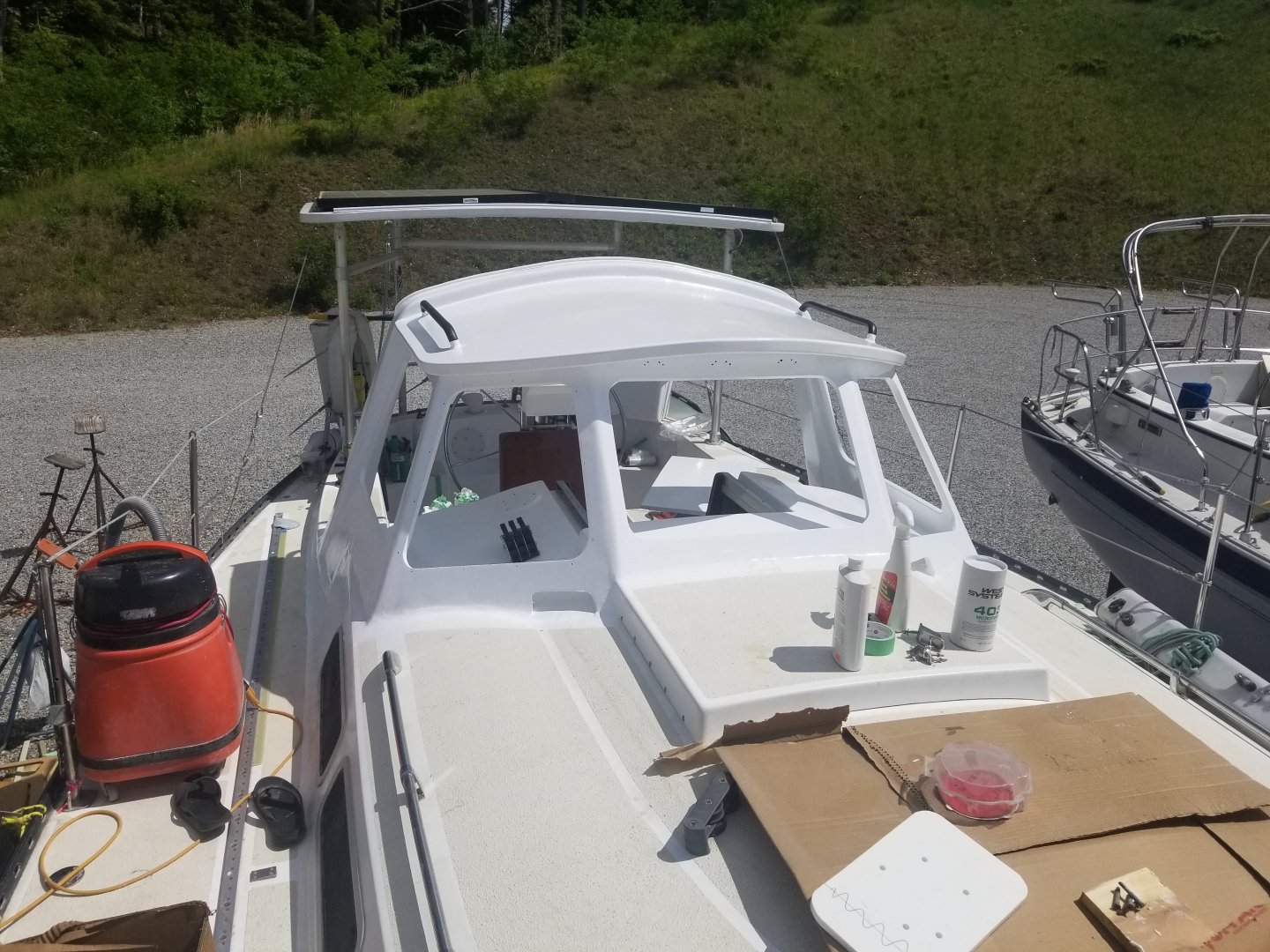
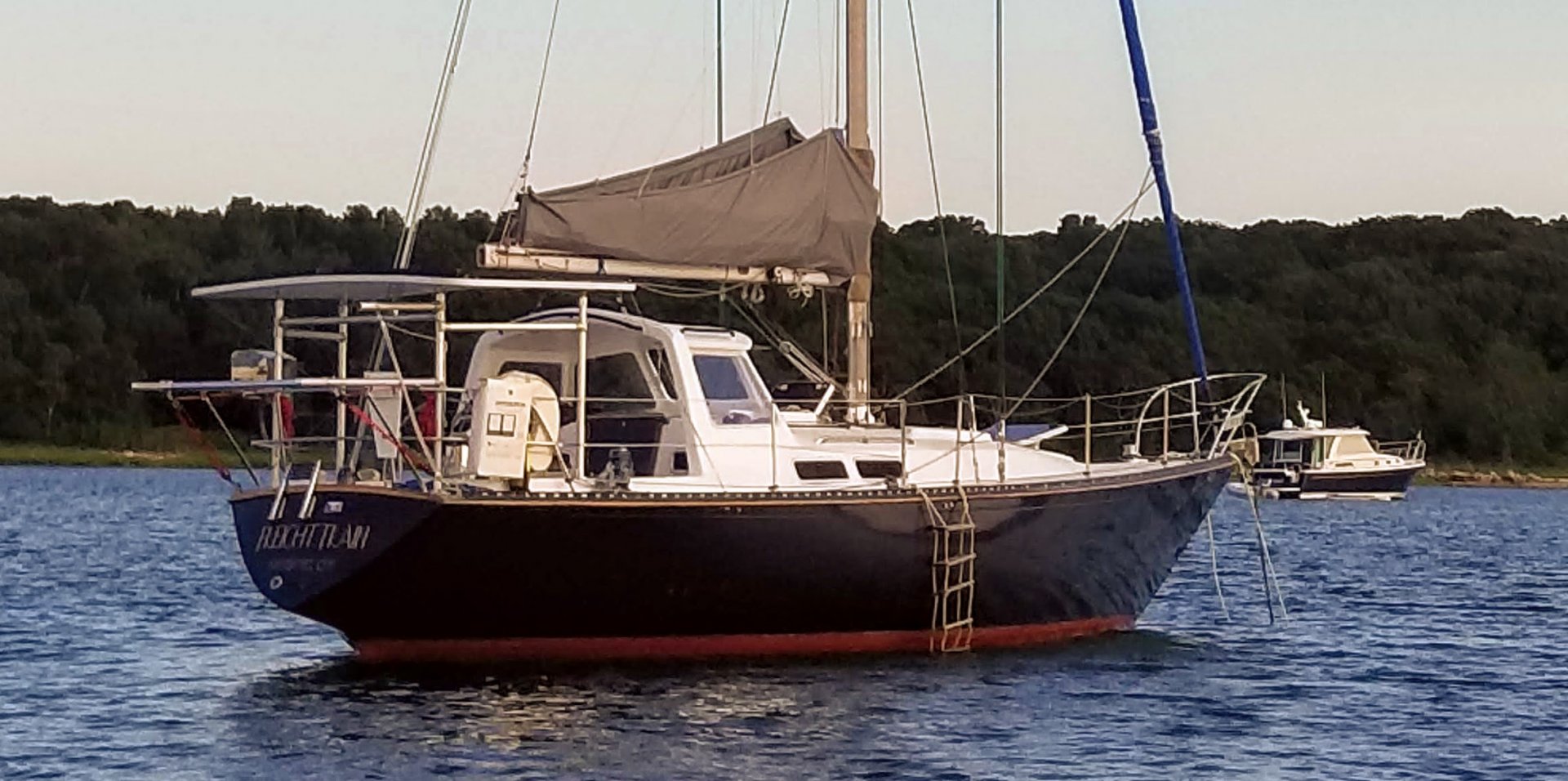
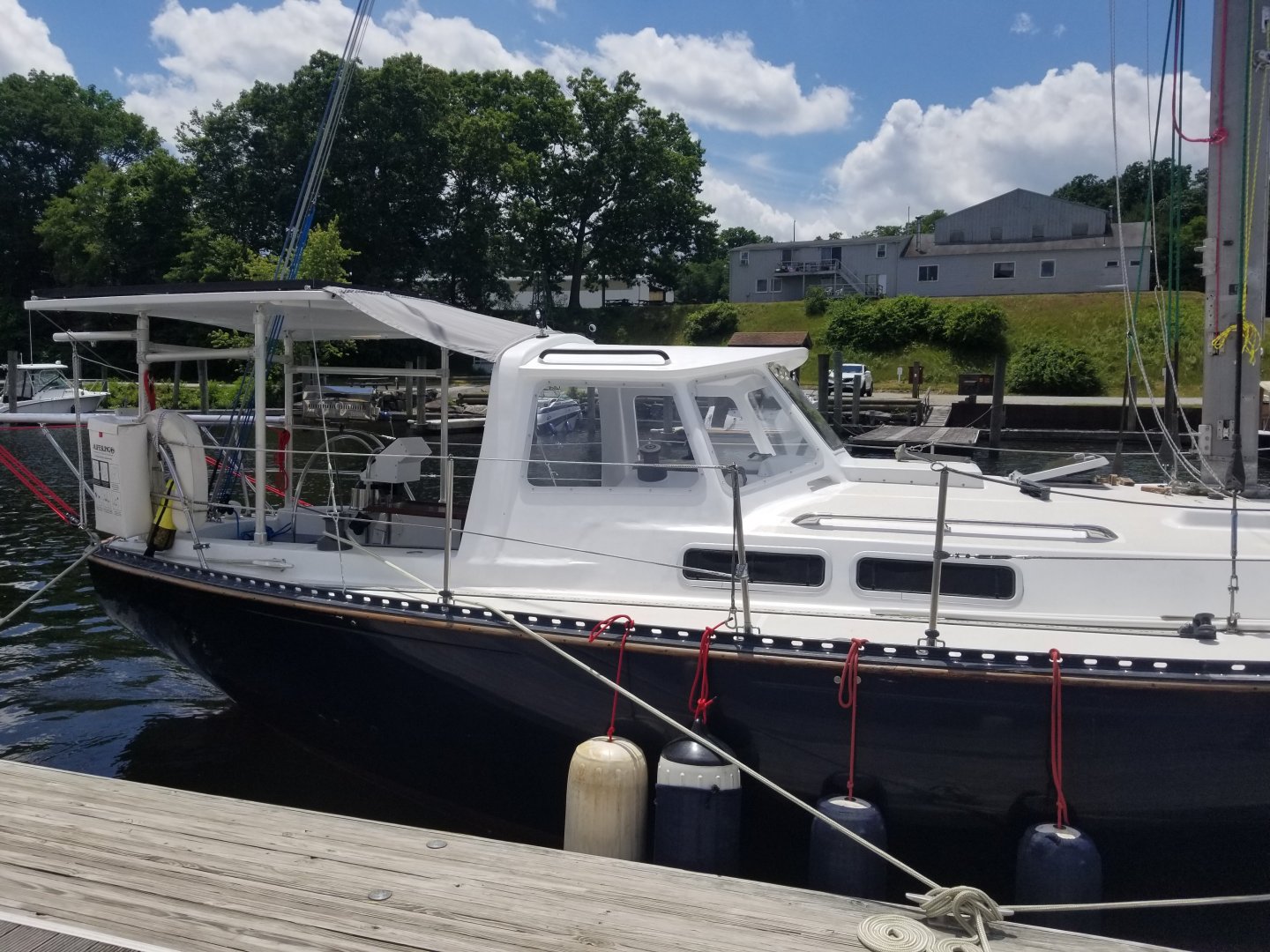
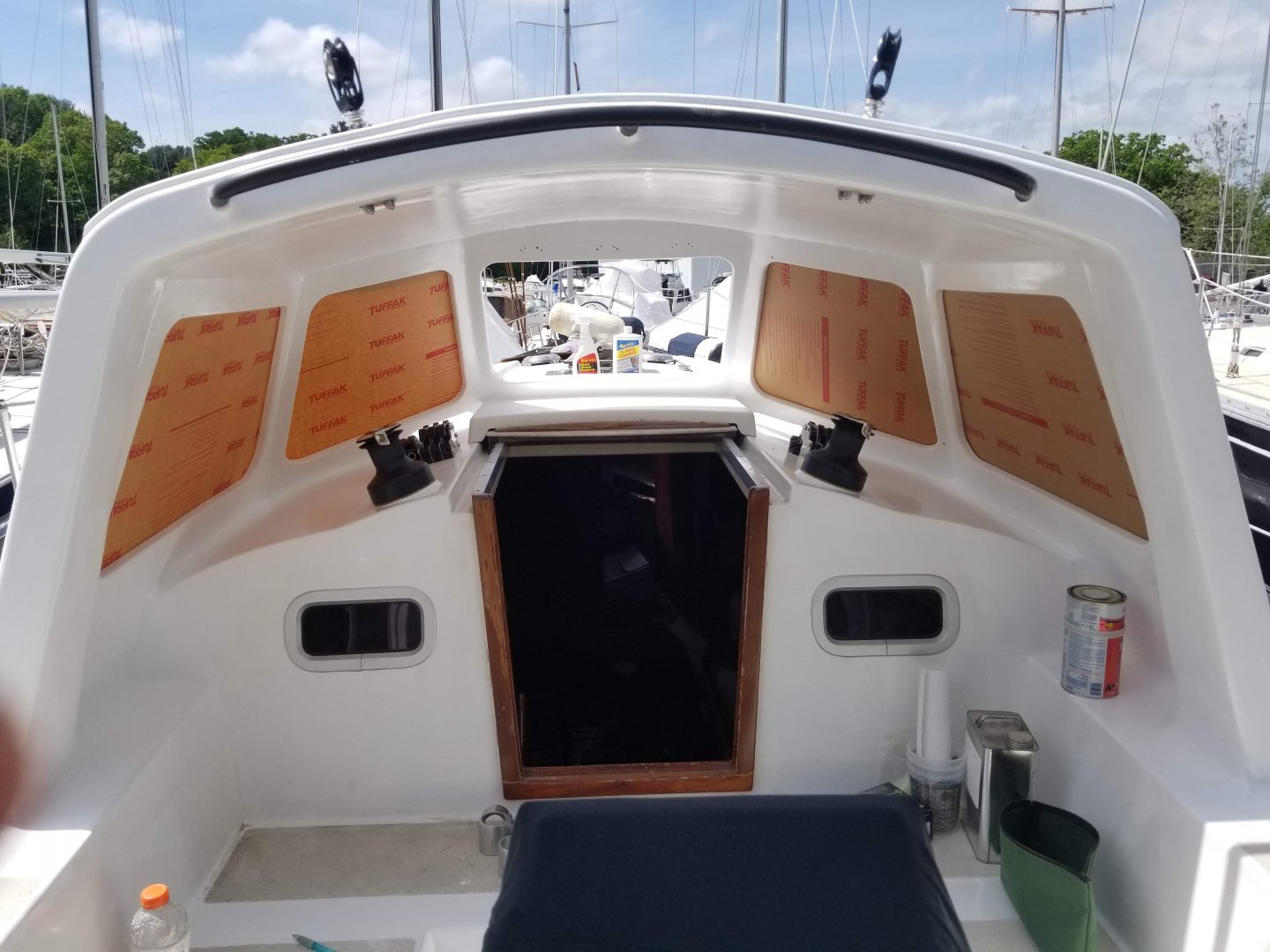
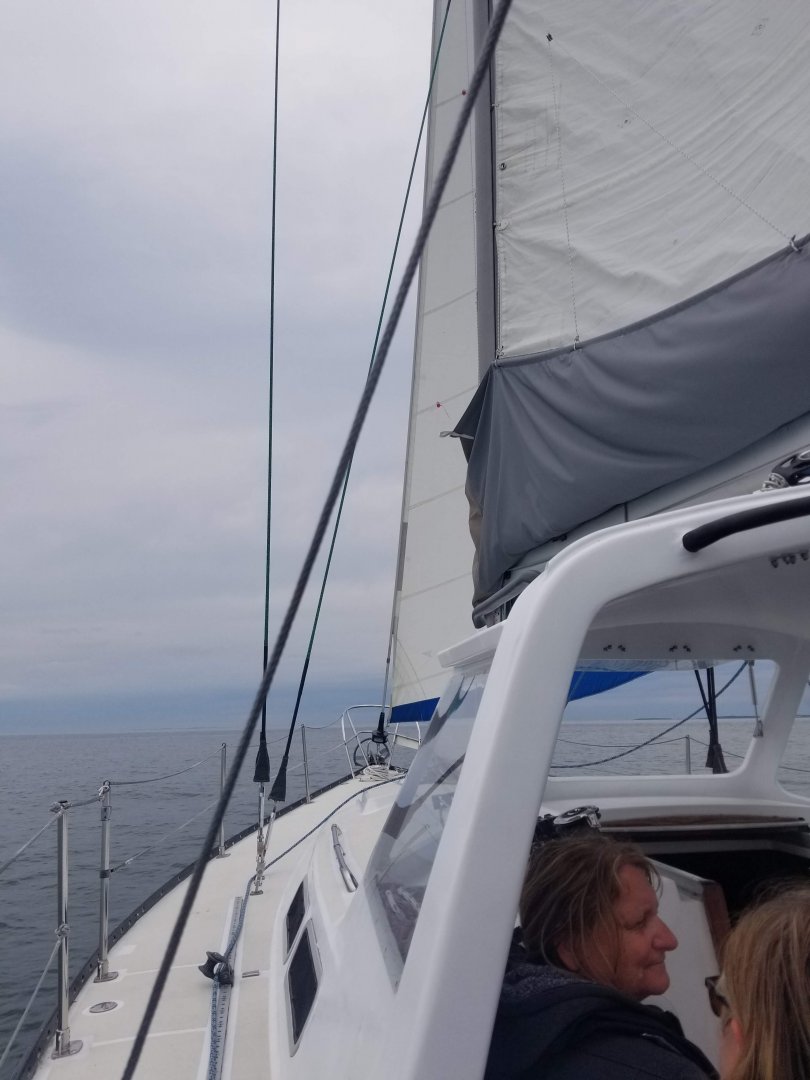
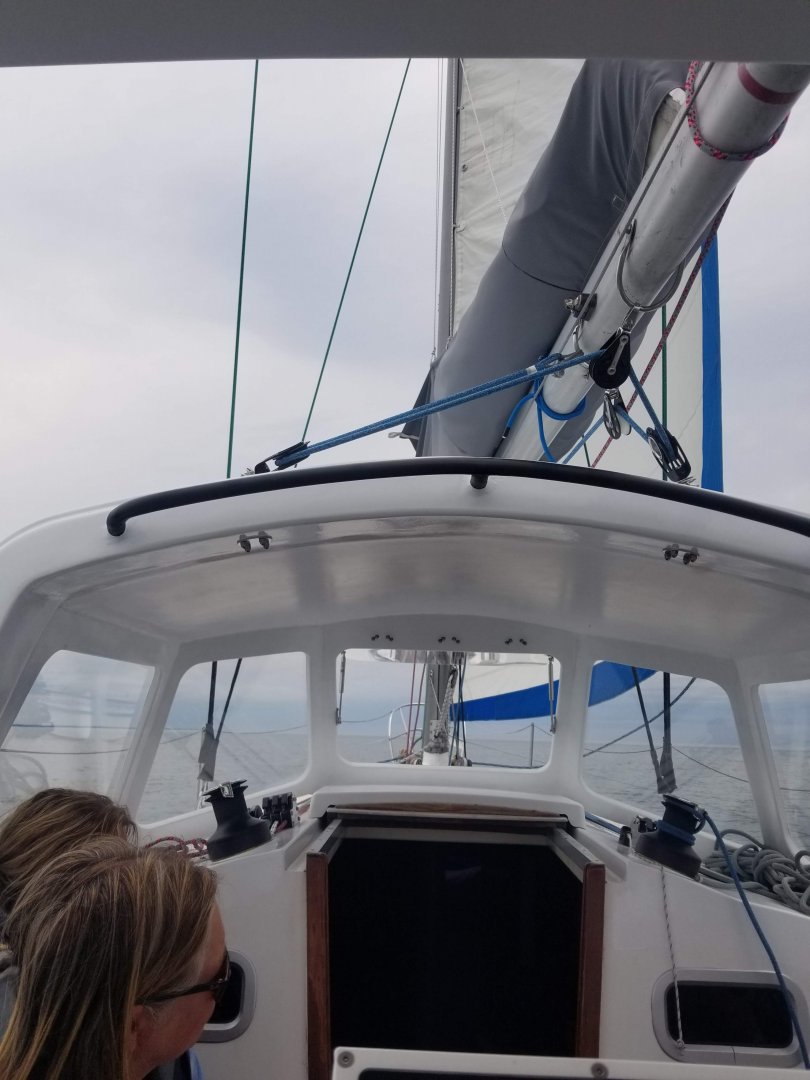 The boat is a 1976 C&C 38-2. You can look up the specs if you're curious.
Feel free to ask questions. I'll tell you what I did and why but keep in mind, I'm not a naval architect.
Another warning, before attempting structural modifications like a mainsheet arch, you should make sure you know damn well what you're doing or consult someone who does! I'm just another guy on the internet!
I'll try to post some better photos in the next few days.
This is a fully cored composite structure, engineered to take all of the force from the main sail (plus a hefty safety factor of 5x). For my needs and wants, it works great and I think it fits the boat well. The compromise is the loss of a traveller but since removing that, I've never looked back.
There are lots of itterations that one could adapt for their own needs, for example, if bringing the boom to windward in a close haul makes a big difference on your boat, you could easily adapt my system to German sheeting.
For the technically oriented:
The arch and dodger were build seperately.
The arch is 75mm (3") balsa cored, tapering to 125mm (5") at the legs. Its fore and aft width is 150mm (6") and tapers to 200mm (8") at the bases. The beam span is 1500mm (60") and the span at the legs is 2235mm (88"). The laminate schedule is 4 layers 955g/m2 (28oz/yd2) unidirectional e-glass and 3 layers 350g/m2 (9oz/yd2) unidirectional carbon on the top and bottom skins. The entire arch is then wrapped in 3 layers of 440g/m2 (12oz/yd2) biaxial (-45/45) e-glass. It weighs ~32 kg (70lbs) and my rough engineering estimates that it should hold ~44kN (10,000 lbs force) in core shear. The laminate schedule is overkill, as the core would shear long before the skins would yield but I wanted it to be bullet proof in case the boom (or worse, the mast!) ever fell on it. It is attached to the 30mm (1.25") thick cockpit coamings with thickened epoxy, and a substantial amount of uni and biax tabbing, as well as two 15mm (5/8") stainless threaded rods embedded into each leg that bolt through the coaming and are secured with a 10mm (3/8") aluminum backing plate 150mm x 300mm (6" x 12"), nuts, and washers. If this sounds over kill, it is. In theory, the surface area of the base of each leg should be able to hold the loads just with epoxy gluing it. The swivel blocks are mounted through the arch with stainless backing plates. Each bolt hole was drilled out and filled with 25mm (1") G11 rod the thickness of the arch. These rods were epoxied into the core before glassing. Once glassed, I drilled the plugs for the bolts. This way, the plugs are bonded to the core and fixed by the glass. The plugs take the compression of the bolts and ensure that the balsa is well protected.
The dodger top was contrusted using 2 layers of 20mm (3/4") Nida Core for a total thickness of 40mm (1.5") and yes I'm aware that it can just be bought in thicker sizes but this was not available in my area. It has a single layer of 1200g/m2 (32oz/yd2) triaxial e-glass with the 0 degree orientation running athwardship. These curved structures are very easy to build. I built this top and the hard bimini in a weekend each. Fairing could take a month...
The dodger sides are built from 20mm (3/4") divinycell with a single layer of 1200g/m2 (32oz/yd2) triaxial e-glass on each side. The 0 degree fibers run vertically here.
Windows are 6mm (1/4") polycarbonate. To avoid showing fasteners on the inside, I made G11 plugs and embedded them into the foam sides before glassing. These plugs were then drilled and tapped to except flat head machine screws.
The carbon handrails were built by forming 3/4" PVC pipe around a mold with hot sand. Once set, the sand is removed and the pipe is skined in 2 layers of 8 oz carbon braid sleeve. To keep the carbon look and protect the epoxy from UV, I put about 10 layers of polyurethane varnish on them. I'll probably have to varnish these yearly to keep them looking nice. These grab rails are epoxied into the structures with G11 rods. I can do pull ups on them but they do flex a little bit, FYI.
I can jump up and down on the dodger and it doesn't flex at all. All in, the arch and dodger weigh ~58kg (130 lbs) so, less than a crew member. It took me about 500 hours and I had help from my wife and friends at times.
Feel free to ask questions. I'll tell you what I did and why but keep in mind, I'm not a naval architect.
Another warning, before attempting structural modifications like a mainsheet arch, you should make sure you know damn well what you're doing or consult someone who does! I'm just another guy on the internet!
I'll try to post some better photos in the next few days.


