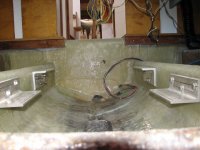
Floor grid of Beneteau

magwas

Senior Member
Joined
Oct 6, 2009
Posts
304
Reaction score
10
Location
Hungary
I am referring to this video:

This couple bought a Beneteau which was beaten to death, and they try to revive it. The floor grid is in a bad shape, and not too much attached to the hull. As they figured out the structure of the grid, they came up with a plan to fix the boat, basically rebuilding the grid and binding it to the hull.
Then someone commented that they basically misunderstanding the function of the grid, and doing unnecessary work. The commenter also said something like that the elasticity of the binder also acts as a shock absorber, so they might even make the structure too rigid.
I would like to hear explanation from someone who actually understands this stuff.
 
Ok, here is a brief try.
The shell takes the main bending loads. This includes the shape of the shell. This is the "Primary Load"
The function of the internal structure is to hold the shell in shape under the influence of the "Secondary Loads" (i.e. generally the point loads and the hydrostatic pressures).
If the internal structure is too "stiff" or too "flexible" relative to the shell, primary load flow could concentrate, causing a failure of the shell.

There is a lot more to it than this, but composite construction ... depending on the original design concept ... is full of snarky pitfalls for the unwary. I have seen composite panels "zipper" off because the lack of flexure in the backing structure allowed the many multiple small holding bolts to be loaded ... individually ... in sequence.
 
There is a lot more to it than this, but composite construction ... depending on the original design concept ... is full of snarky pitfalls for the unwary. I have seen composite panels "zipper" off because the lack of flexure in the backing structure allowed the many multiple small holding bolts to be loaded ... individually ... in sequence.

This is why I wanted to build a steel sailing cat, but all of you said it is a bad idea :)
 
This is why I wanted to build a steel sailing cat, but all of you said it is a bad idea :)
It is. Cats need to be light and stiff. Steel is not without a huge amount of work. Anyone can build a wooden boat because the material is generally self limiting. As you start pushing the edges of the structural envelope, handling the structural material needed becomes harder.
 
Wow, what a mess. While not a professional (a professional gets paid but it doesn't always follow that they know what they are doing) I've become a pretty advanced amateur. I've removed and rebuilt stringers and floors more than once and have learned proper techniques. There is more than one way to construct a stringer/floor grid. That said a couple of things strike me.

Clearly the manufacturer intended the grid structure to carry the loads imposed on it's own. Notice that there are sharp 90 degree corners where the vertical portions of the grid meet the boat. The grid is box or rectangular shaped in profile. I have no idea and have never heard of some kind of bedding compound being used as a "shock absorber".

The couple in the video seems intent on changing the design of the grid and using fiberglass/resin to bond the grid to the hull. This is a completely different type of stringer/floor arrangement than was used in the original build. The new stringers must be shaped so that they will work with fiberglass. This means no sharp edges, every corner, both inside and outside must be radiused and the lay-ups done so that there are no hard points in the stringer/grid structure. With the new grid design, the old stringers would act as a core and the fiberglass would be used as a cover. In this case the fiberglass that covers the core provides all of the strength to the assembly. This is completely different than the Beneteau design where the stringer itself provides the strength. A problem also arises because the old stringers are of a completely inappropriate shape to act as a core for the new stringers that the couple intends to lay-up.

It's very difficult to form fiberglass to a sharp angle. More importantly is the issue of point loading. If you apply force to fiberglass that is formed at a sharp angle the loads are all concentrated in a very small area. This makes the structure prone to failure where the loads are concentrated.

Pictures speak louder than words. Here is a look at a stringer/floor build that is properly designed and shaped to carry it's loads properly.

IMG_0242.JPG

In the grid that the couple proposes to build, the fiberglass that is used to cover the "old" grid will carry all of the loads. This is not the design that the Beneteau people used. This might be why they were unwilling to give out too much information to the couple in the video.

Regards,

MIA
 
Forum posts represent the experience, opinion, and view of individual users. Boat Design Net does not necessarily endorse nor share the view of each individual post.
When making any potentially dangerous or financial decision, always employ and consult appropriate professionals. Your circumstances or experience may be different.

  • Back
    Top