Correcting chain plate location

That looks closer to a racing rig to allow a genoa to be trimmed in more for better upwind performance. They require a lot of tension to keep them from breaking. The cheapest and easiest solution is to put longer spreaders.
 
That makes sense Gonzo. From what I've learned and inferred about the boat, I believe she was a go fast design. Fairly light for her LWL, lightweight steel framing for all interior millwork, laminated 150 Genoa, and her original name was Blew By You.
Have you looked at the technical information for the rig? The links were in the OP.
The compression post is bomb proof.
If the spars are up to the task, I have no issue with the current design.

The real problem is that the chainplates were improperly placed.
Can I just locate them directly below the lower spreader tips? That's, by far, the least expensive option. Virtually free in fact as I'm the welder.
I don't mean to be difficult, I would just really prefer to not Have to buy new spreaders.

 
Warning on buying mast parts. The isomat stuff comes from Europe if it's not in stock. I've been waiting for a mast step over 6 months. I bought 0* spreader bases and they did stock them. I've got an ng46 mast.
 
Is the mast currently stepped on your boat?
If so, can you post some photos of it on the boat (and of the boat as well, if you have some) to complement the sketches that you posted earlier please?
 
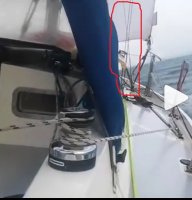
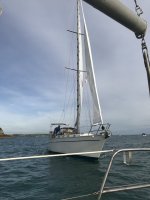
Unfortunately, it is not. I do have one image which is what caught my eye to the issue in question. It's somewhat demonstrative of the rig and issue overall.
IMG_20170211_121133076.jpg


PXL_20220607_001102654~2.jpg
 
I am certainly no expert, but looking at your photograph, it seems shortening the upper spreaders would give you the solution you seek.
 
I am certainly no expert, but looking at your photograph, it seems shortening the upper spreaders would give you the solution you seek.

I would be hesitant about doing this - Deepnit notes that the angle of the cap shroud with the existing spreader is 12.5 degrees, and if you shorten the spreader then this angle will decrease further.
Gonzo has also noted above that the angle for a cruising boat should be at least 14 degrees.
 
any reputable rigger should be able to sort this out for you. what is your shroud base (width) measurement? on our steel 345 the chainplates were all inboard, just outboard of the cabin top. that should give an indication as to whats wrong, if your spreaders are shorter than the cabin top width and vice versa. our one was one of 4 or 5 built by a professional steel boatbuilder so i take it she was relatively correct
 

Attachments

  • grace.jpg
    grace.jpg
    49.4 KB · Views: 264
  • IMG_2517.JPG
    IMG_2517.JPG
    111.9 KB · Views: 302
Now we're getting somewhere.
That's the common sense approach I'm looking for. I had the thought that the lower spreader width should somehow relate to the chainplates width.
Your cap shrouds appear much more vertical than mine. That makes sense!
Thank you so much!
I don't have the time, money or patience to re design the rig. I just want to make sure what's there is properly supported.
Not due to step the mast for some time. Before new rigging gets ordered, I'll make sure to consult an engineer or rigger if I'm not able to do the force calculations to ensure the rigging is sufficient but not overkill.
Right now, I just need to weld the chainplates to the deck.
Thanks so much Container! +1!
 
All,
For anyone interested in some real good information on rig design I uncovered this gem...
rig design hints https://www.aes.net.nz/info.html
Tons of good information in there.
Pertinent to my issue the following was found...

"Geometry: Cap Shroud/Chainplate
Most sloop rigs which use rod rigging use a cap shroud angle of 10 degrees to the mast wall. This is normally considered a state of the art angle and it usually permits a reasonable compromise between sail sheeting and rig stiffness. Similarly, the chainplate angle for an overlaping 140% genoa on an inline spreader rig is normally about 13.5 degrees from the forestay (forward end of J). This defines the most common chainplate position. With the V1 shroud vertical and the cap shroud coming from the hounds at 10 degrees it then remains to obtain a modest spreader envelope to generate even spreader pokes on each spreader; kind of like joining the dots."


And...

"Neutral Axis
The neutral axis of a section is it geometric centre of area. If plane sections remain plane and a bunch of other engineering stuff, then when you bend a section along its principal axes then there is no strain on the neutral axis that is to say it is between the region of compression on one side and the region of tension on the other side. For mast sections it is commonly confused with the centreline. If a mast was a perfect circle or ellipse the neutral axis would be the centreline too. However for most mast sections they represent an egg which has been booted up the backside or if you prefer an inflated bullet. In any case the net result is that the neutral axis is some 55% to 60% aft along the section. The question arises, should the spreader rake and chainplates be set from the neutral axis or the centreline? There actually isn’t much difference. You could argue that by putting chainplates and stays on the centreline it will induce mast inversion because you are compressing the mast on the forward face. However, the mast will probably still bend the same way and the so-called inversion will actually stiffen the mast up. Further some people get really lost because with stiffening in the mast the neutral axis can move in every mast panel. So at the end of the day use the mast centreline is our advice. Thus V1 chainplate for an inline rig is halfway between front face and aft face of the mast when you layout the deck plan"
 
Forum posts represent the experience, opinion, and view of individual users. Boat Design Net does not necessarily endorse nor share the view of each individual post.
When making any potentially dangerous or financial decision, always employ and consult appropriate professionals. Your circumstances or experience may be different.

  • Back
    Top