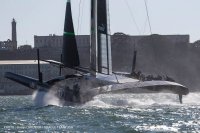
CT249, If you're referring to my comments, please understand that I wasn't saying what they should have done to save it, I was merely explaining to Stephen Ditmore that releasing the mainsheet at the moment the bows were already down would have just assisted the pitchpole as the wing loads up with extra power, and sheeting it in would be the only way to stall the wing & depower it. The guys on board have many multihull hours under them and they knew this as well, which is why they tried to carry on bearing away while holding the main IN. I was not inferring that they responded incorrectly, merely explaining to others here who might think in monohull terms how to remedy a situation, which doesn't always work on multi's.
My thought that they should not have attempted the bearaway without coming up to full speed first, and if the boat was designed with no reserve bouyancy in the bows and designed to rely on the foils to provide the lift absent in the bows, still stands, and is confirmed by their own designers who's comments on the matter are listed a few posts ago. In no way was I inferring that these guys should learn from the world's top cat sailors - They ARE the world's top cat sailors.
My post was partly referring to your post and partly to others - Doug's comment that he doesn't "think the crew was ready to handle the boat in those conditions", Petereng's reference to operator error and the fact that it seemed that they "just gave it a go to see what happens?", Gary's comment that the Oracle guys were "asking for it" and that people should ask the A Class guys about it. As you say,there were bloody good cat sailors on board, of course they know about this stuff!
As earlier noted, I agree that sheeting in is a common depowering technique; more common in some types of craft than in others simply because the dynamics of CoE/CLR and apparent wind work differently, at a guess. But there is info that indicates that sheeting in would not have helped in this case.
Steve Clark doesn't seem to believe that "sheeting it in would be the only way to stall the wing & depower it". On SA he wrote;
"On staying sheeted in on a bearaway:
It's not a sail, it has a slot and maintains lift at a higher angle of attack.
So if you stay sheeted on, it doesn't turn off (lee stall) as quickly as a sail.It also has a higher Coefficient of Lift, so as you try to power down through the zone, you also have to deal with more power than a sail generates.
It's different."
He posted again later with l/d graphs and noted
"Note that the power goes up faster, goes up further and stays on longer.
All good reasons for having a wing on a racing sailboat, and good reason not to stay sheeted on hard during a bear away.
So rather than being some lack of knowledge that stopped them from sheeting in, it appears that practice and theory shows that sheeting in to depower does not apply in the same way to solid wings.
The comment that these guys are the world's best appears to be at odds with the comment that you "thought that they should not have attempted the bearaway without coming up to full speed first." You are saying that the world's best did something that you think they "should not have attempted".
When there is a difference of opinion between the world's best who were on the boat and those of us who are not the world's best and were not on the boat, surely logic demands that we should assume that they know best.
This is not saying that we cannot criticise, but we should have a pretty damn good factual basis for any criticism and the fact that we would not have done it that way on soft-sailed 16 footer lowrider cats does not mean that they should not have done it that way on a solid-wing 72 foot foiling cat.