
Wave Resistance on Submarine vs Surface

zstine

Senior Member
Joined
Sep 26, 2013
Posts
143
Reaction score
18
Location
New Jersey
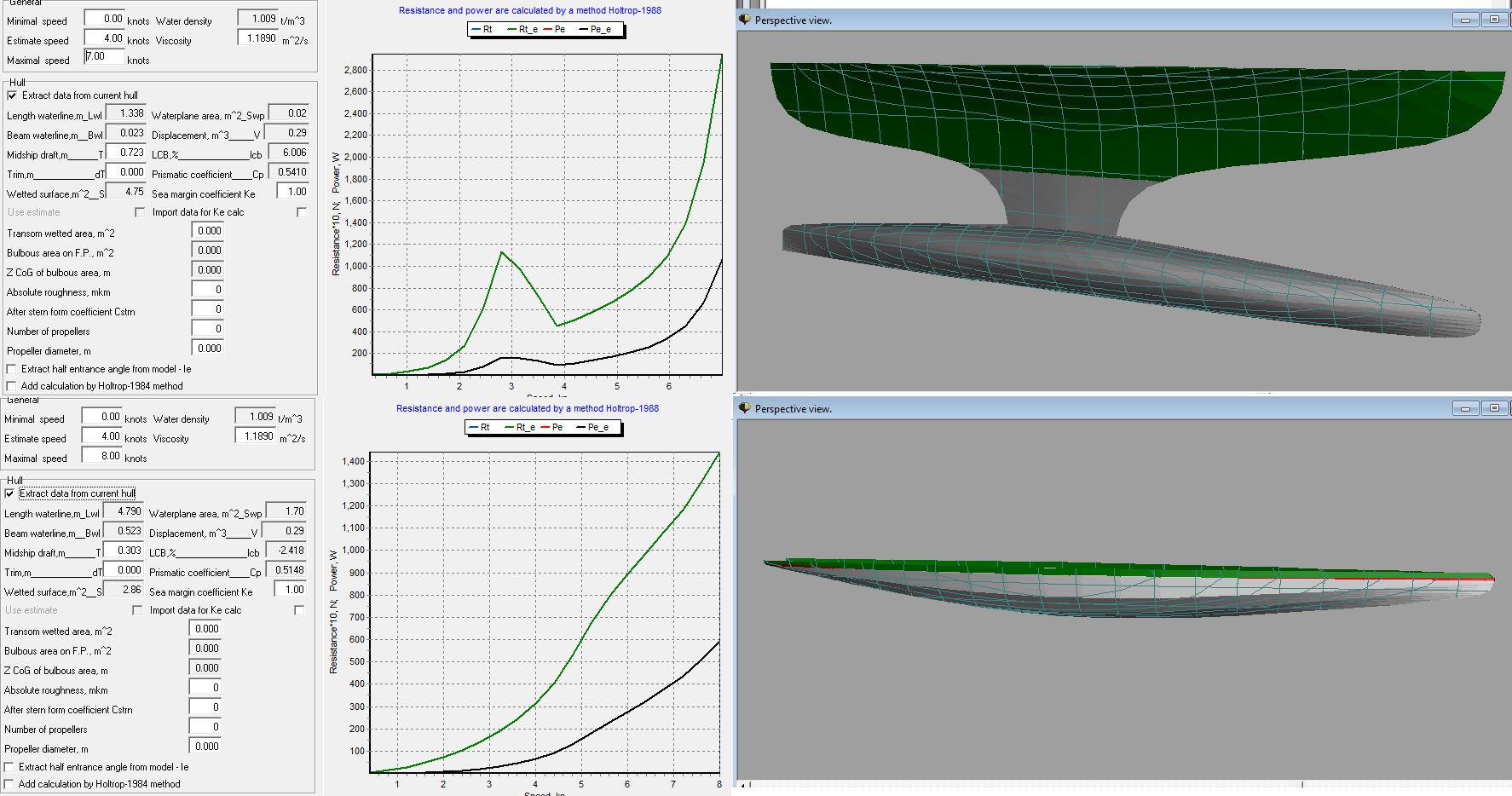
After a bit of study, I thought that a submarine or torpedo would not exhibit a drag hump at the 'hull' speed, compared to a surface ship, due to lack of wave resistance. So I developed a torpedo with a very thin strut in FreeShip (freeship can't run drag calcs if vessel isn't surface piercing, hence the need for the strut). I also made a surface ship of the same length (16ft) and displacement (700lbs). I expected to see a more smooth parabolic curve for the torpedo compared to the surface ship which I expected a pronounced hump at the ~5.5knt speed. FreeShip uses Holtrop 1988 method, which I'm unfamiliar with.
Here's the results... not really what I expected. Obviously the <1 inch wide strut is coming up with a much larger wave drag at 3knts than expected, but the surface ship hump at 5.4kn is relatively small. I was expecting to see a larger hump in the surface ship, possibly where the torpedo would have less drag due to lack of wave resistance. But the submerged vessel with the added surface area is showing higher drag at all speeds.. Food for thought.
upload_2022-6-17_17-24-24.png
 

Attachments

  • upload_2022-6-17_17-10-46.png
    upload_2022-6-17_17-10-46.png
    172.5 KB · Views: 382
  • upload_2022-6-17_17-19-17.png
    upload_2022-6-17_17-19-17.png
    172.4 KB · Views: 389
Also, a submarine needs to be submerged to a certain depth to seperate from wave making.
 
Good you all...
Doug, for the unwashed, what would be benchmark submergence for a (say) 2m x 10% chord bulb?
 
Typically, 3X it's diameter...
So 60cm (0.6m).
 
The Holtrop-Mennen method does not work for this type of hull. Neither for the underwater hull nor for the "normal" hull. No wonder you get weird stuff.
unfortunately, it is the only tool I have. And while there are several parameters that are out of range for the submerged design, only Bwl/T is out for the 'normal' hull. So when you say 'it doesn't work', what i believe that really means is 'your result will have error'. that is of course true with all analysis. I wonder what the error is compared to reality, 10%, 20%? sometimes you have to cut wood with a butter knife. Work or Not, I'm convinced that given a length and displacement in this realm, the surface-running hull is going to have less resistance at almost any speed than a slightly submerged torpedo body. Would you say that statement is in error?
"Holtrop and Mennen's method is arguably the most popular method to estimate resistance and powering of displacement type ships. It is based on the regression analysis of a vast range of model tests and trial data which give it a wide applicability"

Depth issue noted. If motivated, I will increase the draft and rerun the analysis
 
I would not say that the resistance of a submarine running near surface is bigger than the resistance running at surface is an error, it's true. The submerged submarine will have wave making resistance but also it has much more wetted surface area than the surface running submarine which results in a larger frictional resistance.
 
Last edited:
I would not say that the resistance of a submarine running near surface is bigger than the resistance running at surface is an error, it's true. The submerged submarine will have wave making resistance but also it has much more wetted surface area than the surface running submarine which results in a larger frictional resistance.
I think a better way to say it is:
While running on the surface, the submarine is subjected to wetted surface drag, form resistance, and all the effects of its surface wake (knowing that the surface wake causes a speed dependent variation in the form resistance). As the vessel submerges, wetted surface and form resistance increases while wake effects continue. Maximum resistance occurs just as the main hull is fully submerged as wetted surface and form resistance reach maximum and wake effects continue. As the vessel continues to dive, the surface reflection continues to apply a wake effect (i.e. Newtonian Wake) that reduces with increasing depth until the vessel is "deeply submerged". Once the submarines is "deeply submerged" the drag of the vessel is only dependent upon speed (and a very, very, small temperature and density variation) as the wetted surface and form drag are constant up until the point of cavitation.
Also note for submarines there is a bottom reflection also. Resistance increases the closer the vessel is to the bottom. This is why there are blue water submarines and costal submarines, you can have both reflections at the same time.

Edit: make sure that everyone understands that there is only a very, very small change in resistance due to seawater effect at depth.
 
A submerged submarine with a round cross section has the same wetted surface to displacement ratio as the same sub floating with its axis at the surface. The submerged sub has twice the wetted area AND twice the displacement. If the sub is capable of floating with half its hull out of the water, that hull is too large for the load it's carrying. Or else it's really a boat.

Consider a semi circular cross section 1 foot wide. The circumference is pi/2 feet. The area is (pi/2) r^2. For a submerged craft with a circular cross section, it's pi and pi(r^2)
 
Consider a semi circular cross section 1 foot wide. The circumference is pi/2 feet. The area is (pi/2) r^2. For a submerged craft with a circular cross section, it's pi and pi(r^2)
I would suggest that you check your math.
And, FWIW, an arbitrary sectional area to wetted perimeter ratio has very little to do with the overall resistance of a submarine on the surface or submerged. Some (and not even most) moderns submarines are round but that has to do with many other issues than resistance.
 
I wonder what the error is compared to reality, 10%, 20%?
High end, million dollar software might not manage 10% for your oddball hull. Probably do 20%. Here, the errors would be so large as to seem like random guesses. It takes a bit of getting used to - realizing the best tow tank data might be good for +/- 25% - meaning if you gave the same exact model to the ten best tow tanks in the world, the high predicted drag figure might be 5o% higher than the low one at critical transitions like thrust needed to get on a plane. This was actually done by Delft, with very few of the original test groups willing to go public with the results. There is a thread here about it, but I can't find it.
 
It takes a bit of getting used to - realizing the best tow tank data might be good for +/- 25% - meaning if you gave the same exact model to the ten best tow tanks in the world, the high predicted drag figure might be 5o% higher than the low one at critical transitions like thrust needed to get on a plane.
I'd like to think it is closer than that, but then again the closest I ever got was a calculated estimate 7% higher than trials data, but only because I used a really sharp pencil for the appendage interference drag using "million dollar software" then added 10%.
But maybe zstine could go ask these people; seems like somebody has done this before.

8a755fe8716ce8ae356176dc679bb14786287b2b_IMG-PRODUCT-785015-4.jpeg

bateau-de-plongee-playmobil-family-fun-6981.html
 
Forum posts represent the experience, opinion, and view of individual users. Boat Design Net does not necessarily endorse nor share the view of each individual post.
When making any potentially dangerous or financial decision, always employ and consult appropriate professionals. Your circumstances or experience may be different.

  • Back
    Top