Aerodynamics of 'overlapped' staysails

Another effect is to make the quarter chord lines (or whatever cord line is applicable here) of the staysail/mainsail combo and the A-sail more parallel. This means that the circulation boost of the staysail/mainsail will be in the same plane as the self-induced circulation of the A-sail. If I'm not mistaken, that maximizes the effective aspect ratio of the overall combo and minimizes induced drag.
 
Rumars, could you say more about the "specific conditions" you mention? E.g., certainly point of sail generates differences in terms of risk of interference among sails. Is that what you mean?

Yes, something like this. The key is the separation between sails, and the specific sheeting angle. Seperation has to do with boat length, the longer the boat the more space there is between the individual sails. I believe a class 40 is to short to fly 3 sails without interference (it would need a truely long bowsprit), while over 60' there might be enough space at certain apparent wind angles. On every photo of three foresails flying the separation between the sail on the bowsprit end and the jib is bigger then the one between jib and staysail, and that is not by accident, it translates to horizontal separation at the clews, wich means the inner sails are not "burried". Important is not what we see, but what the apparent wind sees.

There are also practical reasons for using this approach, mainly overall sail area and sheeting geometry. If you use a big overlapping first foresail, like a 150% genoa, you effectively kill much of the mainsail drive, as observed in the IOR era. That was no problem then with their tiny mains and non planing boats, but it would be a problem now. Any sail you put forward of this 150% genoa must be smaller, you end up with less overall area, and a not really working main. Given how fast this boats are, in order to sheet the more forward sail correctly for the apparent wind, the sheet must pass through the previous sail.
Draw the sheeting angles of such a configuration when the boat is traveling at over 20kn and you will see what I mean. It worked for the ancient cutters and square riggers, but those were never that fast.

What is important is the end result expressed in knots, not the ideal working efficiency of the sail. The ideal is the rigid wingsail that can change shape and reef, but we are not there. What we do is pile on more sail area, even if we loose some efficiency on some sail combinations, the net result is positive, giving us more speed. This is just like the tradeoff on pointing, or downwind gybing, you sail a longer distance, but you are faster, and arrive sooner overall.
 
Another effect is to make the quarter chord lines (or whatever cord line is applicable here) of the staysail/mainsail combo and the A-sail more parallel. This means that the circulation boost of the staysail/mainsail will be in the same plane as the self-induced circulation of the A-sail. If I'm not mistaken, that maximizes the effective aspect ratio of the overall combo and minimizes induced drag.

Sorry, not quite following...

Do you mean all the sails should run in parallel... which I don't think makes sense because the point of multiple elements foils is to allow the aft edge to achieve a narrower angle to the wind than otherwise.

Or, as I suspect, do you mean to make the quarter chord of all the sails parallel but to tune the aft edge of each to progressively closer angles?

Or do you just mean that the staysail/mainsail combo should have parallel quarter chords because they are acting as one element?
 
Yes, something like this. The key is the separation between sails, and the specific sheeting angle. Seperation has to do with boat length, the longer the boat the more space there is between the individual sails. I believe a class 40 is to short to fly 3 sails without interference (it would need a truely long bowsprit), while over 60' there might be enough space at certain apparent wind angles. On every photo of three foresails flying the separation between the sail on the bowsprit end and the jib is bigger then the one between jib and staysail, and that is not by accident, it translates to horizontal separation at the clews, wich means the inner sails are not "burried". Important is not what we see, but what the apparent wind sees.

Yes, I see the point. If the clew of the A-sail is far enough apart from the staysails, then one does not need to worry about interference. In that instance, it's just about adding sail area for drive. Or, maybe the inner sails work with the main as a multi-element foil, but the big headsail sees them as one unit and does not interact with any of them separately.
 
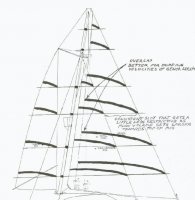
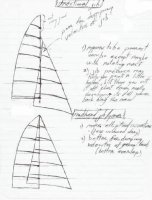
I have tried to make a sketch for the case of two and three sails (attached). The additional staysail allows a closer sheeting angle of the main. On the rear suction side of the main the pressure is negative and has to increase to zero at the trailing edge. This steep pressure increase can cause separation. The additional staysail has its pressure side towards the suction side of the main. The positive pressure induced by the staysail will reduce the negative pressure peak at the main. Therefore, the pressure increase towards the trailing edge at the suction side of the main will be less steep and separation will not occur. The result is, that the sheeting angle and hence the lift coefficient of the main can be increased.

I accept this explanation completely. Very helpful. Your sketch passes my 'intuition' test for what that's worth (probably not much!).

But imagine your sketch with the staysail line drawn only 3/5 as long. Does that make a difference? Or, does it make a difference if the staysail line is 1/5 longer or positioned with its tack a bit closer to the main?
 
But imagine your sketch with the staysail line drawn only 3/5 as long. Does that make a difference? Or, does it make a difference if the staysail line is 1/5 longer or positioned with its tack a bit closer to the main?

If the gap between foresail and main is small, the genoa will create a positive pressure at the rear side of the main. If the gap is large, then the distance between the two sails is too large for a strong interaction. In this case, an additional staysail can create the support for the rear side of the main. The further the staysail extends towards the leech of the main, the more positive pressure it creates on the main. However, at the same time the staysail will create additional drag, so there is a trade off. To find the optimum overlap is only possible by trial and error, either in the wind-tunnel or with CFD.

Arvel Gentry shows in fig.14 the pressure distribution on the main with and without the jib. With the jib, the negative pressure spike at the main is dramatically reduced and the pressure gradient towards the trailing edge is much milder. But keep in mind, that Gentry shows the flow pattern for potential, inviscid flow. In reality, there is always some kind of separation. http://www.remmlinger.com/2D aerodynamics.pdf
 

Attachments

Revboat - I meant the second one. The idea is to get the interaction of the A-sail and the Staysail/mainsail to be as constructive as possible. That is helped by having the spanwise line connecting the quarter-chord points of the two foils systems be parallel.
 
Revboat - I meant the second one. The idea is to get the interaction of the A-sail and the Staysail/mainsail to be as constructive as possible. That is helped by having the spanwise line connecting the quarter-chord points of the two foils systems be parallel.

Yes, that's what I figured. Thank you. This makes intuitive sense to me. Do you happen to know of any articles or resources that discuss this idea of getting the quarter-chord of the sails interacting with each other in parallel (in conjunction with the trailing edges nonparallel)? It makes me think of the potential value of vertically parallel luff lines (as opposed to converging luff lines, as on boats with multiple masthead sails). Also a number of things to do with leech tuning.
 
Arvel Gentry shows in fig.14 the pressure distribution on the main with and without the jib. With the jib, the negative pressure spike at the main is dramatically reduced and the pressure gradient towards the trailing edge is much milder. But keep in mind, that Gentry shows the flow pattern for potential, inviscid flow. In reality, there is always some kind of separation. http://www.remmlinger.com/2D aerodynamics.pdf

Thank you, Remmlinger. And thanks for posting all the material on your website. Took me a few days to get through it!
 
I'm working out the sail suite for a Class 40 under construction, and am wrestling with a problem that seems to bother no one but me.

The problem is that it's common for racers to use multiple headsails in such a way that the leech of the A-sail extends further aft than the leech of the aft-most headsail -- thereby ruining the various 'slot effect' benefits of the inner sails. It doesn't seem sensible aerodynamically.

Since reading Gentry, my (amateur) understanding is that the leech of the trailing sail must extend further aft than the leech of the leading sail, or else the singular foil is compromised. A staysail that is 'buried' by the leech a big A-sail might help a bit with mainsail flow attachment... or might reduce the drag of the mast... but is more likely to simply add drag itself or to generally interfere (particularly if its twist cannot be controlled to match that of the A-sail and main, which is usually the case in the low clew jibs and genoas used on most racers).

Staysails that are 'overlapped' by A-sails don't add upwash, lift, etc.

But no one seems to pay attention to this. Very smart people are violating it everywhere -- on Maxis, VORs, Class 40s...


But so far, I'm only getting blank stares and shrugs from designers. Conventional practice ignores the issue. I just can't figure out why I'm wrong.

Thoughts and/or recommended resources very much appreciated.

I assume you are referring to this article by Gentry, attached

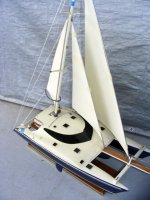
That is one reason I chose the twin headsail arrangement I did on my aftmast rigged cat.
 

Attachments

I think it's easier to understand if you find pictures showing the same configuration from the lee side. There is a huge gap between the A-sail on the bowsprit and the mainsail, not only fore-n-aft, but also sideways, and down low (from the high clew of the A-sails). There is no chance to have the right slot effect if you only flew the A-sail and the mainsail, you need something in between. The staysail provides exactly that, it cleans the airflow over the mainsail. Staysail drive is secondary here, the main does the work and is to be kept happy at all times, hence the blade, non overlapping staysail you see on all this boats.
On a class40 there is probably no benefit to also fly a second staysail/jib at the same time, Open 60's and longer can do it in specific conditions.

Not if you configure the slot between the headsail and the staysail the way i did with the aftmast rig,...consistent slot

dscf9594-jpg.190809


177077-2f16a97161cb2b1c459b7193b89617c4.jpg
dscf9600-jpg.190812
 
Sails in Combination

...I thought it might be interesting to revisit this portion of Paul Bogataj's paper

SAILS IN COMBINATION
Each sail by itself is much simpler than the combination of a foresail and mainsail as in the sloop rig. The sails are operating so close to each other that they both have significant interaction with the other. The most interesting feature of this is that the two sails together produce more force to pull the boat than the sum of their forces if they were each alone.

Earlier, upwash was identified as the increase in flow angle immediately upstream of a wing. There is also a corresponding change in angle, called downwash, just behind a wing, where the flow leaving the wing has been turned to an angle lower than the original flow. This is the cause of the well known “bad-air” that a boat just to windward and behind another boat experiences.

The mainsail of a sloop rig operates in the downwash of the forward sail, causing the flow angle approaching the mainsail to be significantly reduced from what it would be otherwise. This decreases the amount of force that the mainsail produces. The observed affect commonly referred to as “backwinding” is partially a result of downwash from the foresail, but is also due to the higher pressure on the windward side of the genoa being very close to the forward, leeward side of the mainsail, causing the flexible material of the mainsail to move away from that higher pressure.

The foresail of a sloop rig operates in the upwash of the mainsail. The wind as far upstream as the luff of a genoa is influenced by the upwash created by the mainsail. Hence, a jib or genoa in front of a mainsail has a higher flow angle than it otherwise would have by itself, causing an increase in the amount of force that the forward sail produces. So, while the mainsail is experiencing detrimental interference from the foresail, the foresail benefits from the interference of the mainsail. Notice that more air is directed around the curved leeward side of the foresail. This causes higher velocity (lower pressure) and more force. The net result is that the total force of the two-sail system is increased, with the foresail gaining more than the mainsail loses.

There is a converse affect to a windward boat receiving “bad air” (downwash) from a boat ahead and to leeward. A leeward boat gains additional upwash (“good-air”?) from a boat just to windward and slightly behind that acts like a lifting windshift until it moves ahead of the windward boat. This is the same phenomenon from which a foresail of a sloop rig benefits.

Another consequence of the difference in flow angles that the two sails experience in each others’ presence is that the mainsail must be trimmed to a much closer angle with the boat’s centerline than the foresail, which is able to be trimmed to a lead position well outboard. This angle represents the difference in upwash on the foresail and downwash on the mainsail due to each other.

MASTHEAD RIG.
On a masthead rig, where the forestay is attached to the top of the mast and both sails taper to basically zero chord length at their heads in a similar fashion, the interference effects of the sails on each other are similar along the entire height of the mast. The mainsail ends up being rather tightly trimmed all the way up becauseof the genoa’s downwash, and the genoa gains from favorable upwash all the way up.

FRACTIONAL RIG.
A fractional rig has the more complicated characteristic that the top of foresail is not as high as the top of the mainsail. This means that the top of the foresail is very close to the front of the mainsail at a height where there is still an ample amount of chord length in the mainsail. As the foresail luff approaches the mainsail luff, the upwash on the foresail due to the mainsail increases, because the low pressure behind the mainsail has more affect the closer the flow gets to it. This causes the top of the foresail to experience even more upwash and contributes to a fractional rig’s foresail being trimmed more twisted than a masthead rig’s foresail.

The top of the main on a fractional rig extends well above the foresail, leaving the upper portion of the mainsail free to experience the apparent wind without the downwash interference of the foresail. Apparent wind toward the top of the mast comes from a much higher angle, so the mainsail above the foresail experiences much higher wind angles than the lower portion of the mainsail where the genoa is causing substantial downwash. This change in flow angle with height on a mainsail is quite dramatic with a fractional rig and leads to trimming a fractional rig’s mainsail with more twist than a masthead rig’s mainsail

...and a couple of flow sketches (please excuse their older rough nature)

Attached Files:
RunningTideYachts.com

 
SODEBO Trimaran

Sodebo almost pitchpoles at start of singlehanded race. Thank goodness she didn't have her full mainsail up.

I particularly like this photo of her with her rig set well back on the boat, and sailing under a three sail combination.

...more photos and a video of the wild ride here:
http://www.sail-world.com/index.cfm?Nid=79811&refre=y&ntid=118&rid=4

sodebo-tri-dbl-headsail-reefed-main-jpg.53266
 
I'm rather surprised that there were no additional postings made to this subject thread when it stopped in 2021, and then continued after my multiple postings in 2023 ??
 
Forum posts represent the experience, opinion, and view of individual users. Boat Design Net does not necessarily endorse nor share the view of each individual post.
When making any potentially dangerous or financial decision, always employ and consult appropriate professionals. Your circumstances or experience may be different.

  • Back
    Top