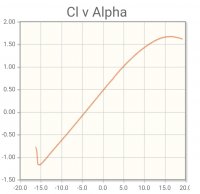
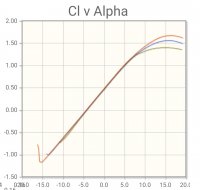
Design subject: ~6m LOA hydrofoil (a bit less than 20 feet) assisted catamaran planning (LDL???) power catamaran. To be exact - submerged tandem foils operating near the surface, at 0.2-0.4 chord depth
Operational speeds - 20-32kts
There is a limit for the foils of around 0.8m of tunnel width, as I want to make that cat less than ~2.25m wide total with all the possible appendages.
I am using at this moment quick and dirty Excell spreadsheet to calculate lifting force, and the bad part is that I have to stick with aspect ratio AR =~3 and pretty high angle of attack of in the range 4.5-5.5 degrees. The foils are fully passive and in the keel depth - similar to HYSUCAT type.
At 30 knots I am getting 5000N loading on 0.2 sq m foil, so it is 25000N (~2500kg) on 1 sq m. which I feel is way too much
The question is: what is the reasonable limits of the foil loading to avoid cavitation at such speeds?
The foil profile is still under question, but would like to stick with flat bottom ones for the simpler manufacturing process.
My calculations are attached
Attachments
Last edited: