America's Cup declining?

Status
Not open for further replies.
Quote "My main quarrel with the AC72's is that they are too extreme." Quote.

So was the De Haviland "Comet".
It was a whole technical leap ahead of the "C 47". but suffered from structural failure. The lessons learnt from that failure enabled the successful development of the Boeing 707 and the Douglas DC8.
Jet travel then became the safest method of transport ever devised by man.
The AC catamarans have to be recognised as a similar leap in sailing technology. Nat Herreshoff would be proud. :)

The comet was about materials science, particulalry understanding of airframe fatigue. The initial design had stress risers that lead to catastrophic failure. Once the stress risers were ironed out the vehicle was fit for service since the fundamental design was not flawed.

That's nothing like the AC72. The AC 72 are extreme in their very SOR, their level of structural safety (FOS) is always a gamble in a racing ULDB. Large sailing foilers can have no useful application they are just extreme sport platforms.

Even Le HYdroptere which is a tougher foiler than the AC72's is very extreme and quite prone to catastrophic failure. And they might sit for another year waiting for a weather window to smash the Transpac record and they still have an 'extreme' risk of foundering while doing it.

They are extreme alright.

For reference officially the safest form of transport ever invented is the lift not the airliner.
 
===============
The apparent wind on an AC boat will be between Force 8 and Force 10. Your "real" sailboat definition ignores that ,it seems to me. These boats are specifically designed as race boats and therefore,in my opinion, it is ludicrous to attempt to hold them to the same criteria you might hold an ocean cruising boat to.
These boats are highly engineered ,state of the art sailboats the likes of which have never been seen on this planet-to fault them for being new and state of the art + is shortsighted because you're faulting progress and new development at the same time............

Hardly Doug. Taberly and friends did the ground work in the 90's and the Hydroptere concept has been continually researched funded and refined for how many decades now ? And it's still extreme and severely limited by ocean conditions and always will be.

Force 10 in a seaway would completely trash any of these types of boats.
 
America's Cup Ascending!

Hardly Doug. Taberly and friends did the ground work in the 90's and the Hydroptere concept has been continually researched funded and refined for how many decades now ? And it's still extreme and severely limited by ocean conditions and always will be.

Force 10 in a seaway would completely trash any of these types of boats.
================
"Hardly, Doug."
Really? Who cares about Force 10 in a seaway in reference to the AC 72?
It's an Americas Cup boat suitable only for the anticipated conditions on the race course-just as it should be.
Your condescending attitude toward hydrofoils is really amazing and completely devalues your contribution. Keipers foiler sailed over 20,000 miles at sea -all around the Pacific. But we're not talking about cruising boats -we're talking about the most amazing America's Cup race boats ever designed.
Sailboats that do what no America's Cup boats in history have ever done-faster upwind and downwind by three or four times compared to other AC boats. Incredible vision of the highest degree of sailing technology from their air wings to their water wings- testaments to a vision for a state of the art + America's Cup raceboat!
They are spectacular boats and part of a vision to change the AC forever-and they will, I hope.

===============
Originally posted by Doug Lord>>
"The apparent wind on an AC boat will be between Force 8 and Force 10. Your "real" sailboat definition ignores that ,it seems to me. These boats are specifically designed as race boats and therefore,in my opinion, it is ludicrous to attempt to hold them to the same criteria you might hold an ocean cruising boat to.
These boats are highly engineered ,state of the art sailboats the likes of which have never been seen on this planet-to fault them for being new and state of the art + is shortsighted because you're faulting progress and new development at the same time............"
 
................Really? Who cares about Force 10 in a seaway in reference to the AC 72? ............"

Doug I was referring to this:

===============
The apparent wind on an AC boat will be between Force 8 and Force 10. Your real sailboat definition ignores that ...........
So apparently you do !

The point is that Force 8 and Force 10 are a weather conditions and nothing to do with the apparent wind.
 
.................
It's an Americas Cup boat suitable only for the anticipated conditions on the race course-just as it should be. ............"
But they didn’t suit the course did they ! Two boats wrecked and numerous capsizes before the weather restrictions were introduced. And the carnage would have continued if everyone hadn’t happily agreed to reduce the weather to ideal benign conditions. Because the flying machines didn’t like rough conditions.
...........Keipers foiler sailed over 20,000 miles at sea -all around the Pacific. ..........
I know one foiler voyaged in the Pacific but that's the exception isn't it ? If people travel across Australia or continental Europe by hang glider or canoe to NZ from Tasmania does that make it a sensible form of transport for anyone but an extreme sportsman ?

I'd be intererested from a practical naval architecture approach as to how a ULDB foiler could match any sensible SOR for cruising, and that includes safety as well ? One down side of any multihull is their weight sensitivity, for a foiler that's going to be not just a downside but a total anathema. Anyway perhaps another thread .

As for it being a pinnacle of racing that's a matter of opinion, and you hold quite a different opinion to mine. That's OK with me but apparently you don't like the idea that anyone could diverge from the one true path.

Your posts sound more and more like fundamentalist religious zeal rather than an interested amateur designer discussing design on a boat design forum, for example:
...........Originally Posted by Doug Lord
================.........
Your condescending attitude toward hydrofoils is really amazing and completely devalues your contribution...............
:rolleyes::rolleyes::rolleyes:

If you turn that comment around and apply it to yourself ; Your emotional zeal is making you condescending in this case isn't it.........

These AC72's are extreme in every regard, it's a different argument as to whether they are good for the sport, so far it doesn't appear that it will be.

I watched the last race and I saw a team of skilled pilots keeping a giant flying machine in the air being followed by another giant flying machine. It looked as interesting as aircraft taxiing on a runway, ah there’s a deHaviland comet…:)

You think that’s the pinnacle of yacht racing, I don’t see it myself. I miss the real ongoing tactical battle that was so enjoyable.
The announcers try hard to inject some excitement but even they struggle at times ….until there’s some broken equipment that bit was interesting. I hope some of the following races are a bit closer for the viwers sake otherwise its just the starts that are exciting to most of us.

I know for you it’s the bestest thing you’ve ever seen ever. As Ad Hoc said to you it’s as though the Messiah has arrived on Foils for Doug.

And I said before and say again this is not new technology as you keep claiming; Taberly and co developed these platforms decades ago and have been refining them to the current form of “le Hydroptere” which is the pinnacle of large ocean foiler technology. She’s sitting in CA right now having failed this season to find the right conditions to cross the Pacific.

It’s all great engineering from very professional engineers and hydrodynamicists and I take my hat off to them all. But The pinnacle of sailing……………..come off it, it’s the pinnacle of speed.
 
America's Cup Ascending!

Doug I was referring to this:


So apparently you do !

The point is that Force 8 and Force 10 are a weather conditions and nothing to do with the apparent wind.
-------------------
Beaufort WIND Scale:
"A system of estimating and reporting WIND SPEED devised by British Rear Admiral, Sir Francis Beaufort(1774-1857) in 1805 based on observations 0f the effects of the wind. "
http://www.stormfax.com/beaufort.htm
----------
Since it was originally conceived of to allow estimates of WIND SPEED, I think its perfectly ok to use it as a reference for the WIND SPEED across the deck of a boat in order to emphasize the nature of such wind.
 
Jeez Mike. Your long winded statement in post 136 just repeated what I said in one line. :rolleyes:

"It was a whole technical leap ahead of the "C 47". but suffered from structural failure. The lessons learnt from that failure enabled the successful development of---
 
America's Cup Ascending!

But they didn’t suit the course did they ! Two boats wrecked and numerous capsizes before the weather restrictions were introduced. And the carnage would have continued if everyone hadn’t happily agreed to reduce the weather to ideal benign conditions. Because the flying machines didn’t like rough conditions.
I know one foiler voyaged in the Pacific but that's the exception isn't it ? If people travel across Australia or continental Europe by hang glider or canoe to NZ from Tasmania does that make it a sensible form of transport for anyone but an extreme sportsman ?

I'd be intererested from a practical naval architecture approach as to how a ULDB foiler could match any sensible SOR for cruising, and that includes safety as well ? One down side of any multihull is their weight sensitivity, for a foiler that's going to be not just a downside but a total anathema. Anyway perhaps another thread .

As for it being a pinnacle of racing that's a matter of opinion, and you hold quite a different opinion to mine. That's OK with me but apparently you don't like the idea that anyone could diverge from the one true path.

Your posts sound more and more like fundamentalist religious zeal rather than an interested amateur designer discussing design on a boat design forum, for example:
:rolleyes::rolleyes::rolleyes:

If you turn that comment around and apply it to yourself ; Your emotional zeal is making you condescending in this case isn't it.........

These AC72's are extreme in every regard, it's a different argument as to whether they are good for the sport, so far it doesn't appear that it will be.

I watched the last race and I saw a team of skilled pilots keeping a giant flying machine in the air being followed by another giant flying machine. It looked as interesting as aircraft taxiing on a runway, ah there’s a deHaviland comet…:)

You think that’s the pinnacle of yacht racing, I don’t see it myself. I miss the real ongoing tactical battle that was so enjoyable.
The announcers try hard to inject some excitement but even they struggle at times ….until there’s some broken equipment that bit was interesting. I hope some of the following races are a bit closer for the viwers sake otherwise its just the starts that are exciting to most of us.

I know for you it’s the bestest thing you’ve ever seen ever. As Ad Hoc said to you it’s as though the Messiah has arrived on Foils for Doug.

And I said before and say again this is not new technology as you keep claiming; Taberly and co developed these platforms decades ago and have been refining them to the current form of “le Hydroptere” which is the pinnacle of large ocean foiler technology. She’s sitting in CA right now having failed this season to find the right conditions to cross the Pacific.
It’s all great engineering from very professional engineers and hydrodynamicists and I take my hat off to them all. But The pinnacle of sailing……………..come off it, it’s the pinnacle of speed.

===================
Wrong, again. The foil system on the AC 72 is NEW-never having been used on any sailboat anywhere in the history of hydrofoils.
The three foil configuration with a single main foil is a NEW development foiler design, as is the main foil itself, pioneered by TNZ: a curved foil for a specific range of altitude control plus a "bent up" "L" foil-used in conjunction with manual adjustment of the foils' AOI.
------
Bull! You assume you know why the first boat crashed and presume to know what happened to Artemis(before anyone else).
The Oracle crash had absolutely nothing to due with it being "rough"-just not true. It was a crew error and happens all the time on smaller catamarans. With better systems controlling the foils AND with no crew error that could have been prevented.
As to Artemis, it appears to have been crew error combined with an engineering fault, but since no "official" report has been released ,it is not possible to know for sure. But we do know that it was not "rough" on the day of her tragedy-thats just made up stuff, Mike.
-------------------
I'm not interested in a foiler for cruising, but Tom Speer, an aerohydrodynamisist ,familiar to these pages, has designed a boat similar to Keipers boat-maybe we'll see it one of these days.
===============
You and your buddy, Hoc, make a point of dissing my enthusiasm for the new AC boats and for foilers in general and thats you're right. But you use it as a weapon to try to denigrate the value of what I say about foilers, hydrofoils and the AC 72 in particular and I think that simply shows a lack of ability on your part to translate your obvious bias against foilers and multihulls in general to a well reasoned argument.And as above, if you can't rationally explain it you will make up "facts" out of thin air. Too bad...
Not that I'd pay any attention to either of you at this point.....
I'm too enthusiastic about the most significant developments in sailboat design taking place with the 72's ,45's, Mirabaud, the Moth, and last but not least DSS-probably the most significant use of "foil assist' yet on monohulls. There's a lot to be enthusiastic about and there are many very accomplished designers and engineers that "feel" the same way I do and would surely react negatively to your assesment of multihulls, foilers in general and the AC 72 in particular.

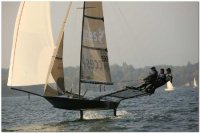
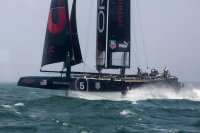
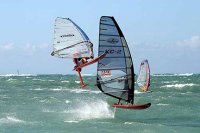
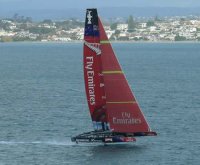
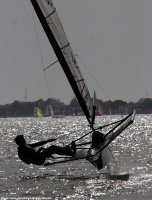
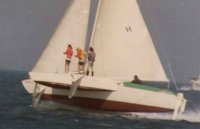
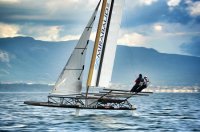
Pictures: L to R- 1) Aussie 18, 2) AC 45,3) Rush Randle foilboard, 4) AC 72, 5) Moth, 6) Williwaw-"cruising" foiler, 7) Mirabaud, 8) Quant 28 DSS
 

Attachments

  • _MG_8767.jpg
    _MG_8767.jpg
    38 KB · Views: 468
  • AC 45 on foils.jpg
    AC 45 on foils.jpg
    247.1 KB · Views: 1,079
  • 5.jpg
    5.jpg
    49.3 KB · Views: 646
  • AC 72- on foils-kiwi's fly first in history.jpg
    AC 72- on foils-kiwi's fly first in history.jpg
    36.6 KB · Views: 1,351
  • _MG_8375.jpg
    _MG_8375.jpg
    195.9 KB · Views: 465
  • williwaw.jpg
    williwaw.jpg
    25.3 KB · Views: 913
  • Mirabaud 2012 5-3-12.jpg
    Mirabaud 2012 5-3-12.jpg
    56.6 KB · Views: 472
  • Quant 28 4-17-12.jpg
    Quant 28 4-17-12.jpg
    43.7 KB · Views: 488
===============
The apparent wind on an AC boat will be between Force 8 and Force 10. Your "real" sailboat definition ignores that ,it seems to me...

No it doesn't.

When I said Force 2 to force 7, I meant force 2 to force 7 conditions, which include, not only actual wind speeds, but resulting sea conditions as well.

Apparent wind speeds would, of course, have too be added to that.

I made this statement to counter someone else's suggestion the the races be held under a very limited range of wind conditions.
 
Quote "My main quarrel with the AC72's is that they are too extreme." Quote.

So was the De Haviland "Comet".
It was a whole technical leap ahead of the "C 47". but suffered from structural failure. The lessons learnt from that failure enabled the successful development of the Boeing 707 and the Douglas DC8.
Jet travel then became the safest method of transport ever devised by man.
The AC catamarans have to be recognised as a similar leap in sailing technology. Nat Herreshoff would be proud. :)

I hate to say it, but your comparison seems ridiculous.

The 'Comet' was far from the first pressurized airframe and it traveled at sub sonic speeds. It did fly higher than other pressurized planes of its time, but nowhere near three times as high.

The Boeing 377, which my dad flew to Europe in the early '50's, for example, was pressurized.

The Comet failed due to a bad engineering choice of its of its designers, who chose more esthetically pleasing rectangular windows over the more structurally sound round ones.

Being of British extraction myself, I feel free to say that kind of mistake is typical of the British.

If we were to make a suitable comparison between these boats and more normal catamarans, in the aircraft world, we would have to compare a normal jet airliner to a scram jet, hypersonic, sub space one which, due to its high performance, could only carry, say, 20 passengers.
 
If we were to make a suitable comparison between these boats and more normal catamarans, in the aircraft world, we would have to compare a normal jet airliner to a scram jet, hypersonic, sub space one which, due to its high performance, could only carry, say, 20 passengers.
That's the whole point, imo.

Foiling cats are good for just a certain type of racing. They don't appear to be suitable for close-quarters tactical battle made of fast tacks and false tacks, which are a real delicacy when it happens. Why are they not suitable for that type of races? Because of their primary characteristics - high speed. Can you imagine two boats coming in contact or crashing at each other due to a wrongly evaluated distance or timing, at a speed of 30 kts (boat 1) + 30 kts (boat 2), followed by a violent capsize due to a sudden dead-stop? It would be a massacre of the crews, literally.

So, each boat to it's own purpose. Foilers for super-speed lovers, other boats for people with other preferences.

And the above reasoning could be extended in a similar manner to other boating or shipping activities. You won't see a foiling cat transport 2,000,000 barrels of crude oil. It just cannot do it in an efficient and economically viable manner. Just as it cannot do many other things which other boat types can.

Cheers
 
CT 249 wrote :
"Sports that suffer such deaths due to significant increases in the power and speed of the equipment have normally reduced the power and speed of the equipment as a result. Sporting bodies have introduced major performance-restricting rules as diverse as the ban on turboes in F1 to the change in rules in javelin design, the end of F1 offshore multis and design restrictions on Tour de France bicycles so why not the AC?"

I don't think the above can be used as an argument for what we're discussing here. Yes, the AC72's are dangerous, mostly only if they capsize.

Yes. And due to their extreme design such is not only likely to but almost certain to happen

Since you can't totally ensure a catamaran that is designed for performance will never capsize, the efforts in making the boats safer must be in ensuring structural integrity of the platform while capsized, and developing quick methods of retrieving crew trapped under the overturned platform. Concentrating on total capsize prevention is not really the correct direction to follow, unless you limit the design so much that it is impossible to capsize. I don't think we want to see slow boats on the course again after seeing what can be achieved.

Just remember, when one of these capsizes, it is doing so at or near highway speeds. Add to that the extreme light construction, which makes these high speeds possible, and you have a recipe for almost certain injury or death. Like a hydroplane, these boats are likely to break up as they capsize, throwing the crew into broken chunks of boat, which may even have sharp, jagged edges. Hydroplanes have protective capsules for their drivers, for this reason. Also, hydroplanes were meant, as a class, to be raced in only smooth inland waters. Not so with the more traditional America's Cup. To reduce it to those conditions is, IMHO, dumbing it down for the sake of mere high performance.

Your comparison to F1 and Tour de France is not convincing me - F1 is going back to turbo engines next year. Their focus on safety has been in providing the driver with a safer protective shell in the event of an accident, not limiting performance to the point where an accident can't happen. If they did that we would see 35mph limits on their top speed.
The speeds that the cyclists do on the Tour through the mountain passes is enough to kill someone who falls off a motorcycle with full protective gear at those speeds, a bicycle helmet and lycra shorts offers far less protection. The limit on what bicycles can be used has little to do with safety.
It isn't the javelin that makes the sport unsafe, it's the ridiculous practice of having folks with tape measures standing in the field where the javelin is being thrown.

The AC72 class could be much safer if they had 6 crew per side of the boat, that remain in their stations at all times, and don't cross the boat in tacks. Perhaps even with seatbelts on. 2 helmsmen, one for each tack. In the event of a pitchpole or capsize, they are in a safe position and have quick release systems to eject from their station when their hull lands in the water. With 10minutes of bottled air as they already have, it should be relatively easy to get out of the boat. The danger is mostly being pinned under a 50ft x 50ft trampoline, which could be eliminated as the boat won't need to have one. Safety problem solved, now we can see if we can make these boats faster for the next Cup.

Now this is an intelligent suggestion. Elimination of the trampoline would also help prevent kiting, which is a huge hazard for these boats.

Sharpii wrote :
"To give a slight idea of how extreme they are, I will scale them down to the size of a Hobie 16.

For a Hobie 16 to have the same D/L as an AC72 it would have to weigh only about 120 lbs. Maybe about 140 lbs, after the crew was added."

I don't believe that you can scale these ratios as you have, as it brings about some weird comparisons. Quite correct, the crew would weigh 20lbs if you work it your way, but another conversion method (11 crew at 85kg each = 935kg, 16/72 x 935 = 207kg, more realistic if not overweight ?

Nope. I didn't know exactly how many crew these boats had when I made that post. I guessed at 10. So, my reasoning went as follows: 10 * 91 kg = 910 kg = 0.91 mt. That is added to the high end weight of 5.9mt to get 6.81 mt, which gives you a D/L of 18.27.
A Hobie 16, to have the same D/L would have to weigh 136 lbs total. including crew. Even though I was wrong about the number of crew, I was not too far off on the D/L.

Your math doesn't work because it over estimates, by a huge factor, the proportion of crew to boat weights. In order to get it to work, you need the following formula: ((16/72)^3) * 935. This is because you are shrinking the crew in three dimensions, not just one (same with the boat).


Also, the AC72 at their top speed is doing one boatlength per second, so by your comparison, the 120lb Hobie 16 with 20lb crew and 200square foot wingsail will have a top speed of 9,5knots.

Nope again. Planing speeds and foiling speeds do not scale up and down the same way displacement speeds do. Displacement speeds are limited by wave making. For this reason they scale up and down more exactly. Your wave making drag increases geometrically with speed. If the Hobie 16 and the AC72 were both non planing monos, the boat lengths per second would be a fairer comparison. Since, in both these cases (of the AC72 and the Hobie 16), the limiting factor is power/friction, your comparison is all but useless and therefor misleading.

Oh yes, and if the wind limit set for racing is scaled the same way, they would be doing all that in a maximum wind strength of 4,4knots.
That right there, is pretty safe !

Nope again. 16/72*38=8.44kts top wind speed. (Per your scaling formula)

See comments in text.
 
"The Prejudiced Brigade" - good title for a book? ... but I'll not write it; hardly riveting reading I would imagine.
Seems certain arch-conservative Australians gravitate to this type.
Why don't you soapbox negative-ists ... find something else to do instead of decrying breakthrough, experimental yachting craft.
You're not compelled to watch. Instead you fill up this site with your biased nonsense. No one is listening to you ... enthusiasts of fast sailing will ignore, skim and dismiss your rants ... and turn to the enjoyment of observing the peak of modern technological yacht design - and the skill of the crews sailing them.
 
the peak of modern technological yacht design
...under a well-defined set of rules, aimed at obtaining a goal of high speeds.

But they are admirable sailing machines indeed.
 
...under a well-defined set of rules, aimed at obtaining a goal of high speeds.

But they are admirable sailing machines indeed.
The crews are skilled the engineering is terrific and no one has ever said otherwise.
I look at these craft on two quite separate levels, one is the excitement of refined technology and the achievement of modern materials. The other is looking for the racing tactical skills. That might….. maybe come with a much closer match.

The head on was quite close in the last race and NZ were a bit wobbly without the headsail, that has probably raised a few concerns.

I think it’s better if a certain amount of skill and a bit of luck can make up for the technological edge. But I think the class is doomed and the future of the AC depends on some more suitable designs. No matter what the small number of very vocal posters may opine.
 
Forum posts represent the experience, opinion, and view of individual users. Boat Design Net does not necessarily endorse nor share the view of each individual post.
When making any potentially dangerous or financial decision, always employ and consult appropriate professionals. Your circumstances or experience may be different.
Status
Not open for further replies.

  • Back
    Top