minimum l/b ratio for a trimaran vaka

peterchech

Senior Member
Joined
Aug 17, 2010
Posts
241
Reaction score
10
Location
new jersey
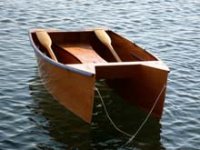
I am designing a 10' outrigger canoe to be used as a tender on my 25' keelboat. I may try tortured ply, or I may go with s&g a little like this one:

images


Except, mine will have a transom (needs all the volume possible on such a short waterline). Also, although paddles will be present, I plan on powering this craft with my 2.5 horse ob.

I want this to be narrow (to take up less precious forward deck space when upside down), but it still needs about a 400# carrying capacity.

My question is, what is the minimum l/b ratio necessary to still allow a vaka to exceed hull speed?

I know it is more complicated than JUST l/b ratio, but I would like a baseline here, a starting point.

I have read that the buccaneer 24, with its 8/1 ratio is a good "compromise", but true racers go 10/1 or more. Is 6/1 acceptable? I think that would make the waterline beam about 20 inches, which would probably be just enough displacement for this to work. Any thoughts?
 
Getting enough displacement will be your problem

You want 200kgs (0.2m3) on a 3m WL. Assume a Cp of 0.55 as you won't be going very fast when paddling or rowing

Displ = L x Cp x CSA (cross sectional area)
so CSA = .2/(.55 x 3) = 0.12sqm

If you have a BWL of 0.6m your draft is .12/.6 = 0.2 or about 8in if you have a rectangular box hull, more if your hull is curved, more still if it is Veed

If you go narrower you must go deeper

8in is deep if you put the boat on the beach, 4in would be better, which means you must be twice as wide on the WL

Which is why most dinghies are short and fat

Richard Woods of Woods Designs

www.sailingcatamarans.com
 
.6 meters is 23.6 inches at the beam, assuming a 9' wl then that's about a 4.5/1 l/b ratio.

I plan on using the outboard mostly, and would like to be able to hit 6 knots lightly loaded. This is 50% over the 9' waterline theoretical hull speed of 4 knots. I guess I want to know whether a 4.5/1 l/b ratio will allow this (I was under the impression that at least 5/1 is needed to start exceeding displacement speeds, but I could certainly be wrong)

Good point about pulling up on a beach, though by moving back towards the stern upon landing the bow can be gotten pretty much up onto dry land, at least in the type of sloping beaches we have around here. (I did this regularly on my last outrigger).
 
I realize this may be a bit outside the design you were intending, but maybe it would be better to build it so that the outrigger also takes a significant portion of the load?

I was thinking you could build it such that the outrigger hull nests nicely right inside the main hull, so maybe 1 or 2" less in ever dimension. You could either plan on riding it like a catamaran, or using it like an outrigger and just put the 2nd person in the other hull, or put your gear and stuff in the other hull.

Just a thought on something that might take up less deck space because you could fold it up, put the cross beams and the outrigger hull right inside the main hull. Could even do a trimaran this way if you need more capacity.

That might allow you to narrow your water line to get the speed you're wanting out of it.
 
I am designing a 10' outrigger canoe to be used as a tender on my 25' keelboat. I may try tortured ply, or I may go with s&g a little like this one:

Except, mine will have a transom (needs all the volume possible on such a short waterline). Also, although paddles will be present, I plan on powering this craft with my 2.5 horse ob.

I want this to be narrow (to take up less precious forward deck space when upside down), but it still needs about a 400# carrying capacity.

My question is, what is the minimum l/b ratio necessary to still allow a vaka to exceed hull speed?

I know it is more complicated than JUST l/b ratio, but I would like a baseline here, a starting point.

I have read that the buccaneer 24, with its 8/1 ratio is a good "compromise", but true racers go 10/1 or more. Is 6/1 acceptable? I think that would make the waterline beam about 20 inches, which would probably be just enough displacement for this to work. Any thoughts?

-------------------
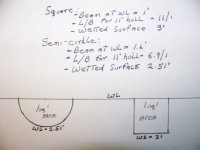
I think the answer to your question can be found in the Moth class*. A 10/1-11/1
L/B ratio has been found nearly ideal even though it makes the little monohull very difficult to sail due to initial instability. In fact, a 10/1 box shape hull trumps a low wetted surface hull of the same displacement.
Before they used hydrofoils the skinny Moth hull exceeded 1.34 X sq.rt. of the waterline easily.
----
* Unless the main hull is a planing hull like the Weta where the L/B ratio is 5.5/1 and has the SA to plane, about 500sq.ft. per long ton(2240lb).
click on image:
 

Attachments

  • Hull Section comparison 001.jpg
    Hull Section comparison 001.jpg
    128.8 KB · Views: 1,176
You can exceed hull speed at 6/1, with the ob powering (or under spinnaker!). Search site for forced displacement.

Watch your LCF position, aft of mid. Some rocker and transom not bad, IMHO.
 
* "Unless the main hull is a planing hull like the Weta where the L/B ratio is 5.5/1 and has the SA to plane, about 500sq.ft. per long ton(2240lb)."
This is sort of incomplete Doug, as the wind builds less sail area is needed to plane.
 
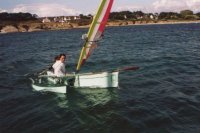
Des jours meilleurs had a baby proa.
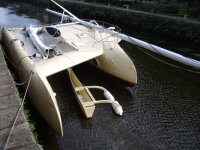
Epicure proa has a dinky outrigger.
 

Attachments

  • epicure_tender.jpg
    epicure_tender.jpg
    109.8 KB · Views: 1,031
  • prao7.jpg
    prao7.jpg
    27.6 KB · Views: 905
* "Unless the main hull is a planing hull like the Weta where the L/B ratio is 5.5/1 and has the SA to plane, about 500sq.ft. per long ton(2240lb)."
This is sort of incomplete Doug, as the wind builds less sail area is needed to plane.
=================
I don't know ,Cav: it's a rule of thumb first brought out by CA Marchaj 30 or so years ago. Its fairly accurate based on the numerous boats I've used it on. Most planing boats have to depower at some point and would ,of course, plane with less SA. It also doesn't take RM into account. Bethwaite has a good formula for upwind planing that does include RM.
 
I realize this may be a bit outside the design you were intending, but maybe it would be better to build it so that the outrigger also takes a significant portion of the load?

This is a good idea Jetboy, although if I build it too big the dinghy will start to get heavy and be difficult to assemble on my small foredeck...

If I put the ob on the transom, and then the helmsman sits facing abeam on a seat/plank between the akas (on the ama side), then the ama would take a considerable part of the weight. In fact, such an arrangement may be necessary to allow the helmsman to control the tiller/gas on the ob anyway!
 
You can exceed hull speed at 6/1, with the ob powering (or under spinnaker!). Search site for forced displacement.

Watch your LCF position, aft of mid. Some rocker and transom not bad, IMHO.

So 6/1 looks to be my answer! I searched "forced displacement" on google and got a bunch of links to pro palestine websites

6/1 will be difficult, but I think possible to do with some serious thought...

Now to determine what hull form... I think tortured ply would be really light, and would give me a really nice hull shape, but getting some rocker in such a short waterline with the method may not be possible...
 
Did you search BoatDesign.net for "forced displacement":confused:

Chines have many advantages on a small dinghy, tortured ply (compound curve) as in a Tornado?

Not having any rocker means you are dragging the transom from the start, probably a bad idea, and there will be trim to contend with too. Better ride, stronger, simple to construct - the rocker makes the edges of the sides very close to straight. There are a number of simple programs around for stitch & glue/chine hulls, like Carlson Design - Hull designer.

RWoods is right about displacement being the problem, hull flare - times when you are weighted down and there is more than a ripple?
 
...I want this to be narrow (to take up less precious forward deck space when upside down), but it still needs about a 400# carrying capacity. ...

I know nesting dinghies typically split the boat at a bulkhead. But I think you could split a nesting tender fore-aft and have a large keelson running down the middle. That would make for a narrow package on deck. Maybe even stow the two halves separately along the rails, which would allow them to be longer. If you have outriggers they could still stow inside the halves. It might impose some constraints on the hull form, like having a rocker equal to the curve of the sides. Fore-aft symmetry might be something to explore, too. The ultimate in a compact dinghy would be one that nested in quarters!
 
Drawn and quartered has terrible associations.....
 
Forum posts represent the experience, opinion, and view of individual users. Boat Design Net does not necessarily endorse nor share the view of each individual post.
When making any potentially dangerous or financial decision, always employ and consult appropriate professionals. Your circumstances or experience may be different.

  • Back
    Top